I have been out of synch for a while, but today I realized that it is Shrove Tuesday, AKA Mardi Gras. In Finland, this day is known as laskiaistiistai, and people used to go on laskiainen downhill sledding (alternatively on laskiaissunnuntai, February 15th this year) and eat laskiaispulla which is sweet wheat bun cut like a burger but filled with whipped cream and marzipan or berry jam. Then begins lent and after that it is again Easter.
Being unprepared, did not eat laskiaispulla, and would not have time for a day of downhill sledding, even if Berkeley weather would have allowed it (hint, there is no snow, though it was hailing a bit.) But I have a number of video clips, some maybe presentable, waiting to be processed and their fates decided, and last weekend I discovered an October 19th, 2025 squirrel eating ginkgo fruit that would be fun to post. While not exactly topical to this religious celebration, here it is, anyways.
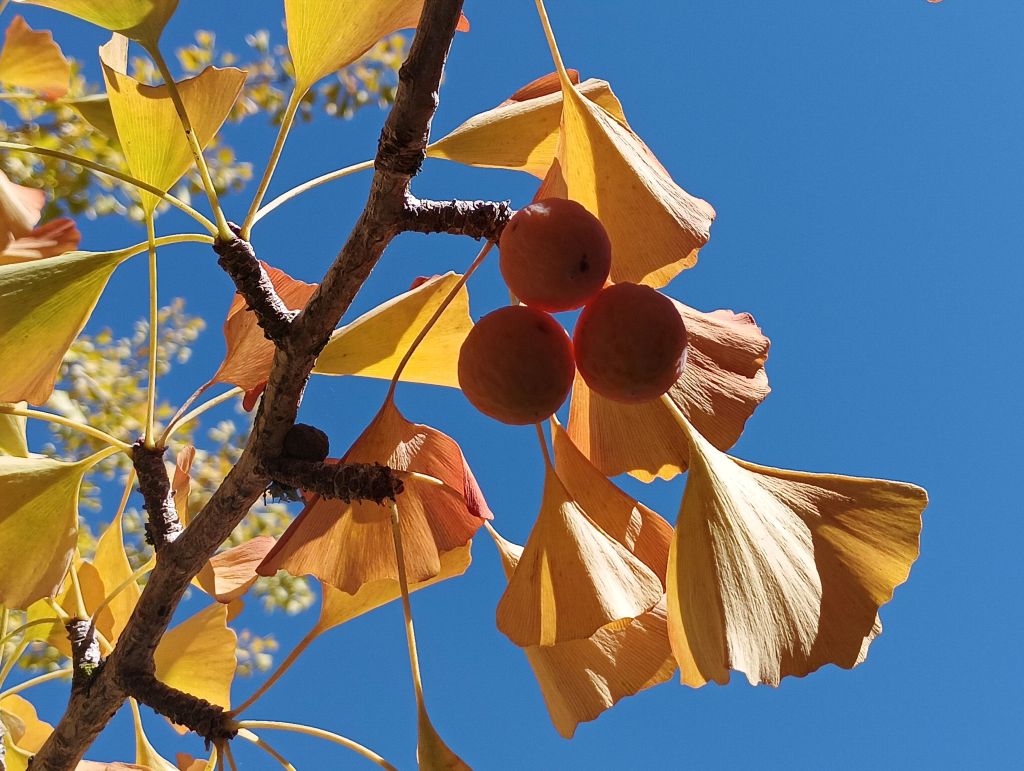
I was surprised last year that ginkgo fruits are yellow.
Maybe that should not have been surprising, as their autumn leaves are also yellow.
I also saw a flight of geese (based on honks and flight pattern) going north-north west, but they had disappeared by the time I had adjusted my device for photography. Weird.
The night after that, it was really windy. There was a tree branch on the sidewalk, when I was getting to my car. The morning wind came from north, soon after it turned and arrived from east. There were a few more geese, seemed to be going sort of westward (towards the Bay). The direction does not matter, I was surprised to see any, going any direction.
Today, while walking with my mobile ready to snap a picture or even a video, I noticed a number of hummingbirds, not as a flock but a hummingbird or two every now and then. More than I could photograph. Aside from being fast, the little birds are well camouflaged when sitting among the green leaves of a tree. Also, they are small, which means my camera’s resolution will not be sufficient for a good picture or a video. Hummingbirds are migratory, moving south for winter and flowers. I don’t know if they stay here in Berkeley for winter, maybe they are just passing through, but some were singing.
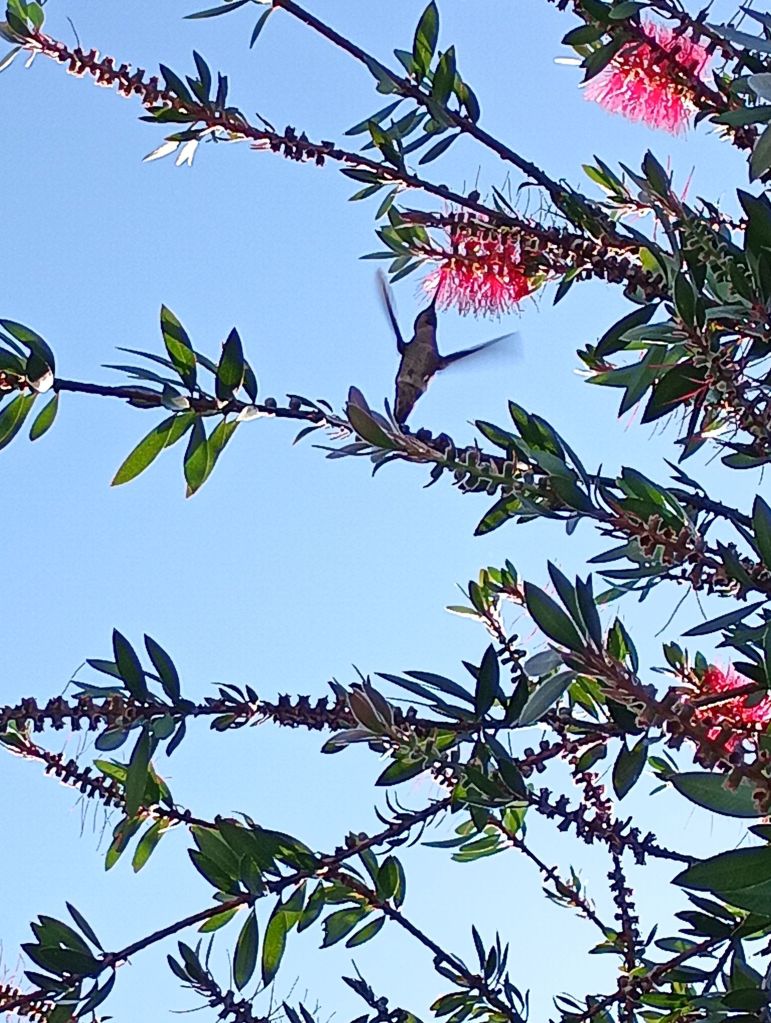
A photo of a hummingbird and a bottle brush plant, October 19th, 2025, Berkeley, CA
Monday’s rain had apparently inspired little green shoots to peek from the ground. Hopefully this was not a false start. The best part of the winter is the greenery as the rainy season ushers new growth.
Skipper butterflies were still around, though this time I did not see a swarm. There were also occasional Monarchs and smaller white butterflies.
I was lucky enough to be aiming for a red bottle brush flower, when a hummingbird flew to feed. Quick switch to video mode captured a few seconds of hummingbird and red flower.
A short video of a hummingbird and a bottle brush plant, October 19th, 2025, Berkeley, CA
The ants are haplodiploid relatives of wasps, females are diploid, males are haploid. In Messor ibericus species the queens can produce two types of male offspring, one of their own species, other from a related species Messor structor, with which they have been estimated to have a common ancestor about 5 million years ago. The queens mate with both types of males, because ibericus males are needed to make new queens, whereas structor males are needed to make hybrid workers. The structor male genome survives because the queen can somehow clone haploid offspring from sperm (though the mitochondria of the ova come from ibericus.) It should be noted that the ibericus-born genetically structor males are morphologically different from wild structor males, which the authors of the study hypothesized to result from differences in mitonuclear environment, from differences in brood rearing conditions, or from genetic differentiation of the ‘cloned’ lineage of structor males. This case is interesting, because it stretches the concept of biological species to have genomes of two species, separate but intertwined by sexual reproduction to maintain the colonies of the species lineages.
Little black ants in Finland, crawling in and around their hole in the ground. Not connected to the ants discussed above.
As for life on Mars, NASA scientists published a paper on speckles on Mars rock, which on Earth would have formed by metabolism of accumulated microbes. I do not know enough of mineralogy to follow the paper, but the NASA press release was much more accessible. The speckled rock was found in area that had contained long ago liquid water. While alternative processes have not been totally excluded, the most likely ones were. This biosignature is the strongest evidence that Mars has some time in the past hosted life. This implies either life evolving easily in multiple locations or if life evolves rarely, panspermia, i.e., life spreading in space, and it has been speculated that life on Earth and Mars being related. Also, considering the prevalence of lithospheric life on Earth, I would not consider it impossible that there still exists (microbial) life deep underground in Mars.
I saw an interesting video from YanasaTV. He was discussing about blue pigs and their causes in California. I think this is a symptom of even bigger problem than he described, so I thought to expand a bit.
The starting point was boar meat that had turned blue in some parts of California, because of liberal use of rat poison, which dyes the meat.
According to the video, farmers have been fighting against a figurative tidal wave of rodents, whose populations had exploded in four counties due to farm and orchard closures leaving them tens of thousands of acres of prime breeding areas in almond country.
The official explanation of the laws was the environment and need to save water. However, an important underlying cause influencing the passing of water laws was consolidation of water rights under the big players. (get reference)
Any case, according to Yanasa TV, last year California lost 8000 farms, to multifactorial causes, but lack of water is a big one. Oddly enough, Texas lost even more farms, 18000, also often due to lack of water. In Texas, the irrigation competes against AI server farms. And is losing.
That caught my attention. The news have been buzzing for a couple of years about how the Silicon Valley firms have been moving to Texas because of their nicer regulatory environment. The discussion online had given me the impression that this was due to the taxes and insane regulatory policies of California. I had not thought about the water regulation, but in hindsight, it should be obvious. The firms are moving to what is greener pastures (more resources) for them, never mind the parched pastures of the ranchers. Which are blamed on climate change.
The final point I got from this YanasaTV video was the question, how do we feed the billions of people if we reallocate agricultural resources to feed AI? The regulations hindering the agriculture are passed under the pretense of ‘conserving the resources’, but to me it seems that most if not all conservation regulations are nowadays just to preserve the ‘protected’ resources for the powerful, whereas the little people like me get to enjoy the Green New Leap as increased energy and food prices. And as shortages of critical resources.
The California water rationing for urban dwellers and destruction of small farms is not about conserving resources, since water is very much available for the Big Almond, golf courses, and such. It is about extirpating the competition for scarce resources the big players want for themselves. If the side effect is the ballooning fruit, vegetable and meat prices for the small people, someone is making money of that, too. At some point the breakeven point when increasing prices will not bring more profits because the consumers cannot afford to buy will be reached but the availability of food (and energy or other resources) relative to the need will determine whether that happens before or after a mass uprising.
Speaking of AI and energy, I wrote the other day about rolling blackout warnings in Maryland and New Jersey. I think the AI industry will have to begin to address its effects on the energy grid soon, maybe already next winter. Once people will begin to experience survival threatening acute shortages, backlash is guaranteed. The incoming collapse of the power grid, by the way, is the main reason why I chose coastal California as my bugin place. If the grid fails, I will not freeze to death.
But my realization about all of the above: there is no such thing as a conservation law. There are only resource reallocation from the poor to the wealthy laws.
Note added in proof:
Nova Scotia in Canada banned people from going into woods, either Crown lands or privately owned lands belonging to someone else. Traditionally people had enjoyed access to Crown lands, but now they had been told that this privilege had been taken away to prevent forest fires. 25000$ fine for people trespassing their country’s forests. Would you feel like hemmed in?
Then I read that the Nova Scotia woods (over 3500 acres of them) are getting sprayed with defoliant that is being used to kill unwanted (less economically useful) tree species. Imagine large swathes of dying and drying trees in the middle of a drought. Controlled burns to free land for more profitable tree species were speculated. The cost to the ecosystem is hideous, so is the loss of immaterial (and material) value to the people.
Not that immaterial value even matters to the powerful. My uncle back in Finland told that they are planning a data center next to a big hydropower plant in the town he lives in, and the land being developed has stone age sites on it. I don’t know how valuable these sites are archeologically, but I suspect they have not been properly studied, either.
I have been working through my insect clips and this is a bit too short for YouTube as a stand alone but too big for Pinterest, so I posted a mobile phone formatted version here, since the bumblebee and rhododendron video was so pretty.
A bumblebee is an important part of Finnish ecosystem. A garden Rhododendron is an imported species.
I hope this little clip will provide a relaxing break, enjoy!
I have now made a short video (6 min 45 s) on the subject, its consequences, its causes (especially discussing metapopulation dynamics) and about one idea how to combat this trend (microrewilding.)
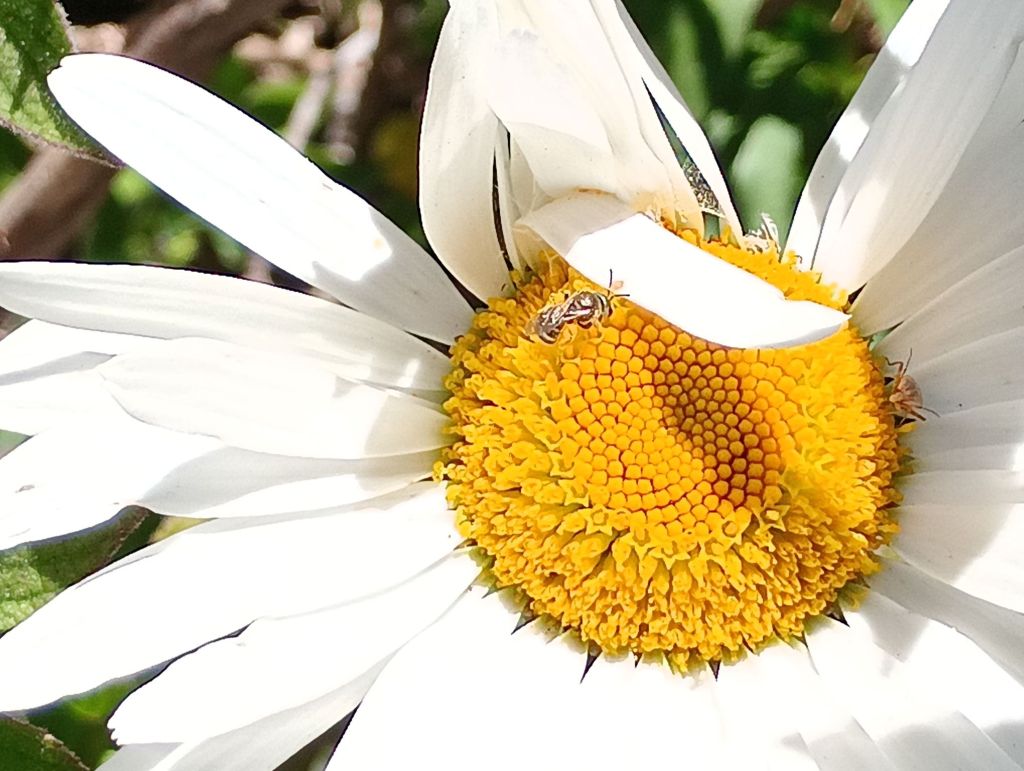
A small Hymenopteran and a probable bug in the same flower in Berkeley, June 2025
Recently, a samizdata channel I watch has had multiple reports that insects are missing this summer, in locations scattered around United States.
This was not unexpected. The reduction in insect numbers started decades ago, if German amateur entomologists’ data is to be believed, but it has since been recorded around the world, including places like Colorado and Costa Rica.
The scientists have sounded an alarm – insect are possibly the most important group of land animals in terms of species numbers and biomass. They are important pollinators, decomposers, soil and biome modifiers, and they disperse nutrients even when not serving as important food source to other species in food web.
The loss of insects has been attributed on a variety of reasons, among other things pesticide use (and other environmental poisons, including chemtrails and 5G radiation), monoculture, spreading diseases (especially Varroa mite born in bees), and changing climate. While a large number of species are affected, reading the reports has given me an impression that the selection of missing species seems to vary from place to place, suggesting multifactorial causes. The modern world apparently does not have space for bees or butterflies.
I would probably blame monoculture, i.e., humans have appropriated too fat a slice of ecological resource flows for themselves. Traditional agricultural landscape in Europe had many verges, ditches and hedges, where wild plants and insects that relied on them could flourish. Now such places are rare.
For example, I have observed in horror, how most species of the meadow flowers, once common on road sides near Turku, Finland, seem to have had a population collapse in the past decade. I blame this on the municipal maintenance crews mowing the verges before the seeds have ripened. Annual plants fare the worst, but I suspect perennials will eventually follow. Any insects relying on those flowers also likely fared poorly.
As the small wild spots grow fewer and further between, I suspect we have crossed a critical threshold on insect metapopulation dynamics. Ilkka Hanski, studying Glanville fritillary butterflies living on dry meadows on rocky islands, showed that as long as there were enough patches with butterflies near each other (in this case, the minimum was estimated to be 32 patches covering total 10ha over 5km2 area), individual patches of plants or insects living on them could be ephemeral, i.e., the butterflies on a given patch could disappear or appear from year to year, but the butterfly populations of individual patches form a metapopulation that keeps the species going if the amount and density of patches are sufficient.
Extrapolated onto insects in general, I think the on-going collapse may indicate that despite good people setting their individual gardens for butterflies, bees and other insects, if a garden population is lost, for example to local bad weather or disease outbreak, there are no longer enough insect patches left nearby to repopulate the patch. Sooner or later, isolated gardens will lose their insects. And then the metapopulation is gone.
What can be done to reverse this trend? I suggest starting by restoring some verges. Also not mowing your yard while the flowers are seeding, as ugly as the drying seedheads may look. Insects are not very big, so they do not require nearly as large sanctuaries like roaming megafauna, but there should be plenty enough patches to maintain a viable metapopulation, so that if some species is lost from one spot, it can be colonized by insects from the neighboring spots. I believe this type of microrewilding to be compatible with current human population, possibly even essential if we want to retain their ecosystem services necessary for food production. Assuming there are no confounding factors like (possibly) 5G radiation to prevent its success.
This week Iberian Peninsula had a massive power outage that darkened large parts of Spain and Portugal, affected Andorra, France and according to some, Netherlands and Belgium. I have not yet seen the proximal cause for the outage published, though speculations have run from Russian hackers to atmospheric phenomena. What is increasingly clear is that the Western European power grid has become extremely vulnerable to disturbances and even the slightest wobble can collapse the interconnect.
European power grid is at 50 Hz and already 0.5 Hz out of sync causes massive troubles – the power grid can choose to shut down or experience massive damage when the system goes off even that slightly. In Spain, the power grid began to experience fluctuations blamed at some point on ‘induced atmospheric oscillations’ (a mistranslation?) or anomalous heating. However, the power grid had lost large fraction of its buffering capacity as the power production has moved from traditional big power stations with big turbines that maintain inertia against minor fluctuations to renewable energy which uses inverters. In other words, the power grid had become more fragile. Spain had just six days earlier boasted about having produced 100% of its daily energy by renewables. Spain is not alone with its fragile grid, the EU wide race to Net Zero has weakened grids over the Western continent. Individual countries have relied on power production of their neighbors to subsidize their climate programs, and when the neighboring countries transform from help to drain, whole Western Europe is in trouble,
Snake
Unrelated to European problems, Japanese Tokaido Shinkansen line had about an hour and half train stoppage due to a power outage caused by a snake that had slithered into power line. Or maybe the snake was a tool of a global conspiracy against power grids. The article did not know the fate of the snake.


 PlanktonPunkt