

I have now made a short video (6 min 45 s) on the subject, its consequences, its causes (especially discussing metapopulation dynamics) and about one idea how to combat this trend (microrewilding.)
Category: Collapse
-
Department of Narrative Mismanagement
I have followed the recent discussions about Jeffrey E., a dead criminal whose suspicious passing away in custody has caused years of speculation (including that he was taken secretly away and is now living somewhere nice.) Namely, he is known to have committed his crimes with lots of people and suspected of blackmailing the said people, which tend to be the very wealthy and powerful type. Which is why he was rumored to have been self-deleted.
The current administration has loudly and repeatedly promised to publish the list of Jeffrey’s associates, until about a week ago an FBI memo was leaked(?) to Axios claiming: he offed himself, there is no list of people, and he did not blackmail anybody. The administration is trying to sweep the issue under the metaphorical carpet. Then the officials published a video of his cell from the night of his death. Except the video contained about 1 minute gap (or maybe more than 1 minute). It had been stitched together so badly that aside from the gap in the timestamp, the aspect ratios were subtly off. As Asmongold pointed out, there could be legitimate reasons for this blooper, but with all the other circumstatial evidence, to me this points towards a conspiracy concerning Jeffrey E.’s demise, the reasons for it, and the existence of more rot in the circles of power.
As I keep on watching the government stumble from narrative fail to a narrative fail, with people becoming increasingly convinced that something is off with the official story (which has presented already by the previous administration), I have began to suspect that all this furor is deliberately fanned to distract the hoi polloi from something really important, possibly even more insidious than the idea that we are being governed by a huge criminal blackmail network, until it is too late to do something about it. This is quite a common tactic by the powers that be. For example, in Finland, I have imprecise memories on how government starts making noises about changing regulations or taxes on selling beer, and people get upset. Huge discussions rage over newspaper opinion columns and on-line boards, pro and con, while the government passes something else, much more important for people’s lives. The beer issue can be resolved, or if necessary, retreated from, people will calm down, and meanwhile something actually nasty was done to them.
While the incompetence of governments can be stupendous, it stretches my credulity to have so many bloopers in the narrative management coming one after each other, and I am beginning to suspect we are being purposefully distracted. Whether it is from the coming (proxy) war against China (maybe started between Thailand and Cambodia, maybe still waiting for the Iran situation to worsen), the ongoing (officially proxy) war against Russia, the economic collapse (US consumers sentiment has been reportedly low earlier this year, though Goldman Sacks just reassured that everything is merely returning to normal), the incoming digital surveillance grid (brought to you in collaboration with Musk and Thiel under the guise of tracking immigrants – spoiler alert: to track immigrants they will “need to” also map the non-immigrants), or something possibly worse, it must be humongous to merit this level of egging of the masses. I don’t think Obama’s referral to Department of Justice for suspicion of having ordered narrative to be manufactured for the Russia Collusion quite qualifies, more likely it is just more noise to distract the masses. By the way, US just moved nukes to UK, but that’s probably a nothing-burger (I am still sitting on the fence about whether to link and comment to the article on the subject in aviationnews.eu.)
I am also currently sitting on the fence on whether our government truly is this incompetent at narrative management or whether there is some obscure Department of Narrative Management, who are gloating about their latest glorious success in psyop against the people. Or maybe the Department of Narrative Management has gone rogue and is actively fighting against the current administration.
Although considering the everyday dysfunction I live in due to the ongoing complexity crisis infecting all aspects of modern society and worsened by the ongoing incompetence crisis fanned by the decades of education crisis, I still think that, yes, they really could be that incompetent. Maybe.
-
Insects Are Vanishing
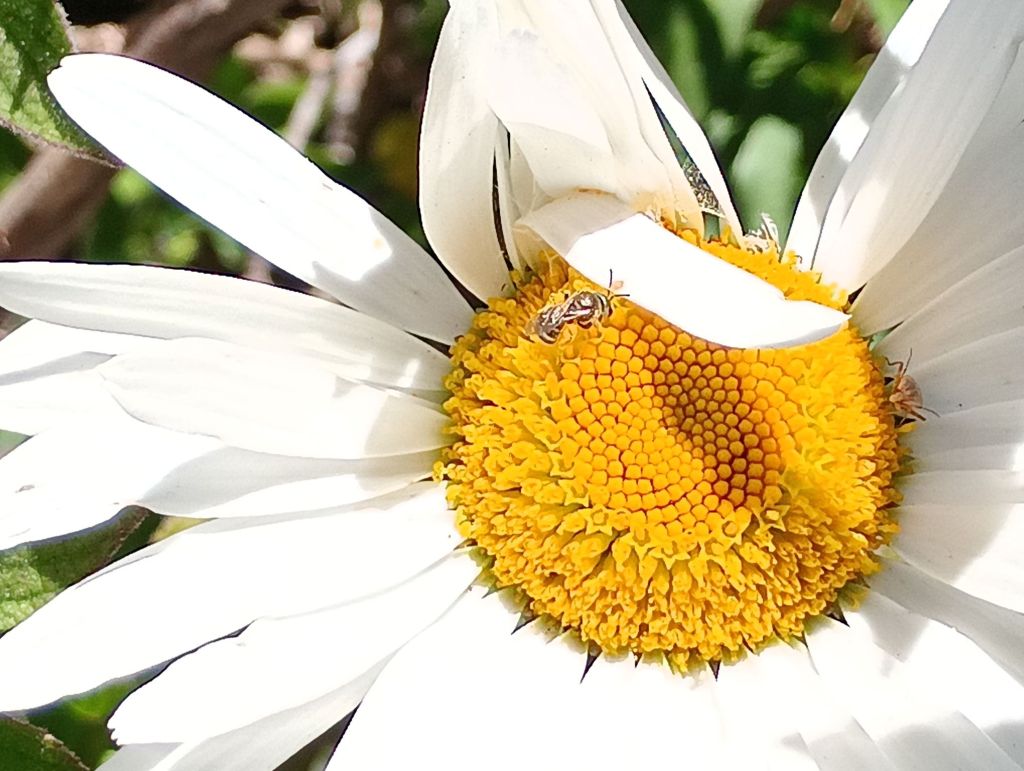
A small Hymenopteran and a probable bug in the same flower in Berkeley, June 2025
Recently, a samizdata channel I watch has had multiple reports that insects are missing this summer, in locations scattered around United States.
This was not unexpected. The reduction in insect numbers started decades ago, if German amateur entomologists’ data is to be believed, but it has since been recorded around the world, including places like Colorado and Costa Rica.
The scientists have sounded an alarm – insect are possibly the most important group of land animals in terms of species numbers and biomass. They are important pollinators, decomposers, soil and biome modifiers, and they disperse nutrients even when not serving as important food source to other species in food web.
Bee colony collapses around USA and the rest of the world have been reported for years, and is important for food production and economic reasons. Without the ~2 million beehives transported annually, canola, almond, citrus, and many other insect pollinated crops would collapse. Because not only the natural pollinators are about gone, all the flowers in monoculture orchards are blooming only few weeks a year.
The loss of insects has been attributed on a variety of reasons, among other things pesticide use (and other environmental poisons, including chemtrails and 5G radiation), monoculture, spreading diseases (especially Varroa mite born in bees), and changing climate. While a large number of species are affected, reading the reports has given me an impression that the selection of missing species seems to vary from place to place, suggesting multifactorial causes. The modern world apparently does not have space for bees or butterflies.
I would probably blame monoculture, i.e., humans have appropriated too fat a slice of ecological resource flows for themselves. Traditional agricultural landscape in Europe had many verges, ditches and hedges, where wild plants and insects that relied on them could flourish. Now such places are rare.
For example, I have observed in horror, how most species of the meadow flowers, once common on road sides near Turku, Finland, seem to have had a population collapse in the past decade. I blame this on the municipal maintenance crews mowing the verges before the seeds have ripened. Annual plants fare the worst, but I suspect perennials will eventually follow. Any insects relying on those flowers also likely fared poorly.
As the small wild spots grow fewer and further between, I suspect we have crossed a critical threshold on insect metapopulation dynamics. Ilkka Hanski, studying Glanville fritillary butterflies living on dry meadows on rocky islands, showed that as long as there were enough patches with butterflies near each other (in this case, the minimum was estimated to be 32 patches covering total 10ha over 5km2 area), individual patches of plants or insects living on them could be ephemeral, i.e., the butterflies on a given patch could disappear or appear from year to year, but the butterfly populations of individual patches form a metapopulation that keeps the species going if the amount and density of patches are sufficient.
Extrapolated onto insects in general, I think the on-going collapse may indicate that despite good people setting their individual gardens for butterflies, bees and other insects, if a garden population is lost, for example to local bad weather or disease outbreak, there are no longer enough insect patches left nearby to repopulate the patch. Sooner or later, isolated gardens will lose their insects. And then the metapopulation is gone.
What can be done to reverse this trend? I suggest starting by restoring some verges. Also not mowing your yard while the flowers are seeding, as ugly as the drying seedheads may look. Insects are not very big, so they do not require nearly as large sanctuaries like roaming megafauna, but there should be plenty enough patches to maintain a viable metapopulation, so that if some species is lost from one spot, it can be colonized by insects from the neighboring spots. I believe this type of microrewilding to be compatible with current human population, possibly even essential if we want to retain their ecosystem services necessary for food production. Assuming there are no confounding factors like (possibly) 5G radiation to prevent its success.
 PlanktonPunkt