Go back

Your message has been sent

Warning

PlanktonPunkt Designs puzzles available in CreateJigsawPuzzles

link to order print on demand PlanktonPunkt Designs jigsaw puzzles (printed in China)

PlanktonPunkt Designs POD products in Printify

link to order PlanktonPunkt Designs print on demand wares from the source

PlanktonPunkt Designs POD products in Etsy

A link to order from a selection of PlanktonPunkt Designs print on demand wares from Etsy

Tag: Survivalism

  • Travel Prepping for Urban Professionals

    Despite prepping being understood as something done by ultra patriotic rednecks hoarding spam and ammo in their remote homestead/bunkers, there are many practical things that can be done by urban professionals and digital nomads, and many are already doing it without realizing what it is.

    Preparedness is not about hoarding survival items. Though it is good to have a set of survival tools, whether it is a power bank + backup memory for your laptop, snow chains for your vehicle or a pressure cooker, the exact set of the tools you need depends on what you can use. If you have a garden and can can fruits, thumbs up and power to you! For someone like me, living in a second floor studio, survival gear means having portable electronics and their backups.

    Having said that, I think everyone should have a bugout bag (a shameless PlanktonPunkt Designs commercial included at the bottom of the post.)

    Bugout bags are preps for emergencies when you need to move fast and have no time to pack. Even if you have not one waiting in a closet, everyone should know what should go into their bugout bag and where the items to toss in are.

    Again, the exact contents of the bugout bag depend on your exact needs and where and how you are bugging out. My bugout bag is for sudden international air travel, because I used to travel back and forth to manage my affairs in California and Finland. I have never needed to escape war, civil unrest, impending sanctions, natural disaster or such calamities, but I have had family emergencies that have required me to quickly pack my bag and hurry to airport. Even quick changes in work plans may need a sudden departure.

    I believe my plan for a bugout bag to work for any person who needs to be ready to travel fast by air.

    Generic rules:

    1. Only take carry-on baggage. If you need to transfer planes, especially between airports, your chances of missing the connecting flight and/or your luggage decrease if you carry it all with you. Also bumping to earlier flight is only possible if you don’t have checked in luggage and time is of essence.
    2. Use a duffel bag. For more leisurely travel it is OK to use hard shell luggage, but to ensure your carry-on luggage fits the overhead compartments, I recommend a duffel bag. Back bags are more rigid and therefore less likely to adjust into overhead compartments, and many of them contain unnecessary extra straps and padding that is away from your weight allowance. Unless you plan on hiking a lot, duffel bags are optimal airline bugout bags.
    3. If the airline allows an extra cabin item, take a laptop bag or handbag (that can hold your laptop.) In nicer airlines, the check-in often does not count your cabin item to carry-on weight allowance, which leaves more space for the rest of your bugout items. For the same reason, unless the weather is too hot, I recommend an overcoat with many and large pockets. If your carry-on luggage is too heavy or bulky, rather than arguing with airline check-in remove those items you can live without and leave them, but if you are wearing an overcoat with pockets, you may try to stuff some items in your pockets, especially if you are over the weight rather than the size limit and there are small but heavy items like small electronics or books you need.

    What to pack into a bugout bag?

    Most items people carry are not necessary, even I tend to carry maybe 1/3 of the volume of items that I never use during the trip. And I miss rarely needed items that I left out.

    Below is a list based on my experiences, but everyone should tailor the contents of their bag according to their personal and bugout needs.

    1. Absolute travel essentials

    Valid passport(s) – everyone should have one or more

    multiple credit and debit cards for different banks and credit card companies

    banking tokens and/or keylogger devise

    cash, preferably in multiple denominations.

    The passports should be kept behind a zipper in easy to reach compartment. The one under which the air tickets are issued should be in easier to reach place like handbag or coat pocket, the spare for emergencies (like having lost the primary passport) in a more secure location like inside the carry-on luggage.

    The multiple debit and credit cards and cash should be divided between your luggage, handbag and pockets, so that if you lose some not all is lost.

    Cash is essential for those situations when ATMs and credit cards do not work, whereas credit cards are essential for those situations, where cash is not accepted.

    The easiest way to transport cash is debit card. I usually start my travel with some dollars, but when I get into another country, I withdraw cash from an airport ATM. This saves the time that would be spent dealing with banks’ currency exchange counters or Forex dealers. Also, ATMs are common and open 24/7, whereas banks and currency exchanges typically are not.

    Banking tokens and key-logger can be kept deep in your carry-on luggage (or in your handbag), they are essential if you need to move funds between your bank and credit card accounts, e.g., to buy new plane tickets or rent a vehicle or stay longer in your hotel room.

    In case of extreme hurry / emergency, everything else is expendable, but you will need a valid ID and cash to travel and with cash, the rest of the travel gear can be bought under normal circumstances.

    Also good to have:

    driver’s license (useful for renting cars in the destination)

    medical insurance card

    Driver’s license and medical insurance card are kept safe deep inside your carry-on luggage in case they are needed. Driver’s license is for renting a car in your destination, so that can be closer to zipper than the medical insurance card.

    2. Medical kit: your prescription medications, common travel ailments and first aid.

    If you have a medical condition, your prescription medications would go to the absolute travel essentials, but it is good to have a first aid kit for travel ailments and mishaps.

    Prescription medicines should come with the prescription, which should be kept with boarding passes and passport for the security screen and can go inside your duffel bag afterwards.

    My selection of travel medicine and first aid kit:

    head ache pills (non-drowsy, ibuprofen and aspirin; aspirin doubles as clot preventer for long flights)

    stomach ache pills (famotidine)

    allergy medicine (non-drowsy like loraditine)

    cough drops (I prefer eucalyptus)

    zinc, quercetin and multivitamin (against airborne infections)

    hydrocortisone ointment (against insect bites – those can also happen in urban environments)

    aloe vera antibiotic ointment against burns and scrapes

    pocket hand sanitizer

    pocket pack of tissues

    earplugs and chewing gums

    All ointments and liquids should be under 100ml and all containers together should fit into a resealable plastic zipper bag of maximum 1 liter size.

    To avoid hassle in security screen, put the resealable zipper bag on the top of everything under the duffel bag zipper, preferably on the top of spare clothing item. This will also reduce the likelihood that your bottles are crushed and tubes squeezed, and if they do, only your spare clothing suffers.

    Also the pills and tissues should be kept close to the top of the duffel bag – if you cut your finger or your head begins to ache you don’t want to begin excavations into your carefully packed bugout bag.

    Chewing gums and earplugs can be carried in pockets. Chewing gums should be put into mouth just before boarding – chewing will help against air pressure in ear drums during takeoff and landing.

    Earplugs are essential, if you want to sleep in crowded (noisy) environments.

    3. Essential electronics

    For me, those are work laptop, personal laptop, two mobile phones, minitablet with SIM card slot, spare portable memories (USB sticks are usually enough for short trips), power cords and adaptors, international electric socket adaptors (important!), and earbuds with microphone

    Two laptops are good – if one fails the other can act as a backup until a replacement laptop can be bought. Ditto with mobiles. Assuming availability of Wi-Fi, laptops can be used for checking travel connections and other essential data even when you are in a country not covered by your mobile phone subscription.

    Minitablet with SIM card slot is an international travel essential – rather than buying a mobile phone for every local network, buy a prepaid SIM card for host nation network. This saves time and money, and is lighter to carry.

    If you are traveling abroad (or your bugout bag includes international option) an international electric socket adapter is a must. It may take time to find one in your destination country while your electronics are running out of battery. Bring a cord and an adapter for each devise you have. If possible have adapters that can be plugged into power cords, and you can switch cords with plugs for local sockets (which is what I do when traveling between United States and Finland.)

    All files should be backed up into USB sticks (or other memory) in case one of the electronics fails or is lost. The USB sticks should be carried separate from the laptops and mobile devises – if laptops are in carry-on luggage, the USB sticks are in your handbag, or in a wallet in a pocket.

    Earbuds are not strictly speaking essential, but considerate for other passengers plus not all airlines any more offer free earbuds for watching movies.

    4. Personal hygiene (comb, dental hygiene, make up, sanitary napkins)

    If there is time, always use the airport amenities for personal hygiene and visiting toilet. Cramped airplane toilets are miserable places to take care of your hygiene, especially 8 hours into trans-Atlantic flight.

    I don’t recommend packing a razor into a carry-on luggage.

    5. Spare clothing

    3 – 5 changes of underwear and 3 shirts. Depending on the number of changes and anticipated delays while in transit and after settling in your destination, i.e., the length of time before you can shop for fresh clothing or do laundry, you should have multiple changes of underwear and T-shirts or long sleeved shirts depending on your destination weather.

    1 extra sweater or heavy college shirt – no matter where you go, sooner or later it will be cold.

    Spare pair of trousers or a spare skirt in case something happens to what you are wearing. Alternatively, or additionally, a small travel sewing kit for emergency repairs.

    In case of a wintery destination (Alaska, Canada, Nordic countries), extra pair of long johns, an extra pair of woolen gloves, two pairs of wool socks. You should have your knitted cap and another pair of gloves on you or in your pockets.

    If space or weight does not allow too much extra weight, the extra trousers/skirt can be ditched.

    While some spare clothing can be transported ‘on person’, so to speak, heat dissipation will set limits to that. Don’t exhaust yourself or get a heat stroke just to pack extra spare clothing. You can usually buy more in the destination.

    6. Notebook, pen, pencil and pocket book

    Notebook and ink pen are essential. Notebook for memos, appointments, ticket details and other important information into format that does not require electricity, pen additionally for filling immigration paperwork and other forms. Unless you have everything essential memorized, it is a good idea to write it down ready to be used in emergency without internet access.

    While not strictly speaking essential, I like to travel with at least one pocket book to keep myself amused without need for charging stations and to reduce eye strain from screen time.

    PlanktonPunkt Designs Commercial:

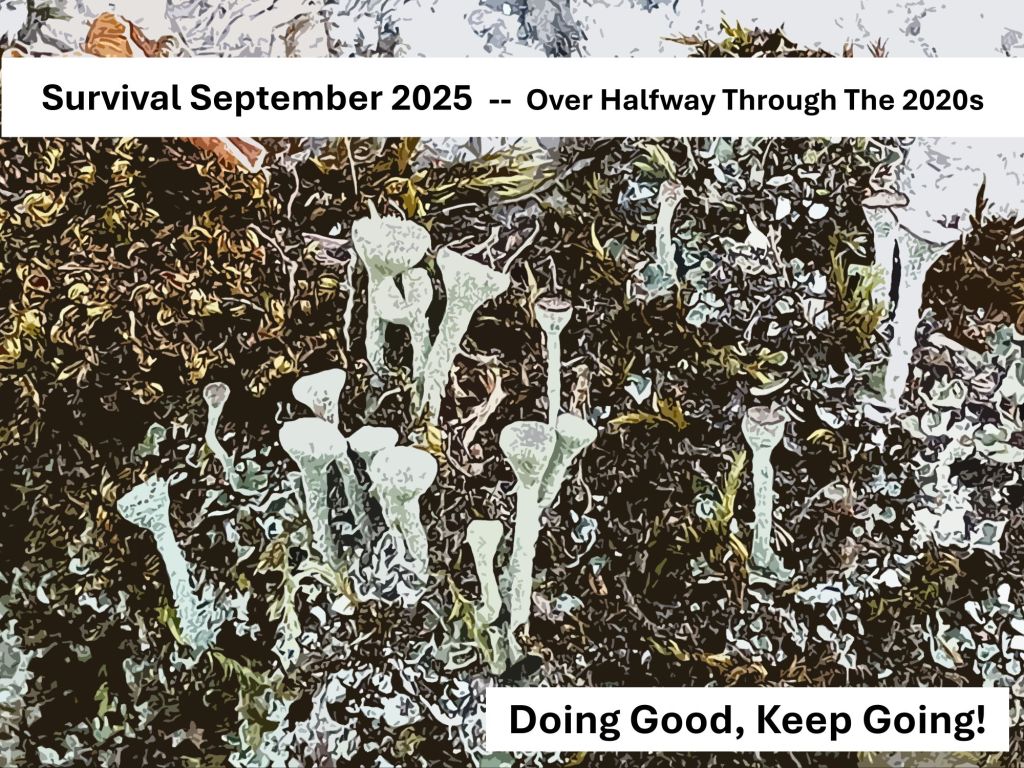
    I am selling print on demand duffel bags within USA, on sale for September 2025. This above version with Cladonia cup lichen pattern and “Survival September 2025”-motto is available in PlanktonPunkt Designs Printify and Etsy shop spaces (clicking the mock up image takes to Printify store.) I also have notebooks and accessory pouches available for US customers. Apologies to the rest of the world, but being a solo operator still learning the basics, the international regulations are overwhelming, so unfortunately, USA only for now.

  • Resource Competition

    I saw an interesting video from YanasaTV. He was discussing about blue pigs and their causes in California. I think this is a symptom of even bigger problem than he described, so I thought to expand a bit.

    The starting point was boar meat that had turned blue in some parts of California, because of liberal use of rat poison, which dyes the meat.

    According to the video, farmers have been fighting against a figurative tidal wave of rodents, whose populations had exploded in four counties due to farm and orchard closures leaving them tens of thousands of acres of prime breeding areas in almond country.

    The orchards and farms are closing because of California’s water policies, justified by drought blamed on climate change, specifically the conservation laws passed 2014 were a death blow to many farms. I remember the wave of orchard cuttings when many farmers got rid of their almond trees and then the markets in the urban areas got bundles of (expensive) almond firewood. After all, you might at least sell the cut trees for the last bit of income. Recent growing season, documented orchard removals took more Kern County almond acreage than those of Stanislaus County. Again, not surprising. When I drove to LA in 2022, Kern County was drought burned chiaroscuro, like Dali painting, only dusty orchards being green, Stanislaus County being greener, though still dry. If I correctly recall, that year Kern County had gotten 100% of its water allocation cut, Stanislaus County 50%.

    The official explanation of the laws was the environment and need to save water. However, an important underlying cause influencing the passing of water laws was consolidation of water rights under the big players. (get reference)

    Any case, according to Yanasa TV, last year California lost 8000 farms, to multifactorial causes, but lack of water is a big one. Oddly enough, Texas lost even more farms, 18000, also often due to lack of water. In Texas, the irrigation competes against AI server farms. And is losing.

    That caught my attention. The news have been buzzing for a couple of years about how the Silicon Valley firms have been moving to Texas because of their nicer regulatory environment. The discussion online had given me the impression that this was due to the taxes and insane regulatory policies of California. I had not thought about the water regulation, but in hindsight, it should be obvious. The firms are moving to what is greener pastures (more resources) for them, never mind the parched pastures of the ranchers. Which are blamed on climate change.

    The final point I got from this YanasaTV video was the question, how do we feed the billions of people if we reallocate agricultural resources to feed AI? The regulations hindering the agriculture are passed under the pretense of ‘conserving the resources’, but to me it seems that most if not all conservation regulations are nowadays just to preserve the ‘protected’ resources for the powerful, whereas the little people like me get to enjoy the Green New Leap as increased energy and food prices. And as shortages of critical resources.

    The California water rationing for urban dwellers and destruction of small farms is not about conserving resources, since water is very much available for the Big Almond, golf courses, and such. It is about extirpating the competition for scarce resources the big players want for themselves. If the side effect is the ballooning fruit, vegetable and meat prices for the small people, someone is making money of that, too. At some point the breakeven point when increasing prices will not bring more profits because the consumers cannot afford to buy will be reached but the availability of food (and energy or other resources) relative to the need will determine whether that happens before or after a mass uprising.

    Speaking of AI and energy, I wrote the other day about rolling blackout warnings in Maryland and New Jersey. I think the AI industry will have to begin to address its effects on the energy grid soon, maybe already next winter. Once people will begin to experience survival threatening acute shortages, backlash is guaranteed. The incoming collapse of the power grid, by the way, is the main reason why I chose coastal California as my bugin place. If the grid fails, I will not freeze to death.

    But my realization about all of the above: there is no such thing as a conservation law. There are only resource reallocation from the poor to the wealthy laws.

    Note added in proof:

    Nova Scotia in Canada banned people from going into woods, either Crown lands or privately owned lands belonging to someone else. Traditionally people had enjoyed access to Crown lands, but now they had been told that this privilege had been taken away to prevent forest fires. 25000$ fine for people trespassing their country’s forests. Would you feel like hemmed in?

    Then I read that the Nova Scotia woods (over 3500 acres of them) are getting sprayed with defoliant that is being used to kill unwanted (less economically useful) tree species. Imagine large swathes of dying and drying trees in the middle of a drought. Controlled burns to free land for more profitable tree species were speculated. The cost to the ecosystem is hideous, so is the loss of immaterial (and material) value to the people.

    Not that immaterial value even matters to the powerful. My uncle back in Finland told that they are planning a data center next to a big hydropower plant in the town he lives in, and the land being developed has stone age sites on it. I don’t know how valuable these sites are archeologically, but I suspect they have not been properly studied, either.

  • Ersatz Soda

    If you are bored with the Big Corporate flavors but do not want to pay $$$ for specialty sodas, do as I do.

    Buy cheap, no brand or shop brand bubble water (mineral or seltzer) and add juice concentrate to your taste. Bonus points if home made from self-grown and picked berries, but commercial juice concentrates should work just as well. The amount of extra chemicals in the ‘soda’ depend mostly on the concentrate used. As a city slicker, I buy concentrates with minimal numbers of additives, especially avoiding artificial sweeteners and azo dyes, which may make the ersatz sodas healthier than many big brand sodas.

    Unripe bilberries, Finland, bubbles rendering *** 110-piece jigsaw puzzle (click the image.)

    This may or may not count as Survival September 2025 post, but IMHO survival comes in many forms, and if this helps others with their finances and health, that is preparedness, too, and more resources for other prepping.

  • Survival September 2025

    I have decided to start a Survival September 2025 campaign in my on-line POD stores (though probably not in CreateJigsawPuzzles.)

    My first design theme was the hardy little Cladonia cup lichen, because I think they are photogenically cute and because they survive the Finnish winter despite being small and cute.

    Shameless commercial exploitation of cup lichen and National Preparedness Day.

    When it comes to POD business, I have had to adapt and learn fast during the past few weeks and months, but I now think that the focus of my non-jigsaw puzzle stores will be the urban, educated and international professional who nevertheless is alarmed at the direction the world is going, economic, cultural and ecological axes. Someone like me. How many we are and does anyone find my stores (links in the top of this site), is anyone’s guess.

    This person, usually traveling a lot within and between continents for work and fun and therefore keeps only minimal apartment, but nevertheless wants to be prepared on the emergencies specific for their circumstances, probably needs lightweight but stylish travel and tech accessories and home decor that does not take too much space. Colorful and / or complex nature or garden based designs balance the dullness of the concrete jungle on-the-go and brighten the home base during a break from hectic life.

    With such lifestyle, preparedness does not mean homesteading in a remote bunker hoarding spam and ammo. It means being flexible and able to travel at a moment’s notice, though the home apartment may have micropreps like cash, backup power pack, good first aid kit, and food and drink for a couple of weeks in case of a natural or governmental disaster.

    As for my theme, this year has been tough, but I hope to keep going next month, too. Then I learned that September is the National Preparedness Month in USA. Additionally, this September 2025 we have survived over halfway through the 2020s, despite all the calamities that are still befalling around the world, and that is an accomplishment.

    There are many governmental and non-governmental websites promoting this (some examples linked in this paragraph and more can be found by searching the Internet using National Preparedness Month as a search term. Disclaimer: None of the agencies or organizations linked here are sponsoring or endorsing me, nor am I their official partner, representative or otherwise connected with them – I just thought people might be interested in the National Preparedness Month.)

    Having checked the National Preparedness Month content online, I felt frivolous about my crass Survival September 2025 commercial promotion, but then I remembered that people are commercializing also Christmas and Halloween which to me are actual holy days, and decided to keep on it. I may get booed or even reviled, but even if people buy nothing but get inspired to increase their preparedness, that is important.(By the way, I think most important part of preparedness is the attitude, closely followed by skills – gear can be helpful but without the first two, it will only be a talisman, an emotional support blanket.) As part of my Survival September 2025, I try to post every now and then about prepping for urban international professional (though I think most of us already know the relevant tricks, or at least most of them.)

    Meanwhile, to all the people who have survived so far, you are Doing Good, Keep Going! Hopefully to the end of the 2020s and long after that!.

    If you have any ideas or opinions on this, or any other content in my shop(s), please comment – feedback from public is always important help for a hermit like me to understand how people actually think.

  • Meat with Cabbage

    Today’s survivalism tip – how to prepare meat and cabbage. People think survivalism as some sort of rugged post-apocalyptic adventure, but most of the prepping is for everyday hardships like unemployment or other forms of poverty. Ability to make food cheaply is very important for modern survival.

    The potatoes in the picture are not involved.

    Ingredients:

    meat about 1lb
    or
    meat with bones about 2lb

    medium sized cabbage (about 4lb)

    water about 1qt

    beef bouillon (Herb ox) 3 or 4 cubes

    salt heaping teaspoon

    nice to add:
    whole yellow or white onion(s)
    ground black pepper

    First, buy the ingredients.

    Meat: I prefer lamb’s neck bones for taste and collagen and they make a good cooking timer, but most of the time they are sold out in a nearby market, so the second choice would be lamb shoulder chops fortified with one lamb round bone chop. Beef will also work, I prefer fattier meats like chuck roast or boneless rib. London broil is a bit dry for my taste. If the cuts include bone, the weight should be increased to get approximately 1lb of meats. Lamb’s neck bones are typically cheaper than meatier parts, beef chuck is typically cheaper than lamb shoulder chops. 10$ is a good current price for meats.

    Cabbage: I prefer to buy the cheapest, usually white cabbage but sometimes cauliflower is on sale. They taste about the same, but behave slightly differently while cooking (cauliflower is slower to compress). I have not tried the more exotic varieties. Cabbage typically currently varies between about $0.80 and $1.40 so this would cost somewhere around 4 or 5 dollars.

    Water: I prefer bought water to avoid chloramines. The latest water was $1.49 per gallon + crv.

    Beef bouillon: Herb ox is my favorite, and typically goes 1 cube per mug of water. This is cheap, a can of few dollars lasts over multiple soups. This also stores well for a Doomsday larder.

    Salt: I like cheap iodized salt, but about any other salt will do. This is not some weird ritual.

    Optional onion: yellow or white, whichever is on sale. One is enough, but if you like onions, go for it. Onion soups can be tasty, too.

    Optional black pepper: I prefer freshly ground for the taste, others prefer whole peppers, while some prefer no peppers.

    Cooking:

    0. Take a really big pot with a lid and pour a quart of water in it. Add the bouillon cubes

    1a. Green cabbage: Take the cabbage and peel the wilting and or dirty surface leaves and toss them to garbage, rip the remaining leaves into the pot with water and bouillon cubes, tear the soft part of the core into the pot and toss the hard stem into garbage. The pot should be mostly full of cabbage with water in the bottom.

    or:

    1b. Cauliflower: I prefer the ones that come in plastic bags, but event those should be rinsed for dirt and other nasties. Check the florets for possible wilting or moldy bits and toss those into garbage, toss the good florets into the pot with water and bouillon cubes, tear the soft part of the core into the pot and toss the hard stem into garbage.

    (2a. If you are adding onion(s), peel them, toss the wilting and or dirty outer peels into garbage and cut the fresh parts into the pot. Not the hard stem, which goes to garbage.)

    2. Rinse the meat (with or without bones) and put it into the pot. It can stay on the top of the cabbages at the beginning.

    3. Sprinkle a heaping teaspoonful of salt onto the meat and cabbages.

    (3b. Grind the black pepper on the meat and cabbages or drop a few peppercorns in the mix.)

    4. Cover with the lid and bring the pot to boil. Remember that only the water, somewhere below the cabbages and meat, boils.

    5. Let the soup simmer at low heat until cabbages compress to the water level, mix the meat with the cabbages and continue slow boil until the meat separates from bones and can be eaten with spoon. Remember to keep the lid on! If you use lamb’s necks, the soup is ready when the vertebrae separate from each other. This will usually take a couple of hours which can be spent doing something else.

    6, When the bones separate, turn the heat off, allow the pot to cool and enjoy the soup. If you kept the lid on, the water did not evaporate burning the soup.

    This recipe has typically given me three or four meals. Unless I forget to eat it before it went bad.

    The cost estimate for a potful is about 15 – 20$ depending on the price of meat and cabbages and if the other ingredients were already at hand or needed to be obtained or replenished (the biggest initial investment is the pot with a lid, but that can be used for other recipes, as can be the water, salt, peppers and bouillon.)

  • A Recipe for the Paranoid

    I like macaroni soup. It has calories.

    My regular recipe:

    12 ounces of cheap elbow macaronis

    3 x 12 ounces of water

    3 Herb ox bouillon cubes

    10 ounce can of corned beef.

    Put the macaronis, water and bouillon cubes into water, and bring it to boil.

    Keep them boiling for a lower heat while opening the corned beef can and carving its contents with the macaronis.

    Keep on slow boil for about 10 minutes.

    If you want, you can add cheese slices or beef bacon or other stuff, but the above four ingredients should be sufficient for multiple meals for an adult.

    Cheese should be added last to melt on the top of the macaroni-corned beef soup (adds a little to the cooking time), whereas bacon should be boiled with the corned beef and macaroni.

    Enjoy.

    Nutritional content:

    • calories: plenty
    • fats: a lot
    • proteins: yes
    • carbohydrates: yes
    • vitamins: unlikely – I’d recommend also eating fruits, vegetables and fish (unprocessed – french fries and ketchup do not count.)

    Now for the paranoid version:

    An important part of survivalism is to be able to live off your preparations. The rule of the thumb is to store those foodstuffs you will actually want to eat. There is nothing more embarrassing than suffering from gastric upset and awful tasting food because you prepared unwisely. (For the many people who have stored cans of Spam, this recipe should also work with that, though I think corned beef tastes better.)

    Take 12 ounces of cheap elbow macaroni (European, to avoid GMOs and more dangerous pesticides, while hoping the grain was not smuggled from Ukraine near Chernobyl or grown on industrial wasteland). Rinse the macaroni with water in case their manufacturer had insects, rat droppings or other such impurities.

    Take 3 x 12 ounces of pure drinking water without chloramines – chloramines kill aquarium fish but officially are harmless to humans at the concentrations used (do you trust the government???). Chloramines are nowadays used because the municipal water companies want more durable disinfection chemical than the traditional chlorine. (Bonus points for rinsing your macaroni with clean water, though I think the modern foodstuff is so full of impurities that I use chloraminated tap water because I am cheap.)

    Put the pure water and rinsed macaronis in a pot, turn the stove on while peeling 3 Herb ox bouillon cubes into the slowly warming water. You did remember to buy more Herb ox to replenish your Doomsday Cache,  right?

    While the water is beginning to boil, open a 10 ounce can of corned beef bought on sale from an Asian supermarket (Brazilian, made in China – wonder about the Amazon rain forest, cattle hormones and Chinese food hygiene standards, then decide to ignore the paranoia because the can was cheap) and carve the contents into the boiling liquid.

    Also add the beef bacon you bought yesterday and needs to be eaten before it goes bad.

    Turn the heat down to let the macaroni soup boil at low temperature while watching a dozen minute conspiracy video.

    Turn the stove off, add some cheese slices into the pot and in your bowl on hot macaroni soup. Let them melt while watching another conspiracy video.

    Enjoy, while checking conspiracy news updates.

    Nutritional content:

    • calories: plenty
    • fats: a lot
    • proteins: yes
    • carbohydrates: yes
    • vitamins: unlikely – I’d recommend also eating fruits, vegetables and fish (assuming those are available after the economic collapse or natural disaster – at the very least, if this is your survival food for the unforeseen future, top it up with a selection of vitamins, omega-3 fatty acids and other supplements from your Doomsday Cache. Surely yours has them?)