← Back

Thank you for your response. ✨

PlanktonPunkt Designs puzzles available in CreateJigsawPuzzles

link to order print on demand PlanktonPunkt Designs jigsaw puzzles (printed in China)

PlanktonPunkt Designs POD products in Printify

link to order PlanktonPunkt Designs print on demand wares from the source

PlanktonPunkt Designs POD products in Etsy

A link to order from a selection of PlanktonPunkt Designs print on demand wares from Etsy

Category: Environment

  • Are You Being Surveilled Enough Yet?

    Sunday March 15th morning, in my feed was an infomercial-like Zerohedge post. A company in California is making impressive humanoid robots that can learn tasks using neural nets. The learned tasks can be extrapolated to unfamiliar objects or environments. The more varied the environment is, the more adaptable the learning becomes. The company has now a working on a prototype that should be alpha tested in homes this year, beta testing in next year or two and functioning product before 2030.

    The kicker #1? All robots are connected to each other (the lag time was not specified), so what one learns all other robots learn.

    The kicker #2? Company owns the robots, the customer will rent them from the company which can then upgrade your rental unit based on training from other units.

    The kicker #3? They are envisioning billions of robots, half for domestic half for production and service industries, eliminating the need for most of the human work force.

    So, they are expecting you to rent an astonishing data collection machine to map your house and activities (down to your personal health data so that the robot can cook you a perfect meal) while you have become surplus to the elites that only have shown interest in you mainly in the amount profit they can extract from you and your existence (taxes, votes, kickbacks on public programs meant to “serve’ you, GDP growth from unfortunately necessary infrastructure investments to increase the pie they slice for their profit.)

    And this is not calculating the amount of energy and minerals to build, train and run 10 billion humanoid robots. We are already competing with data centers for energy and mineral resources. I expect the elites to prioritize robots over people because robots are more profitable (until we run out of energy and resources, at which point feral biology, bacteria, plants and heterotrophes surviving on minimal material in circulation will have an advantage.)

    On a positive note, to me it looks like the amount of climate doomerism has dropped to a fraction of its former deluge in the past few months – apparently it was only us peasants who were supposed to tighten our belts for the better weather, robots and AI will be excused. Or maybe the AI that selects my feed has noticed my skepticism over the current official paradigm (the paradigms will shift – when I was a little one, we were expecting the next glaciation any year soon, and more recently, the word ‘warming’ has already been exchanged to ‘change’.)

    Another corollary of universal unemployment is the dangers to human psyche. Nobody needs drudgery, but everyone needs a reason to get out of the bed and continue with life. NEETs and hikikomori can only exist in affluent societies that can and will support such life styles. Analogous to NEETs, there now exists a new branch of economy, attention economy (used to be entertainment, I suppose) with professional online influencers, content promoters and whatnots. I consider these to be manifestations of the same societal pathology as NEETs: lack of meaningful opportunity and resources in a society where everyone is being crushed by the system and even a pair of eye balls, an extra click, is meaningful, not just for economical survival but in many cases for validation. Look at me! I exist! This is not to bash the content creators, they are still trying and creating despite often limited resources, but I fear that for those people whose self-worth is tied to material possessions or external validation, and are born into the regulatory poverty in a hyperconnected world, this post-resource world is brutal.

    What is regulatory poverty?

    The real issues arise when people become too institutionalized in the invisible cage constructed by the rent-a-surveillance grid, enforced by social credit scores and crushing bureaucracy (that together will severely punish the least deviation from the matrix), that they stop trying to even survive. Case example: learning is a tool for prepping for future adversities. Learning leads to critical thinking and questioning the system that places the needs of the people over the needs of the system. The system, the surveillance matrix, being constructed evidently hates people learning, because some of the Gen Alpha it is raising no longer want to even learn to read because AI does it for them. Exactly what AI reads to them is presumably decided by the algorithm. There are young people (probably there were older people, too) who do not follow plot-based media. They do not understand complex questions nor do they do critical thinking. These youngsters will probably own nothing and be happy renting their non-plot-based media, listening instead of reading what is selected by AI, in their pods located in some anonymously identical 15-minute city owned by a selection of corporations and mismanaged by a local government that the corporations paid for.

    How do you prep for this kind of scenario? There are thousands of prepper channels discussing the pros and cons of bug-out places, urban survival and gear, growing your own garden (I’d love to) and canning your veggies. I think we should also plan for when the society does not collapse but excludes humans, even becoming hostile to human life as we know it. Aldous Huxley’s Brave New World springs to mind, but when I was young, I read a science fiction story about human species had had regressed to infantile cognition while being tended by robots, who knew that when the species forgets how to reproduce, it is finally game over for human line. I wish I remembered what the title was. The description of those future humans was shocking, but now it seems we are rapidly approaching that singularity byy cultural, rather than by biological evolution.

    Learn, keep libraries, think, produce content, and most importantly, develop a spiritual core that will survive potential affluenza (I don’t think the new post-scarcity wealth will be much distributed among the masses, maybe just the equivalent of Roman corn dole or current EBT cards and housing vouchers) and despair caused by systemic dehumanization through decreasing relevance to the system.

    Meanwhile, maintain good cheer despite knowing the state of the world, that is one of the biggest acts of resistance you can do. Giving in to despair and ‘let it rot’ is what the post-industrial system wants from dissidents and other people the elites do not want.

    Take care of your soul, that is the most important thing to do.

  • Resource Competition

    I saw an interesting video from YanasaTV. He was discussing about blue pigs and their causes in California. I think this is a symptom of even bigger problem than he described, so I thought to expand a bit.

    The starting point was boar meat that had turned blue in some parts of California, because of liberal use of rat poison, which dyes the meat.

    According to the video, farmers have been fighting against a figurative tidal wave of rodents, whose populations had exploded in four counties due to farm and orchard closures leaving them tens of thousands of acres of prime breeding areas in almond country.

    The orchards and farms are closing because of California’s water policies, justified by drought blamed on climate change, specifically the conservation laws passed 2014 were a death blow to many farms. I remember the wave of orchard cuttings when many farmers got rid of their almond trees and then the markets in the urban areas got bundles of (expensive) almond firewood. After all, you might at least sell the cut trees for the last bit of income. Recent growing season, documented orchard removals took more Kern County almond acreage than those of Stanislaus County. Again, not surprising. When I drove to LA in 2022, Kern County was drought burned chiaroscuro, like Dali painting, only dusty orchards being green, Stanislaus County being greener, though still dry. If I correctly recall, that year Kern County had gotten 100% of its water allocation cut, Stanislaus County 50%.

    The official explanation of the laws was the environment and need to save water. However, an important underlying cause influencing the passing of water laws was consolidation of water rights under the big players. (get reference)

    Any case, according to Yanasa TV, last year California lost 8000 farms, to multifactorial causes, but lack of water is a big one. Oddly enough, Texas lost even more farms, 18000, also often due to lack of water. In Texas, the irrigation competes against AI server farms. And is losing.

    That caught my attention. The news have been buzzing for a couple of years about how the Silicon Valley firms have been moving to Texas because of their nicer regulatory environment. The discussion online had given me the impression that this was due to the taxes and insane regulatory policies of California. I had not thought about the water regulation, but in hindsight, it should be obvious. The firms are moving to what is greener pastures (more resources) for them, never mind the parched pastures of the ranchers. Which are blamed on climate change.

    The final point I got from this YanasaTV video was the question, how do we feed the billions of people if we reallocate agricultural resources to feed AI? The regulations hindering the agriculture are passed under the pretense of ‘conserving the resources’, but to me it seems that most if not all conservation regulations are nowadays just to preserve the ‘protected’ resources for the powerful, whereas the little people like me get to enjoy the Green New Leap as increased energy and food prices. And as shortages of critical resources.

    The California water rationing for urban dwellers and destruction of small farms is not about conserving resources, since water is very much available for the Big Almond, golf courses, and such. It is about extirpating the competition for scarce resources the big players want for themselves. If the side effect is the ballooning fruit, vegetable and meat prices for the small people, someone is making money of that, too. At some point the breakeven point when increasing prices will not bring more profits because the consumers cannot afford to buy will be reached but the availability of food (and energy or other resources) relative to the need will determine whether that happens before or after a mass uprising.

    Speaking of AI and energy, I wrote the other day about rolling blackout warnings in Maryland and New Jersey. I think the AI industry will have to begin to address its effects on the energy grid soon, maybe already next winter. Once people will begin to experience survival threatening acute shortages, backlash is guaranteed. The incoming collapse of the power grid, by the way, is the main reason why I chose coastal California as my bugin place. If the grid fails, I will not freeze to death.

    But my realization about all of the above: there is no such thing as a conservation law. There are only resource reallocation from the poor to the wealthy laws.

    Note added in proof:

    Nova Scotia in Canada banned people from going into woods, either Crown lands or privately owned lands belonging to someone else. Traditionally people had enjoyed access to Crown lands, but now they had been told that this privilege had been taken away to prevent forest fires. 25000$ fine for people trespassing their country’s forests. Would you feel like hemmed in?

    Then I read that the Nova Scotia woods (over 3500 acres of them) are getting sprayed with defoliant that is being used to kill unwanted (less economically useful) tree species. Imagine large swathes of dying and drying trees in the middle of a drought. Controlled burns to free land for more profitable tree species were speculated. The cost to the ecosystem is hideous, so is the loss of immaterial (and material) value to the people.

    Not that immaterial value even matters to the powerful. My uncle back in Finland told that they are planning a data center next to a big hydropower plant in the town he lives in, and the land being developed has stone age sites on it. I don’t know how valuable these sites are archeologically, but I suspect they have not been properly studied, either.

  • Insects Are Vanishing – A Video

    I have now made a short video (6 min 45 s) on the subject, its consequences, its causes (especially discussing metapopulation dynamics) and about one idea how to combat this trend (microrewilding.)

  • Insects Are Vanishing

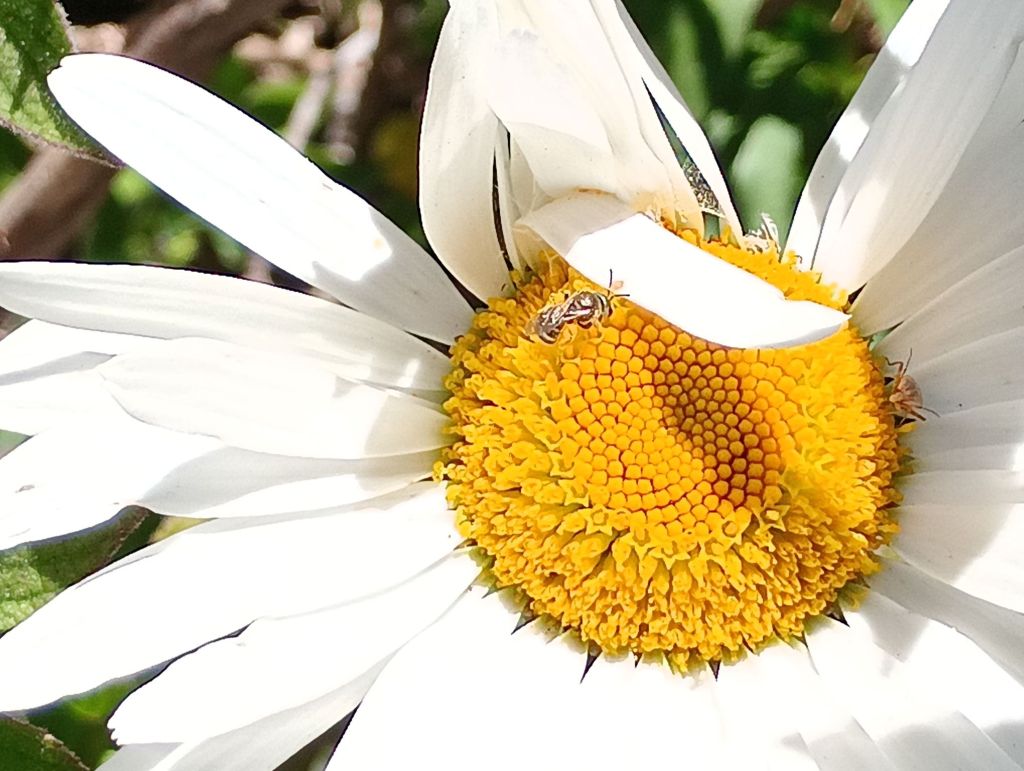
    A small Hymenopteran and a probable bug in the same flower in Berkeley, June 2025

    Recently, a samizdata channel I watch has had multiple reports that insects are missing this summer, in locations scattered around United States.

    This was not unexpected. The reduction in insect numbers started decades ago, if German amateur entomologists’ data is to be believed, but it has since been recorded around the world, including places like Colorado and Costa Rica.

    The scientists have sounded an alarm – insect are possibly the most important group of land animals in terms of species numbers and biomass. They are important pollinators, decomposers, soil and biome modifiers, and they disperse nutrients even when not serving as important food source to other species in food web.

    Bee colony collapses around USA and the rest of the world have been reported for years, and is important for food production and economic reasons. Without the ~2 million beehives transported annually, canola, almond, citrus, and many other insect pollinated crops would collapse. Because not only the natural pollinators are about gone, all the flowers in monoculture orchards are blooming only few weeks a year.

    The loss of insects has been attributed on a variety of reasons, among other things pesticide use (and other environmental poisons, including chemtrails and 5G radiation), monoculture, spreading diseases (especially Varroa mite born in bees), and changing climate. While a large number of species are affected, reading the reports has given me an impression that the selection of missing species seems to vary from place to place, suggesting multifactorial causes. The modern world apparently does not have space for bees or butterflies.

    I would probably blame monoculture, i.e., humans have appropriated too fat a slice of ecological resource flows for themselves. Traditional agricultural landscape in Europe had many verges, ditches and hedges, where wild plants and insects that relied on them could flourish. Now such places are rare.

    For example, I have observed in horror, how most species of the meadow flowers, once common on road sides near Turku, Finland, seem to have had a population collapse in the past decade. I blame this on the municipal maintenance crews mowing the verges before the seeds have ripened. Annual plants fare the worst, but I suspect perennials will eventually follow. Any insects relying on those flowers also likely fared poorly.

    As the small wild spots grow fewer and further between, I suspect we have crossed a critical threshold on insect metapopulation dynamics. Ilkka Hanski, studying Glanville fritillary butterflies living on dry meadows on rocky islands, showed that as long as there were enough patches with butterflies near each other (in this case, the minimum was estimated to be 32 patches covering total 10ha over 5km2 area), individual patches of plants or insects living on them could be ephemeral, i.e., the butterflies on a given patch could disappear or appear from year to year, but the butterfly populations of individual patches form a metapopulation that keeps the species going if the amount and density of patches are sufficient.

    Extrapolated onto insects in general, I think the on-going collapse may indicate that despite good people setting their individual gardens for butterflies, bees and other insects, if a garden population is lost, for example to local bad weather or disease outbreak, there are no longer enough insect patches left nearby to repopulate the patch. Sooner or later, isolated gardens will lose their insects. And then the metapopulation is gone.

    What can be done to reverse this trend? I suggest starting by restoring some verges. Also not mowing your yard while the flowers are seeding, as ugly as the drying seedheads may look. Insects are not very big, so they do not require nearly as large sanctuaries like roaming megafauna, but there should be plenty enough patches to maintain a viable metapopulation, so that if some species is lost from one spot, it can be colonized by insects from the neighboring spots. I believe this type of microrewilding to be compatible with current human population, possibly even essential if we want to retain their ecosystem services necessary for food production. Assuming there are no confounding factors like (possibly) 5G radiation to prevent its success.

  • Update on K2-18b

    There might not be hycean worlds, that is worlds with hydrogen rich atmosphere over liquid ocean.

    A recent study could explain the spectral signature of another potential hycean world, TOI 270d, by an atmosphere over a magma ocean, an environment not conductive to our kind of oceanic of organic life. Bummer.

    But a lava world with boiling atmosphere is interesting to me – those were the conditions of early Earth during Hadean Eon, just after forming. Once the lava cooled enough to form a crust and tolerate liquid water, we got our early ocean, either from meteors or from inside the mantle.

    Earth was small enough to cool soon, now only the ferrous core is molten, maintaining the Earth’s magnetic field and volcanism, both essential for life. Magnetic field shields us from space radiation whereas volcanism recycles back to surface nutrients, gases and water that would otherwise have sedimented or seeped into ground.

    The reason we have oceans in the surface is volcanism, which pushes water towards the surface. Yet, lithosphere contains water, maybe multiple times the amount in world’s oceans.

    So, while a hycean world is not proven, it is not impossible, either. I wonder if maybe, once a large lava world with lots of hydrogen and water vapor cools down enough to have an ocean, a hycean world arises.

  • Interesting Things I Wanted to Post

    I don’t usually work on Sundays (the day of rest and so on), but the recent news about heightening tensions between two nuclear powers have been alarming. No, not the war in Europe, or the slow boiling in Middle East. I am talking about India and Pakistan. Here is what I get from the non-mainstream news/commentary streams I follow.

    Negligible Chance of Mushroom Clouds

    Apparently, there was a terrorist attack in Kashmir where 26 Indian tourists were killed. This region has been contested by Pakistan and India for decades and occasionally, a war has flared up. India blames the attack on Pakistan, which claims innocence. Regardless of truth, the relationship between the countries tensed up, as in India giving 48 hours for all Pakistanis to get out of the country, whereas Pakistan closed Indian borders and Pakistani airspace from Indian airlines, while revoking visas from Indians and telling the Indian government to reduce their embassy size to 30 people, no military attaches allowed. India informed that they will no longer recognize the Indus River Treaty, which allocates the rights over this common river between the two countries. This is very important, because Indus river waters about 80% of Pakistani farmland, and if India were to block the water, it would create a famine that would collapse Pakistan. Pakistan has informed that if India messes with Indus river, it will be an act of war. Presumably, India has already been accused of flooding some Pakistani villages along Indus tributary. The same podcast claimed that there has been clashes along the border, not just small arms fire but actual artillery shelling. This is before the formal declaration of war. The Indus river question is an existential threat to Pakistan, which is estimated to have at least 170 nuclear warheads and has a first strike policy. India is estimated to have over 160 nuclear warheads and if things escalate, we could see mushroom clouds, though this is still a very small possibility.

    Oddly enough, when president Trump was asked about this issue, he seems to hint that United States will stay out of this conflict. That would be a refreshing novelty, a war that USA is not starting or participating in.

    Earthquake (Space) Weather

    A Podcast that YouTube recommended to me says that the magnetic field of the Sun is weakening. Apparently, this may be somehow connected with the likelihood of big earthquakes. Sun’s magnetic field weakens and strengthens by 11-12 year sunspot cycles but the peak magnetic field has been weakening over the latest solar cycles (data starts in 1970s, so we don’t know how things were earlier). This presentation fits the hypothesis that solar weather including sunspot activity triggers earth quakes that has been making rounds around interwebs for some time, except that in this presentation it is the weakening solar magnetic field that creates sunspots and correlates with the frequency of big earthquakes.

    The earthquake – sunspot connection has been explained by the effects of space weather on telluric currents, i.e., the electric currents going through Earth, telluric currents being stronger along fault lines. Living within a walking distance from Hayward fault, I have been interested in earthquakes, waiting for the Big One.

  • Klaus Schwab Has Resigned

    Last weekend, it was announced that Klaus Schwab has resigned from his position as a chairman of WEF. He had been one for 55 years, and was one of the faces of the technocratic globalism that the transnational institutions and Western governments have been pushing on the populaces. You know, things like 15 minute cities, CO2 taxes, energiewende, digital IDs, central bank programmable digital currency, the Great Reset and modified RNA vaccines.

    Now it is said that he has resigned as a consequence of a whistle-blower that had implicated Klaus Schwab and his wife in fiscal (and possibly other types) of improprieties, with the WEF board having a sudden emergency meeting. Somehow I doubt this reason – whistle-blowers do not just conveniently appear after 55 years of people not noticing chairman’s practices. I suspect this has more to do with the disastrous effects of the current forced changes on economy and the cultural blowback against the zealous insistence on the Veblen ideologies of the elites enforced with a surveillance state. Since I have not detected WEF to show interest in actual well-being of the masses, rather than the insistence that masses must adapt to their betters’ vision of the Greater Good, I think Klaus Schwab’s ouster has more to do with the smarter members realizing that sawing the branch they are sitting on, i.e., destroying the countries they live in, is not a viable long-term strategy. Even bugout countries, like New Zealand, would sooner or later be destroyed by technocratic practices.

    In a WEF’s Davos meeting about a year ago, Blackrock’s Larry Fink who also sits in WEF’s Board of Trustees, surprised by praising xenophobic countries which had instead of immigration invested in AI and robotics. At that point I took it as a bad omen – what are they planning to do with the people replaced by AI and robotics? In retrospect, I think that was an outward sign that there will be changes within WEF.

    In summary, I think Klaus Schwab was forced out after his vision of New World Order had proven to be a failure.

  • Tuna

    The Poplar Report alerted me to textured vegetable protein in canned tuna, so I decided to look at the current tuna stocks – are we that close to (commercial) extinction? Or is it just the current trend of substituting food ingredients to cheaper or maybe adding weird chemicals for profit?

    If I correctly remember, I had considered tuna overexploited since 1980s and had avoided eating it maybe since junior high school. Moreover, this century has had lurid food fakery scandals including the percentages of mislabeled fish sold in USA, often cheaper fish species being passed for more expensive ones.

    Tunas, both the canned variety and the sushi can contain mislabeled fish, with especially sushi being notorious for fakery (escolar, also sold as ‘white tuna’, can cause severe gastrointestinal distress), the more expensive varieties were more likely to be faked, risk of fakery presumed to grow with demand exceeding the supply, but sometimes also the cheaper species were mislabeled. (in Spain the likelihood the bluefin tuna you ordered in restaurant is something else is on average 73% with seasonal variation based on bluefin fishing season.)

    Now, checking at the state of the tuna stocks, I was surprised to read that conservation methods to protect commercial tuna stock had apparently worked and that depending on report 15 out of 23 stocks or 11 out of 23 stocks monitored were estimated to be fished at sustainable levels in 2024 reports (assuming I correctly understood their summary tables) with 88% of tuna coming from sustainably fished stocks (according to one of the reports). The contrast to 2007 doomsday news is promising, but when looking at the FAO report from 2007, I noticed that even then 13 – 14 out of 23 stocks were fully or moderately harvested, the status of the rest being unknown (3 stocks), overexploited (4 – 5 stocks) or depleted (2 stocks). Maybe the difference between today and then is in the levels of overexploitation reducing?

    Nevertheless, it is nice to read some good news, assuming the tuna statistics are real. However, considering the unreliable climate reporting, I cannot avoid creeping suspicion that the earlier tuna depletion may have been overrated or the current improvements overstated. And maybe I should go to supermarket myself to check if I can find TVP in tuna can, possibly to buy a can of Albacore labeled as sustainably caught.

  • Termites Farting Around

    Termite farting has been studied for quite a long time.

    A Nature paper by Ito (2023) estimates the global termite methane production 2020 as 14.8 +- 6.7 Tg per year from estimated 122.3 Tg termites (dry weight). Termite biomass estimates range from 40 – 200 Tg (dry weight), and their methane emission estimates vary even more, but by Ito’s estimate, termites produce about 2% of global methane.

    The global annual methane production is estimated by IEA to be about 580 metric tons, and Ito’s maybe ~15 metric tons would be on the ballpark of 2.6% of that.

    These farts are actually produced by termites’ gut symbionts, complex communities of microbes that help termites to digest lignocellulose and contribute to nitrogen metabolism.

    Termites evolved some time during Mesozoic from gregarious cockroaches that ate rotting wood with changes in gut symbiont microbiota, diets and eusociality. Today, termites are important in carbon cycle (and other nutrient cycles).

    There is some uncertainty about the fate of the termite farts (such as how large fraction of them even make it out of the termite hive or gets absorbed into surrounding terrain). For example, some termite hives can survive tens of thousands of years and may accumulate carbon in the mounds, and affect soil and ground water carbon sequestration.

    I was trying to find some papers on their role in Phanerozoic carbon cycles but with poor success, though it could be said that termites (plus their gut symbionts) are currently quite significant decomposers of plant cellulose, and there apparently has been enough of them already 150 million years ago that a mammal species had evolved to eat them.

    In other words, there is still a niche for people researching the effect of termite farts on global climate – past, present and future. Assuming the atmospheric carbon question remains politically and culturally relevant (for dissenting voices, see, e.g., these articles in Science of Climate Change and The Daily Sceptic).


  • The Problem with Burping Reindeer

    “It became necessary to destroy the village in order to save it”, (said during Vietnam War, where the United States went to help French with their Indochina, ending with Vietnamese eventually kicking out France, USA and China.)

    To me, the modern environmentalism increasingly resembles this insane sentiment.

    Last year, there was an uproar, when Reinhardswald in Germany was slated to make room for wind turbines ‘necessary’ for Energiewende.

    How much of this was hype and how much was counterhype, I don’t know (though I suspect my search engines show me very biased results.) On my recent trip to Finland I saw the changes in the countryside, big wind turbines can cause. It takes lots of land and removal of trees or elimination of agricultural fields to build a wind park.

    In reality, it may be environmentally less harmful to build nuclear reactors than wind turbines (depending on how you calculate EROI – my Google searches were inconclusive because the studies were either old or seemed to be shilling for one form of energy or another), and they kill fewer people (not to mention them having smaller radiation plume) than coal plants.) While there remains need for petroleum, its increasingly difficult extraction reduces its EROI, which means that in future it will probably remain as a raw material for industrial processes, maybe special fuel for internal combustion engines.

    Nevertheless, EU (including Germany) is dedicated to net zero project, which increasingly begins to seem like some weird suicide / flagellant cult with reduction in living standards (rationing energy by rising costs, attacking food production, limiting transportation and movement, and increasing housing density) and reduction in human-accessible territory.

    All these projects, while openly posted on-line, are presented so that opposing voices are portrayed as conspiracy theorists and antienvironmentalists. But is it a conspiracy theory if they themselves tell everyone their plans, or worse, their actions?

    At least the most fanatical theses from the now destroyed Georgia Guidestones are not openly touted. There are people, other than just me, who would consider the reduction of world human population to 500 million from (official) 8 billion or by over 93% rather genocidal.

    But the Green New Leap is not just for UK, Germany, Netherlands or Ireland. Finland, too, is planning ambitious net zero targets, and I mean really ambitious, as in lauded by WEF.

     Most of Finland is above 60° latitude, about the same level as Alaska or south end of Greenland, mostly more north than Yakutsk in Siberia. Energy is of utmost importance there. Roughly speaking, a person can survive a few minutes without air, a few hours without heating, a few days without water and a few weeks without food.

    Finns have survived without fossil fuels for centuries, but that was by burning wood, which is also not OK with the eurocrats – small particle pollution will kill! Presumably freezing to death is more efficient and environmental. At least the official media reassures the Finns that saunas are safe from this regulation. For now. Anyways, the war against Russia and certain realities of energy production have resulted in complications in banning wood in energy production.

    Meanwhile in China, 2024 began to build 94.5 GW worth of coal power plants and resumed 3.3 GW of suspended projects according to two think tanks. Only 2.5 GW of old capacity was closed 2024. (Side note: with China’s economy tanking and exports faltering, what do they need this new energy capacity for?)

    But what about the reindeer burps?

    Indeed, according to our reliable news media, a study was published that Lapland will not be able to meet its greenhouse targets by 2035 because of the large emissions from its agriculture, namely the reindeer. Which as ruminants are burping too much methane, which is a greenhouse gas. Unfortunately, I could not find a link to the original study to check the claims, and to see if the researchers were in earnest or if this was some sort of reductio ad absurdum-document to demonstrate the futility of the Net Zero targets.

    However, assuming the reporting is true, reindeer are part of the Arctic ecosystem, and even if the semidomesticated populations in Lapland were counted as human livestock, those globalist net zero plans that would involve reducing the number of large ruminants, such as grazing cows and sheep, come dangerously close to messing the ecosystems by removing large herbivore guild from the food network. While I can see the point in reducing the use of feedlots and grain / soybean based fodder in ranching, eliminating free-range foraging herbivores is IMHO insane.

    Ironically, the climate war against cattle (products) is not fully compatible with the idea of rewilding the land, which presumably involves switching domesticated large herbivores with wild large herbivores to the net zero effect on burps per acre in case of free grazing animals. Large scale rewilding is currently hypothetical rather than practical, as the numbers of large wild herbivores are insufficient for the switch. Humans and their cattle, pets and pests account for about 96% of terrestrial mammal biomass. The remaining about 4% is everything else from Etruscan shrew to elephant. Cows alone are ~40% of Earth’s land mammal biomass, meaning there are no replacement herbivores. And without ungulates, the grassland ecosystems will collapse.

    But back to the reindeer burps.

    When it comes to climate, worrying about the relative inputs of reindeer burps vs the rest of the nature makes even less sense. In Hunga Tonga-Hunga Ha’apai eruption January 2022 estimated 146 million cubic meters of Pacific salt water causing a couple of years of cooling with effects possibly lasting for the rest of the decade. The atmospheric CO2 concentration near Australia and New Zealand increased from the expected 412 ppm to 414 ppm, about the size of interannual fluctuation on those parts.

    When we consider this and other volcanoes, and the coal plants of China and the rest of the world (not to mention everything else that produces greenhouse gases, such as termites), how much effect would it have on the atmospheric chemistry and global climate change if all the reindeer in Lapland stopped burping?