← Back

Thank you for your response. ✨

PlanktonPunkt Designs puzzles available in CreateJigsawPuzzles

link to order print on demand PlanktonPunkt Designs jigsaw puzzles (printed in China)

PlanktonPunkt Designs POD products in Printify

link to order PlanktonPunkt Designs print on demand wares from the source

PlanktonPunkt Designs POD products in Etsy

A link to order from a selection of PlanktonPunkt Designs print on demand wares from Etsy

Category: Exoplanets

  • Summer Solstice

    Also a Father’s Day in United States. Congratulations to all the fathers, it is, unironically, an important task.

    Since today is a celestial event, this is a good place to mention an update on K2-18b, this potentially hycean exoplanet, that may or may not harbor life (it resides in a habitable zone of a red dwarf but the spectral signs of biosignature molecules are not very reliable and the molecules may also have been formed by abiotic means.) Now, SETI had included this solar system to their radioastronomical survey for alien radio signals. They did not find any, but got plenty of data for future negative controls.

    IMHO, microbial life on exoplanets and larger moons is likely (how common is another matter), but assumption that alien civilizations would communicate via strong radio transmissions seems oddly specific. I expect that if we ever find proof of advanced material civilizations, it would be something like Dyson structures or remnants of extraterrestrial advanced materials not formed by natural processes.

    I thought to get some photos of the sunset of the longest day of the year, but gray clouds had crept over and obscured the sky. It often happens in Berkeley, days are sunny but as the evening sets, the cloud cover spreads from sea to hills. I did not get up there, but in many nights, the blanket of water which is cloud cover over the flats is fog or mist in the hillside. So, instead, here is a picture of jasmine flowers, size reduced from the original taken earlier today.
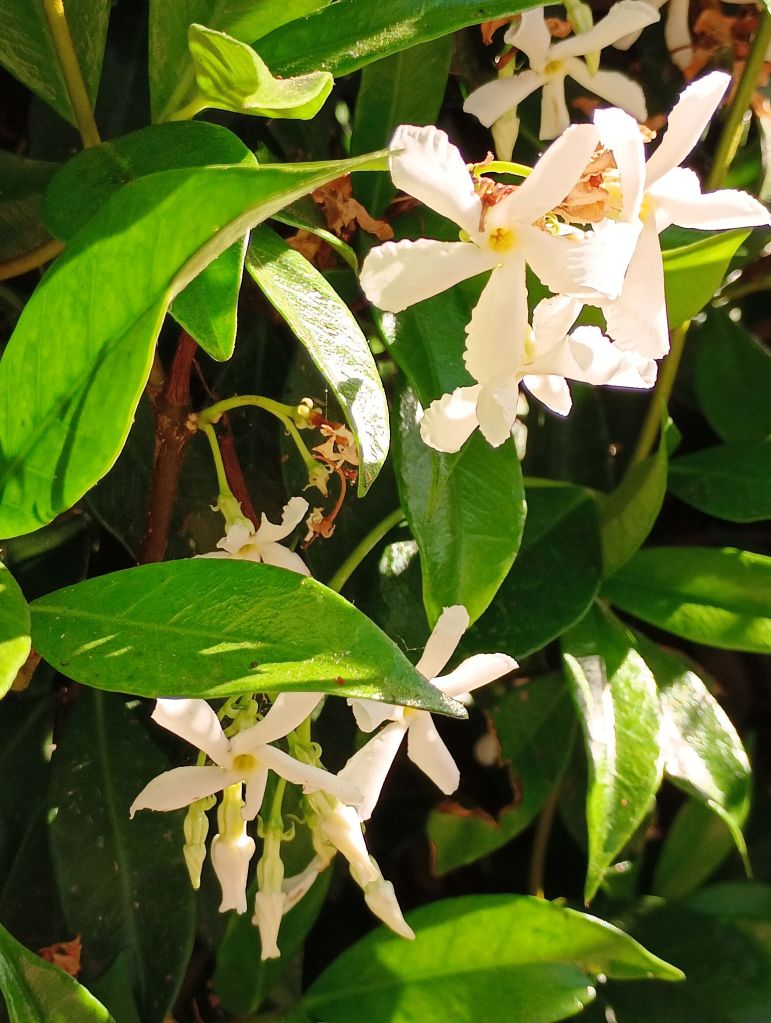
    These are either from South Berkeley or from North Oakland, the city border crosses the block where the plant grows.

  • Update on K2-18b

    There might not be hycean worlds, that is worlds with hydrogen rich atmosphere over liquid ocean.

    A recent study could explain the spectral signature of another potential hycean world, TOI 270d, by an atmosphere over a magma ocean, an environment not conductive to our kind of oceanic of organic life. Bummer.

    But a lava world with boiling atmosphere is interesting to me – those were the conditions of early Earth during Hadean Eon, just after forming. Once the lava cooled enough to form a crust and tolerate liquid water, we got our early ocean, either from meteors or from inside the mantle.

    Earth was small enough to cool soon, now only the ferrous core is molten, maintaining the Earth’s magnetic field and volcanism, both essential for life. Magnetic field shields us from space radiation whereas volcanism recycles back to surface nutrients, gases and water that would otherwise have sedimented or seeped into ground.

    The reason we have oceans in the surface is volcanism, which pushes water towards the surface. Yet, lithosphere contains water, maybe multiple times the amount in world’s oceans.

    So, while a hycean world is not proven, it is not impossible, either. I wonder if maybe, once a large lava world with lots of hydrogen and water vapor cools down enough to have an ocean, a hycean world arises.

  • K2-18b

    Scientists in University of Cambridge have published their analysis of the data collected by James Webb telescope, presenting the results showing likely dimethyl sulfide (DMS) and/or dimethyl disulfide (DMDS) signal in the atmosphere of an exoplanet K2-18b. This is thought to be a hycean world, which is supposed to have large liquid water ocean with hydrogen atmosphere but not all scientists agree even that. There were preliminary results suggesting DMS in the atmosphere published earlier, but this later analysis by the group presented more evidence claiming to have strengthened the earlier findings to 3 sigma levels.

    DMS on Earth is produced by microbes like phytoplankton, and the researchers consider it in the atmosphere of K2-18b as a potential sign of large amounts of life in the ocean of K2-18b. However, the possibility of some exotic chemistry occurring in extraterrestrial conditions (different gravity, temperature, availability of component chemicals, space chemistry, etc) has not been excluded and may explain the signal, in which case it would be abiogenic. Besides, collecting spectroscopy signals from faraway planets (in this case about 120 light years away) is difficult, and more data is needed to verify the DMS/DMDS signal instead of some other chemical with similar spectrum at 5 sigma certainty.

    In any case, an interesting possibility and worth noting, just in case.