

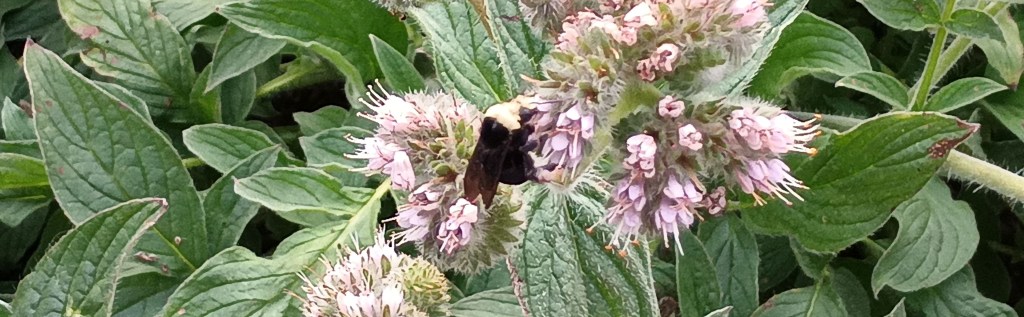
A cute bumblebee seen 2026 April 18 among flowers in Berkeley, CA.
Working hard.
PlanktonPunkt Designs puzzles available in CreateJigsawPuzzles
link to order print on demand PlanktonPunkt Designs jigsaw puzzles (printed in China)
PlanktonPunkt Designs POD products in Printify
link to order PlanktonPunkt Designs print on demand wares from the source
PlanktonPunkt Designs POD products in Etsy
A link to order from a selection of PlanktonPunkt Designs print on demand wares from Etsy
The wisteria season is going out. This post was meant to be out earlier, but my internet started acting up so finishing it got delayed. In any case, redbuds are done, but new flowers are showing up. There were within nearby blocks weird, fluffy white flowered, presumably fruit trees that I have loved to observe for a couple of years already but this year I have been busy and missed the start of their blooming.
The spring was very warm and quick, and it feels like a summer here, though some plants did not get the memo and are still without leaves or flowers. Also, I partially missed spring posting because of internet issues – for some unknown reason my home internet again allowed me to blog dashboard again yesterday. The Liquidambar are full of new leaves and many have new small ‘spiky balls’ growing, light green like the new leaves. The balls began to grow despite many trees had many of their last year’s dark and hardened ‘spiky balls’ hanging, too. Some Liquidambar even had last year’s leaves left among the new growth. Confused about seasons or insufficient winter storms?
Insects had been active, and birds were still singing when I began to draft this post (now the chorus has quieted, presumably they are busy with chicks.) Multiple species of butterflies, not just the wintering monarchs, were flitting around and in flowers. As a testimony of warm weather, I even saw a skipper butterfly, though I do not have photographic evidence – the little beast was too fast.
That was on my walk to a shop and back to get 10lb elbow macaroni. I bought cans of corned beef last weekend and failed to buy canned sprats. By my estimates (based on empirical experience on how many times I can eat the same meal before I lose appetite), I can eat max 1-2lb macaroni boiled with a couple of cans of meat a week (preferably less often than more) thus cutting my grocery bills, should the food situation worsen, either through supply shock (geopolitics), through reduced income (read unemployment) or through inflation (economic collapse.) Adding fresh greens and fruits to stored food to balance the diet should stretch the supplies meant to be a buffer for temporary shocks. There should be at least lemons in Berkeley, CA, barring the most exceptional circumstances. I got 10 more macaroni on my next shopping trip, also keeping my eyes peeled for cheap sprats (protein + fatty acids) and more corned beef or other non-perishable meat products (protein). If the situation lasts over three months, I’ll be in trouble. But then, so will be everyone else.
For the people who are surprised at 3 month preps, rather than a homestead with doomsday bunker, most of the SHTF events are either short term (storms, blips in supply system, specialized economical events) or personal (accidents, injuries, corporate lay-offs) so it makes sense to invest some resources on stuff that might realistically happen to anyone that to invest a lot in case an extremely long tail event like a total thermonuclear war happens.
Remembering the collapse of the Soviet Union, a definite SHTF event for the Soviets, the society remained largely intact, bureaucracies existed, and economy muddled on, as did the regular people. I am expecting similar circumstances in United States, the Obama years reminded me of Brezhnev Era, Biden years of the Andropov/Chernenko years at the twilight of the Soviet Union. I expected Trump to be the Gorbachev of the United States, overseeing the economic collapse and centrifugal tendencies of increasingly assertive states overriding the Federal legislation and enforcement, but apparently our trajectory of failure will resemble more the end of the British Empire, that died by Suez Canal. Meanwhile, canned fish is getting expensive.
But the wisterias were pretty this spring, and I’m happy that I got some pictures.
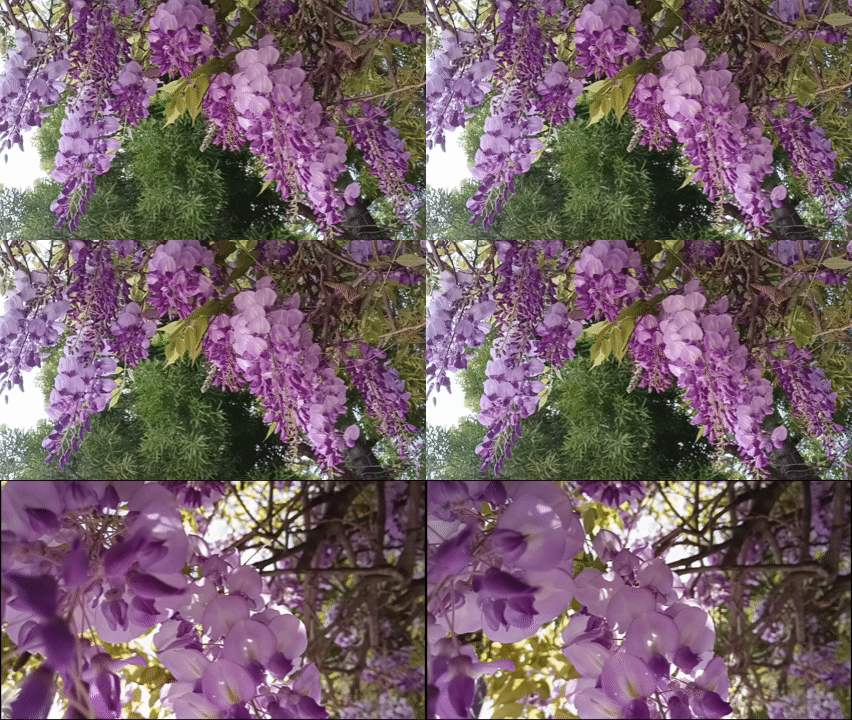
Wisterias from 2026, March 21. Better late than never.
Just realized that today, March 20th is the spring equinox for 2026.
It feels like summer here in Berkeley, CA. Many trees are in nearly full greenery, jasmine flowers seem to be wilting already, wisterias have been going on a full tilt for at least a week or two (started some weeks back.) There has been more butterflies than just an occasional wintering monarch, I saw the other day a swallowtail and cabbage whites or their relatives have been flitting around. We have had a persistent heat wave with temperatures reaching (in Oakland International Airport) 81 to 84 degrees Fahrenheit or about 27 to 29 degrees Celsius.
Nevertheless, before I realized what day this was, returning from work, I had taken a photo of a crescent moon against a tree, the sun had set but the dusk was still bright at the western sky.
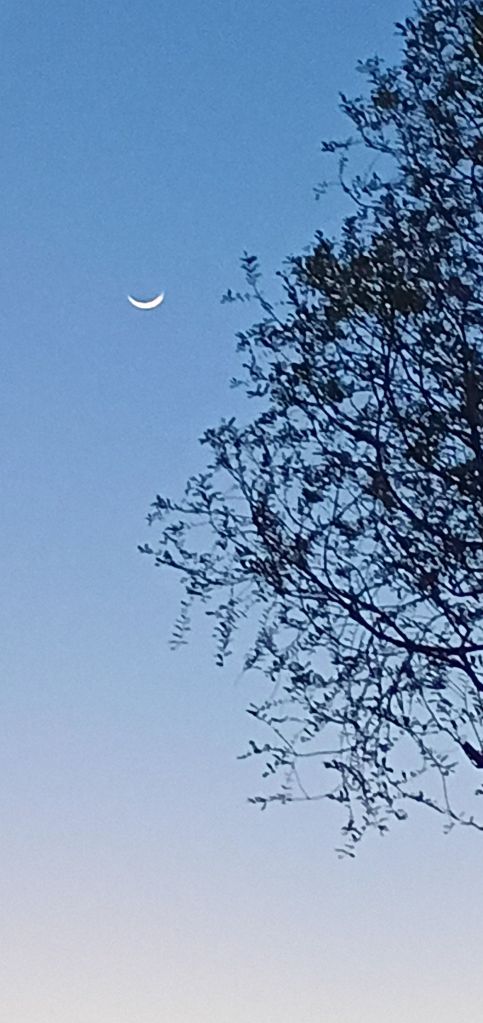
It looked prettier in nature. Or even on phone screen, before cropping and shrinking.
From now on until Autumn Equinox, the days will be longer than nights.
This is a filler posting with a little video.
I am still processing current events, which have been shocking, but I think there is now a change occurring. The old era is crumbling and new will emerge – I see similarities between this change and the change from medieval to Renaissance in that the Renaissance was overhyped as Age of Reason (while in fact, superstitions flourished as did witch hunts and religious wars), just like the current age of atheism has led to a proliferation of cults, superstitions and die-hard fanaticism. Whether the emerging civilization will be more civilized than the dying one is debatable, considering the decreasing literacy rates and the fact that people no longer read much. Worse, critical thinking seems to have been discouraged to make people to conform the centrally managed ideologies, and this has been going on long enough to erode educational standards.
In Finland, which was supposed to have one of the best education systems in the world, some education official had recently stated that the schools should focus on learning processes and how to become good people rather than on concrete skills, which I interpreted as capitulation – children will not learn because they are not able to learn, so they must be taught to learn before they can learn. I did not go to the original news to find out exactly how would the educators grade learning of learning processes and what are the metrics for success but I suspect the standards to be lenient enough to process students out of the system regardless of their actual skills, especially the concrete ones.
Anyone who has discussed with a fundamentalist atheist will soon have realized that their faith is as unshakeable as their urge to convert everyone else, and any doubts about non-existence of God will be met with vehement proselytizing, while any vestige of deistic religious practice will incite their wrath. Ironically, as the old religion fades from mainstream culture, it does not lead to new atheistic world but a hodgepodge of cults, including some seemingly irrational ones.
Combined with decreasing literacy rates, apparent disfavor of critical thinking relative to obedience to centrally directed ideologies, the current system seems to be a perfect incubator for superstitions and cults among masses deprived of their traditional (or any other) culture and seeking meaning to their lives.
It has been written that none should present a problem without offering also a solution. My proposal would be to go medieval, that is reintroduce trivium: logic, grammar and rhetoric, that were the classical curriculum to the modern student body.
Logic, i.e., critical thinking wherein facts could be tested according to a system of formalized structures to detect fallacies, would be absolute minimum. Offshoots of logic, especially arithmetic and natural sciences in general, as well as traditional humanities from times before deconstructionism, would also be useful.
Grammar, especially its application in literacy, is crucial for the functioning of society and of individual within a society. Without ability to communicate clearly, in speaking, reading and writing, information transfer between individuals and generations becomes difficult, as does organizing the societies.
Rhetoric is an obvious application of logic and grammar, but the art of communication is difficult. I have read complaints that modern youth cannot communicate. I interpret those complaints as modern youth having been abandoned without teaching them rhetoric. Without an ability to convey one’s needs and wants, and to persuade others, a person is crippled in a society. Maybe the modern youth have their own society where they communicate amongst themselves, but even then, the intergenerational information transfer has been disrupted. Or, the young today no longer hear the teachings of their forefathers.
In any case, before I got distracted, I meant to post a video of a skipper butterfly in a flower, edited from one taken on October 5th, 2025.
October skipper. Skipper butterflies do not like cold weather, so the temperatures had been quite warm. Now, this winter, the fruit trees and magnolias seem to bloom early.
And I also added a jigsaw puzzle via Jigsaw Explorer.

Bubbles mosaic view of a skipper butterfly on plant. Clicking the above image will lead to 110-piece jigsaw puzzle, courtesy of Jigsaw Explorer.
Going through my folders for images to process for PlanktonPunkt Designs, found this, and decided that it was best suited for a blog posting.
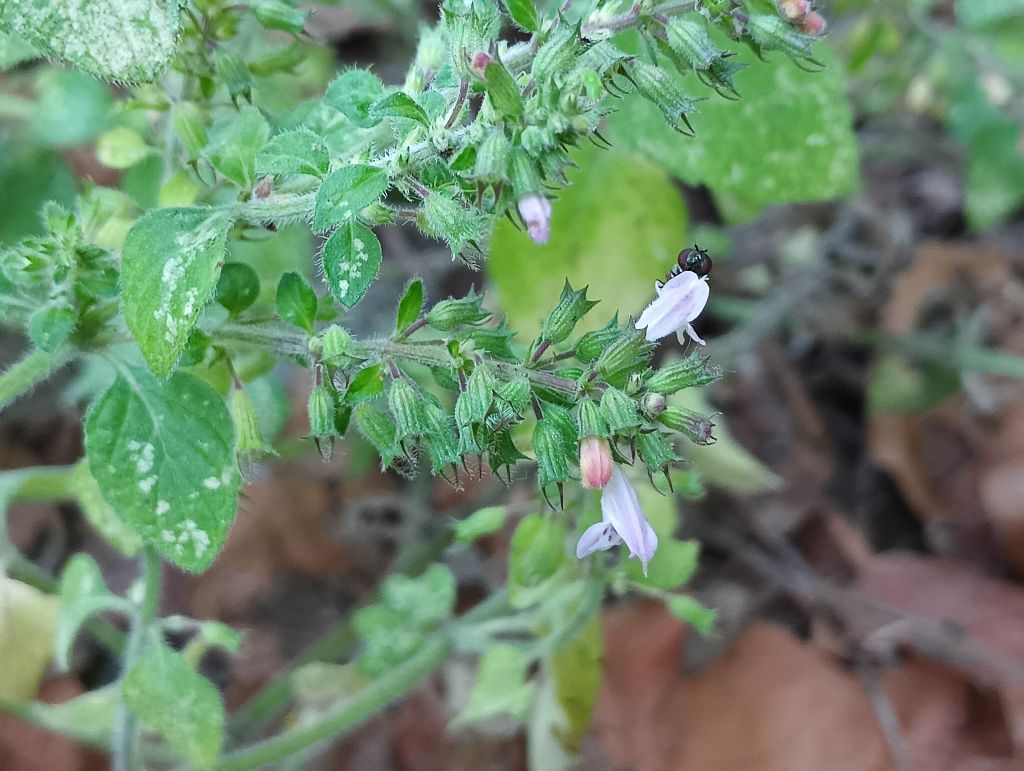
Peekaboo!
Clicking the image will open to Jigsaw Explorer and 24-piece free jigsaw puzzle.
Small is pretty, both in flowers and in insects.
This week has been very strange, even by 2020s standards.
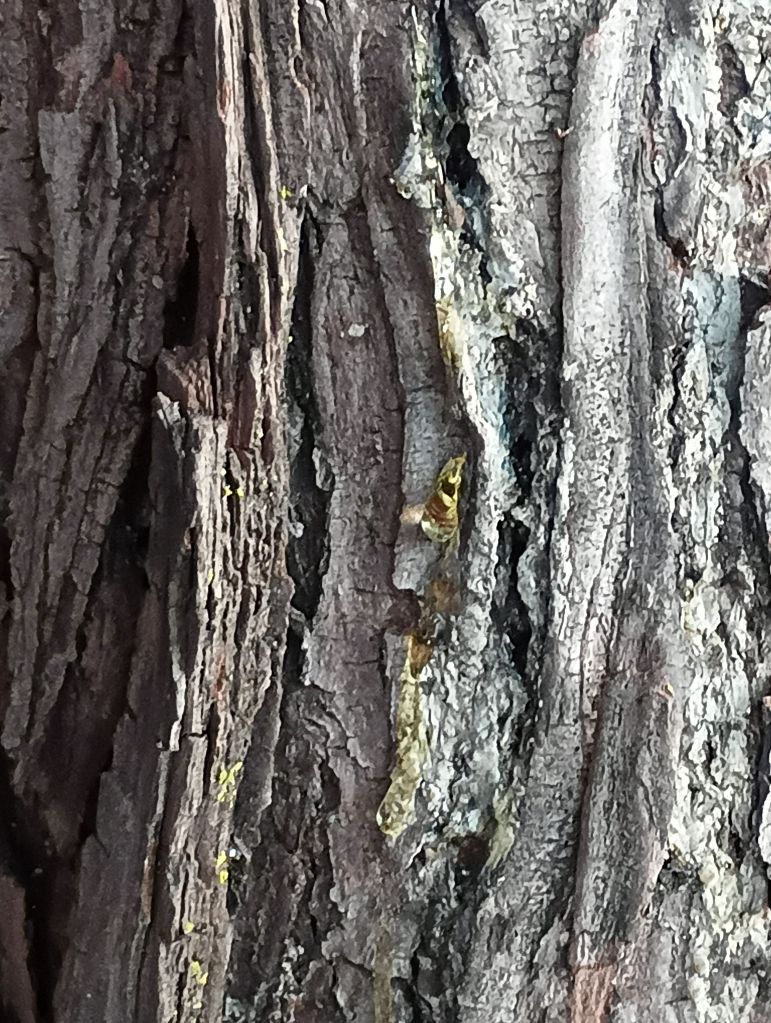
Sap on a tree trunk, August 22nd, 2025, in evening sun light. Just something pretty.
I have been employed since September, a couple of temp extensions and I got another extension last week. Have been working hard to justify my continued paycheck, so posting has been sparse. It will probably continue to be so, until I get things stabilized.
The inflation is getting out of hand. On Thursday, the gold visited briefly at about 5600$ per troy ounce, silver tested 120+ range before settling below 120$. In the cafeteria, where I often go for lunch, the cheap meal of 2 pieces of chicken, a piece of corn bread and some side was 20$, a bigger meal 35$ and there was an 8-piece 70$ option, too. Then on Friday an incomprehensible double digit collapse of gold and silver prices, some say 8 – 10 sigma event. Also crypto went down, hard. The metal move was some times blamed on nomination of Warsh as the next Chairman of the Fed, but metals don’t move that much for nearly anything, at least they did not used to. People online grumble about market manipulation, but even that does not make sense, unless the economy is very, very fragile. A few years back, I could not imagine an event smaller than WWIII moving metal prices that fast. No, scratch that. A few years back, I could not imagine metal prices to move that fast. Period. However, I doubt the chicken will be cheaper next week.
Greenland forgotten, our troops are amassing near Gulf of Persia. Government is currently under partial shutdown. On the top of the shutdown, the Federal administration is trying to stop disbursements to the states that refuse to investigate various forms of fraud on social services, health care, etc. There is a simmering tension that might flare at any provocation back to armed violence – the states are choosing their sides whether to support the Feds on immigration enforcement or not.
Meanwhile, there is the Moltbook issue. To me, it is unclear if this is a clever community make-believe or whether the AI agents are gaining autonomy or something between. Some in the Internet are screeching about Skynet, but it is the reality of our energy infrastructure that is a kicker. For example, there were over 180k households without electricity in Tennessee after a winter storm, tens of thousands still today, though the repairs are ongoing relatively fast. Even under the best of the weather conditions, many interconnects are under enormous strain between the Green New Leap that has destabilized the grid and the AI server farms which require power of millions of households. If I were a betting person, I would place money on the complexity collapse over the shiny AI future.
So, while charging my phone, I decided to use the time for making a no-context video of clips taken August 22nd, 2025, and then start writing a blog post as a place for that video.
Seed structures fluttering in wind, black ants on a tree (some sap)
I saw this on Sunday.
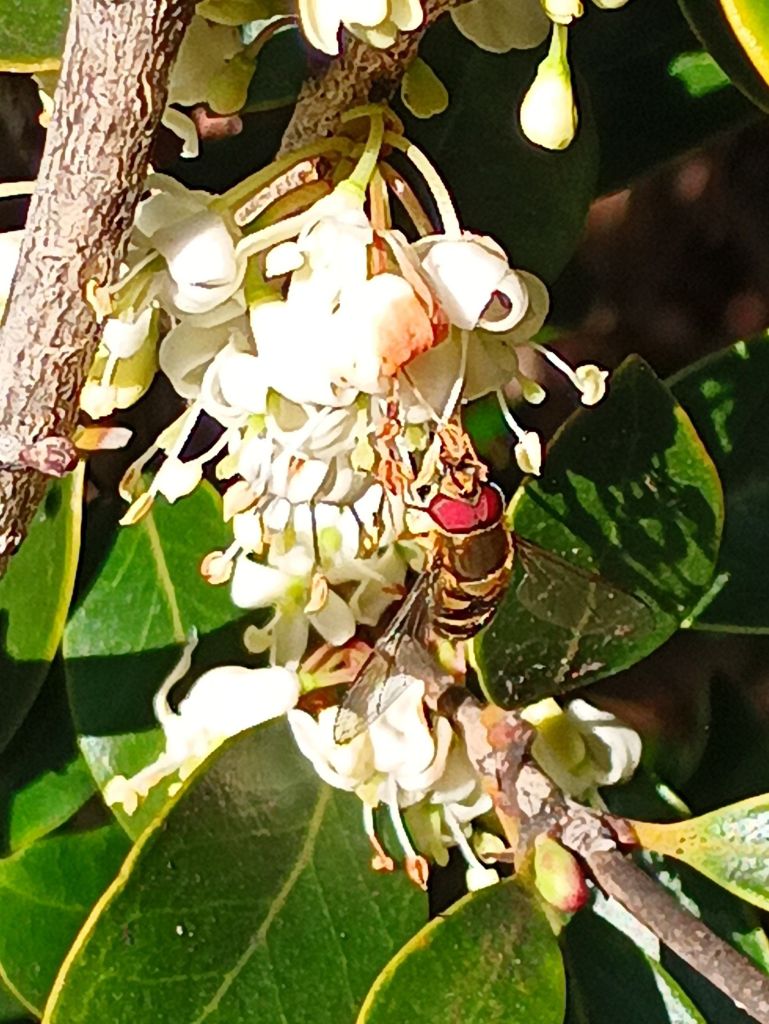
A hoverfly on inflorescence December 28th, 2025, Berkeley, CA
Click the pic to access a 54-piece jigsaw puzzle.
A little video of the little lifeform.
I also saw a flight of geese (based on honks and flight pattern) going north-north west, but they had disappeared by the time I had adjusted my device for photography. Weird.
The night after that, it was really windy. There was a tree branch on the sidewalk, when I was getting to my car. The morning wind came from north, soon after it turned and arrived from east. There were a few more geese, seemed to be going sort of westward (towards the Bay). The direction does not matter, I was surprised to see any, going any direction.
And now for something different, a silent video of a skipper butterfly I saw September 14th 2025. Yes, I know it is mostly plants, but the butterfly is there, doing nothing very interesting.
Sometimes you need a moment of rest and relaxation.
Cheers to the small life.
Today, while walking with my mobile ready to snap a picture or even a video, I noticed a number of hummingbirds, not as a flock but a hummingbird or two every now and then. More than I could photograph. Aside from being fast, the little birds are well camouflaged when sitting among the green leaves of a tree. Also, they are small, which means my camera’s resolution will not be sufficient for a good picture or a video. Hummingbirds are migratory, moving south for winter and flowers. I don’t know if they stay here in Berkeley for winter, maybe they are just passing through, but some were singing.
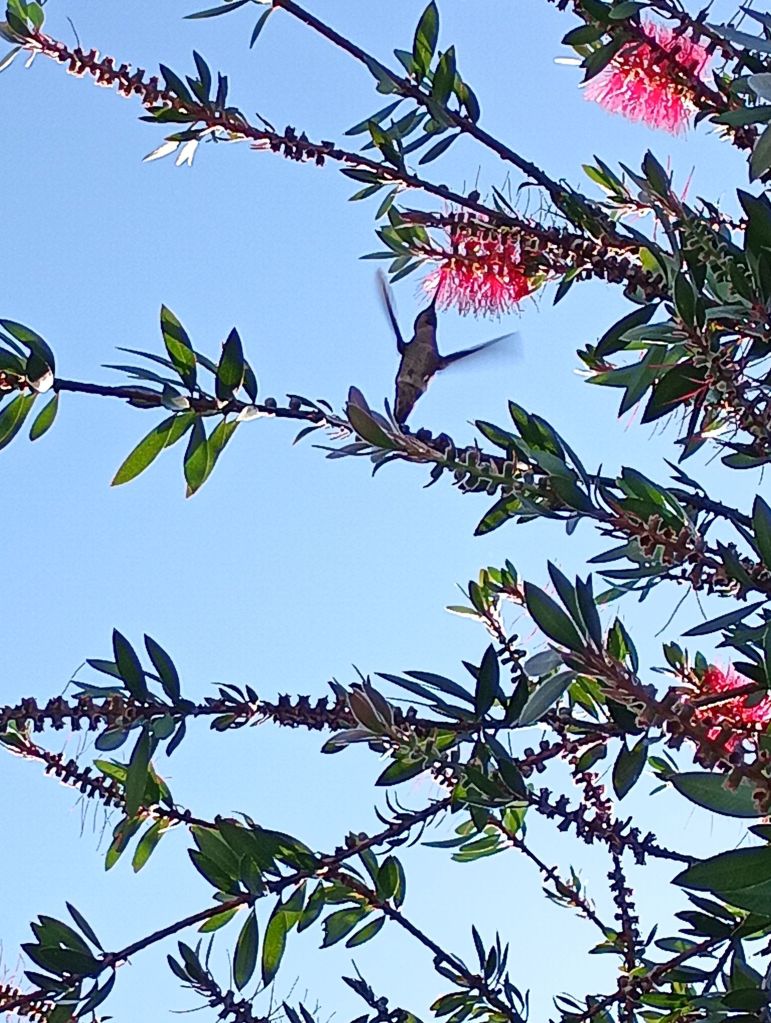
A photo of a hummingbird and a bottle brush plant, October 19th, 2025, Berkeley, CA
Monday’s rain had apparently inspired little green shoots to peek from the ground. Hopefully this was not a false start. The best part of the winter is the greenery as the rainy season ushers new growth.
Skipper butterflies were still around, though this time I did not see a swarm. There were also occasional Monarchs and smaller white butterflies.
I was lucky enough to be aiming for a red bottle brush flower, when a hummingbird flew to feed. Quick switch to video mode captured a few seconds of hummingbird and red flower.
A short video of a hummingbird and a bottle brush plant, October 19th, 2025, Berkeley, CA
Sometimes you need to take a break and appreciate the small things
So, I got a temp job as a scientist starting late September and have been busy. But I am planning on keeping posting, even if the intervals between content get lengthy.
About a week ago I was walking around taking snapshot and videos, and was impressed at the amount of butterflies fluttering around, multiple species of them, multiple places. I am still trying to process my videoclips (I have quite a few of them taken this year) into YouTube videos, but here is a little sample at lower resolution.
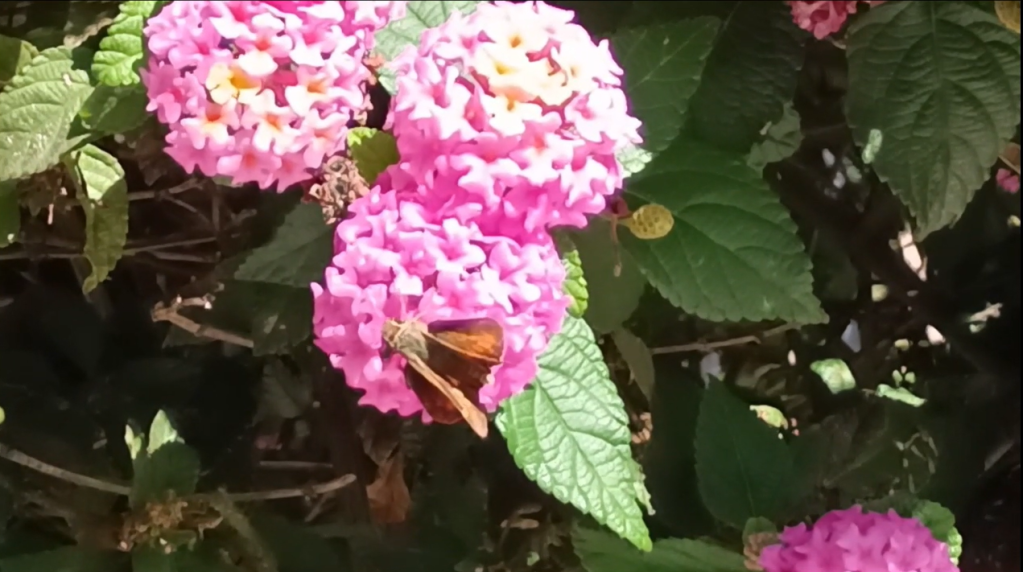
There was a bush (or a cluster of them) with yellow and pink flowers, which seemed to be very popular with small brown and quick butterflies. I had seen them occasionally around, but their numbers had been increasing towards autumn. They look like online photos of skippers, which are common in California and North America, and though I would not presume to identify the exact species with 100% certainty, an Umber Skipper or a Fiery Skipper seems a possibility.
I think this swarm was from the latest brood that had eclosed and was preparing for winter and / or having a mating season. I have some earlier clips of similar-looking butterflies, but those were difficult to obtain because the insects were skittish and quick to fly. The butterflies in this swarm seemed to be more interested in feeding, occasionally chasing each other, but I could get close to this specimen without it flying away. Maybe they were preparing for winter or for laying eggs.
Pure speculation, since Winter in California is the rainy season, with new green shoots, so it may be a good time for new caterpillars to hatch. On the other hand, maybe the adults were preparing to hibernate through the wet and cold.
A skipper butterfly in pink inflorescence, October 04, 2025
