← Back

Thank you for your response. ✨

PlanktonPunkt Designs puzzles available in CreateJigsawPuzzles

link to order print on demand PlanktonPunkt Designs jigsaw puzzles (printed in China)

PlanktonPunkt Designs POD products in Printify

link to order PlanktonPunkt Designs print on demand wares from the source

PlanktonPunkt Designs POD products in Etsy

A link to order from a selection of PlanktonPunkt Designs print on demand wares from Etsy

Category: Microbes

  • Cookies and Milk

    Doomscrolling my news sources, I stumbled on these two gems, cookies and milk:

    cookies

    https://www.sciencealert.com/radical-overhaul-to-milk-production-would-use-up-to-96-less-land-than-cows-study-suggests

    and milk.

    The purpose of microbial ferment of plastic into proteins (and metabolic byproducts, I suspect) is to compress them into cookies that can feed people. Most of whom, according to some poll, would eat it if resource constrained.

    My comment to that:

    “First they destroy farming, pave the nature with concrete and solar farms, and then they offer plastic cookies. This article is probably a psychological test to see if it actually works on masses. Methinks there will be a mass extinction of anything larger than rats and a global desertification to the tune of Sahara before we reach that level of resource constrain.

    More ominously, the elites may have realized that they have destroyed too much of the food system, and the resource constrained conditions might cause social instability like torches and pitchforks, i.e., Arab Spring II. The fact that this sort of dystopia is even attempted to be normalized shows what level of famine they are expecting in their pipeline.”

    was missing the risk of microplastics and exotic chemical impurities.

    I have already cut down eating certain foods for their suspected plastic content, would not trust the cheap mass manufactured plastic cookies, could not afford expensive mass manufactured cookies.

    Lots of current plastics contain many toxic elements or chemicals from manufacturing, and even those that were inert in the original product might be freed during fermentation process. Others, like phthalates were not safe to begin with. And then there are microbial metabolic side products which cannot be cheaply removed fully and may convert inert to toxic. Not to mention that recycled plastic has encountered many environments during its travels and may have collected dangerous souvenirs. I remember from years ago that granola in boxes made of recycled cardboard needed to be bagged into clean plastic bags, because of the hazardous impurities in recycled cardboard.

    As for the milk, I believe in whole milk to be the healthiest alternative, unless one is lactose intolerant or is allergic to milk (different ailments but both unpleasant), and I would not trust the manufacturing processes to be safe enough for microbial milk substitutes, especially for people who have yeast allergies.

    But based on my understanding on the linked original article, it discussed substituting milk in point of view how much land is saved when rapeseed oil and sugar beet residue is used instead of dairy cows. The paper’s point was not improving human nutrition. The final product is supposed to be nearly as good as milk, but without lactose or cholesterol, and fats coming from rapeseed oil, minerals, vitamins and other nutrients were assumed to be added from somewhere but even the authors admitted that since the fat profile differs from milk fat profile, the milk substitute might not be a substitute for all milk uses.

    Why do we want to ‘save’ land? Rewilding, settlement and other agricultural uses were mentioned, as was Net Zero. I have previously discussed rewilding and destruction of food production, but why exactly do we need more settlement when most of the worlds population lives in countries where fertility rates are below replacement level, and soon their populations are beginning to collapse?

    I do not trust the nutritional value of microbial milk substitute. Having read some of the baby formula ingredients lists, I am not surprised that babies fed with formula develop lower IQ than breastfed babies, though I am not condemning their mothers, who often do not have a realistic alternative option for formula. Economics may be too brutal to stay home to nurse, and not all mothers produce enough milk to feed a baby. I have not seen the microbial milk ingredients list, the original paper was speaking of rather generalized data, but whatever the final products to be pushed to us are, I expect their industrial requirements to be about as healthy as an average baby formula.

    Summa summarum, these milk and cookies would be something I would leave for modern Winter Holiday Santa, the commercial one that is supplanting Christmas Santa and older characters like Joulupukki and Krampus. Even if the hypothetical Winter Holiday Santa would leave me lumps of coal as gifts after such skimpflation, those probably would be welcome in the approaching fuel shortage. And if it were anthracite coal, it might even contain a fossil or two!
  • Summer Solstice

    Also a Father’s Day in United States. Congratulations to all the fathers, it is, unironically, an important task.

    Since today is a celestial event, this is a good place to mention an update on K2-18b, this potentially hycean exoplanet, that may or may not harbor life (it resides in a habitable zone of a red dwarf but the spectral signs of biosignature molecules are not very reliable and the molecules may also have been formed by abiotic means.) Now, SETI had included this solar system to their radioastronomical survey for alien radio signals. They did not find any, but got plenty of data for future negative controls.

    IMHO, microbial life on exoplanets and larger moons is likely (how common is another matter), but assumption that alien civilizations would communicate via strong radio transmissions seems oddly specific. I expect that if we ever find proof of advanced material civilizations, it would be something like Dyson structures or remnants of extraterrestrial advanced materials not formed by natural processes.

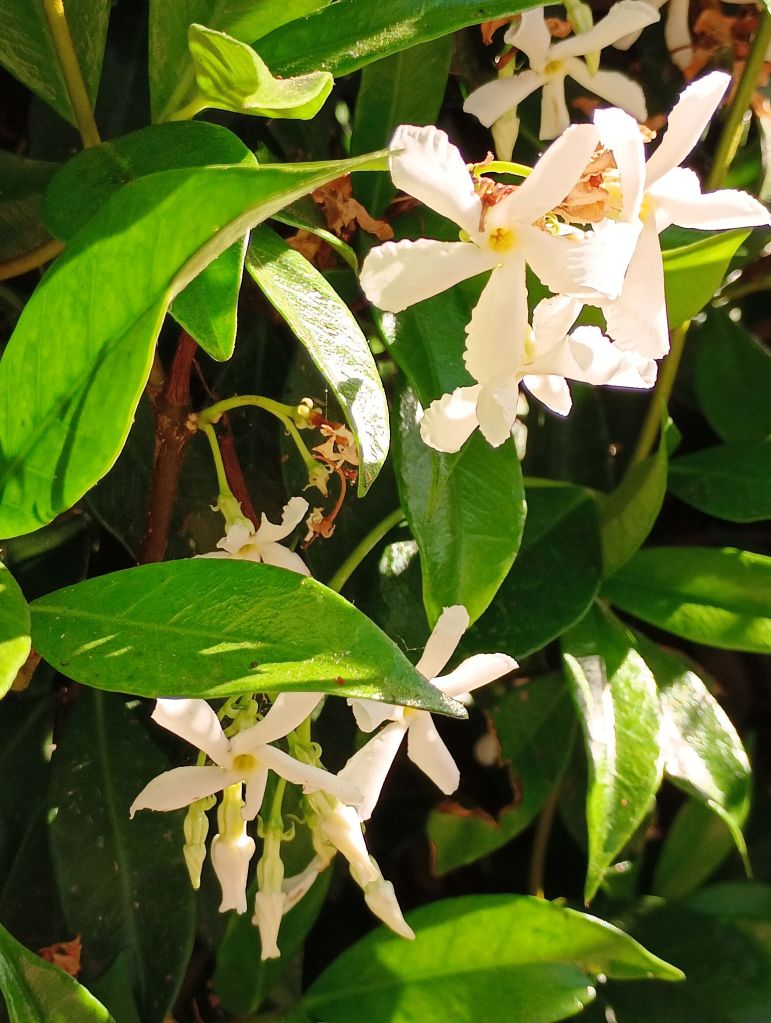
    I thought to get some photos of the sunset of the longest day of the year, but gray clouds had crept over and obscured the sky. It often happens in Berkeley, days are sunny but as the evening sets, the cloud cover spreads from sea to hills. I did not get up there, but in many nights, the blanket of water which is cloud cover over the flats is fog or mist in the hillside. So, instead, here is a picture of jasmine flowers, size reduced from the original taken earlier today.

    These are either from South Berkeley or from North Oakland, the city border crosses the block where the plant grows.

  • Ants and Life on Mars

    I had recently seen two interesting news. One was about an ant species that must clone males of another species to produce hybrid offspring for worker caste. The other was about the possibility of there having been life on Mars.

    The ants are haplodiploid relatives of wasps, females are diploid, males are haploid. In Messor ibericus species the queens can produce two types of male offspring, one of their own species, other from a related species Messor structor, with which they have been estimated to have a common ancestor about 5 million years ago. The queens mate with both types of males, because ibericus males are needed to make new queens, whereas structor males are needed to make hybrid workers. The structor male genome survives because the queen can somehow clone haploid offspring from sperm (though the mitochondria of the ova come from ibericus.) It should be noted that the ibericus-born genetically structor males are morphologically different from wild structor males, which the authors of the study hypothesized to result from differences in mitonuclear environment, from differences in brood rearing conditions, or from genetic differentiation of the ‘cloned’ lineage of structor males. This case is interesting, because it stretches the concept of biological species to have genomes of two species, separate but intertwined by sexual reproduction to maintain the colonies of the species lineages.

    Little black ants in Finland, crawling in and around their hole in the ground. Not connected to the ants discussed above.

    As for life on Mars, NASA scientists published a paper on speckles on Mars rock, which on Earth would have formed by metabolism of accumulated microbes. I do not know enough of mineralogy to follow the paper, but the NASA press release was much more accessible. The speckled rock was found in area that had contained long ago liquid water. While alternative processes have not been totally excluded, the most likely ones were. This biosignature is the strongest evidence that Mars has some time in the past hosted life. This implies either life evolving easily in multiple locations or if life evolves rarely, panspermia, i.e., life spreading in space, and it has been speculated that life on Earth and Mars being related. Also, considering the prevalence of lithospheric life on Earth, I would not consider it impossible that there still exists (microbial) life deep underground in Mars.