I have been busy designing but still keeping an eye (or ear, in case of YouTube videos, which I treat as partial podcasts) on commentary online. Here are some niggling vignettes:
Meanwhile, fuel crisis in Russia (not due to the Iran war, the other war, remember?) has caused the central government to prioritize deliveries in western parts (most of the Russians live west of Urals), which means agriculture in Irkutsk region did not get fuel. I don’t know how much Irkutsk region contributes to global food supplies, but I doubt we can afford to lose any more capacity, anywhere and Russia is one of the main exporters.
And now a big warehouse for frozen goods, Big Bear 7, meant for consolidating all Los Angeles frozen food storage under one roof, has caught fire. Bad news for Angelenos, but since all centralized systems are vulnerable to catastrophal collapse when a critical node fails, one must wonder about the wisdom of concentrating all food in one spot… In general, the Western food systems are overly consolidated with four seed companies having a stranglehold over 80% of corn seeds and nearly 80% of soy bean seeds, and USA occasionally having a chicken shortage due to failing fertilization rates in one of the few chicken breeding corporations.
Molten Salt Cooling
Normally, when I think of this term, it invokes nuclear power generation. However, there is a domestic molten salt cooling method, which may be of interest in saving electricity costs on air conditioner. Note: I have not tested this myself, but it looks relatively cheap to experiment with, so it might be of interest.
Apparently, Glauber salt melts at 32.38 degrees Celsius, storing heat in the process, and by mixing the salt with polymers and nucleating agents (chemical, not nuclear physical) to prevent sedimentation, one can build a flat container (to maximize the surface to volume) heat sink to suck the afternoon heat from a living space. Whether it is as cheap and easy as these, clearly AI assisted/generated videos promise is a different issue. One genuine caveat is that what goes in must come out, i.e., for the cooler to work the next day, the previous day’s heat must dissipate over colder night, so this method will not work in steady heat but will require hot days – cold nights environment. YMMV.
Weather
Has been warmer this year. The spring in California has advanced earlier than I recall from previous year. Flowers are blooming (and withering) earlier and I have snapped a fraction of my photos as a memento to haphazardly ‘document’ their blooming times. Scientists were earlier this year worried that week’s earlier season of Joshua tree bloom would be out of sync with yucca moth breeding, but I haven’t heard any news after the initial worry. I suppose the moths figured it out, probably by using the same environmental cues as the Joshua trees.
The wisteria season is going out. This post was meant to be out earlier, but my internet started acting up so finishing it got delayed. In any case, redbuds are done, but new flowers are showing up. There were within nearby blocks weird, fluffy white flowered, presumably fruit trees that I have loved to observe for a couple of years already but this year I have been busy and missed the start of their blooming.
The spring was very warm and quick, and it feels like a summer here, though some plants did not get the memo and are still without leaves or flowers. Also, I partially missed spring posting because of internet issues – for some unknown reason my home internet again allowed me to blog dashboard again yesterday. The Liquidambar are full of new leaves and many have new small ‘spiky balls’ growing, light green like the new leaves. The balls began to grow despite many trees had many of their last year’s dark and hardened ‘spiky balls’ hanging, too. Some Liquidambar even had last year’s leaves left among the new growth. Confused about seasons or insufficient winter storms?
Insects had been active, and birds were still singing when I began to draft this post (now the chorus has quieted, presumably they are busy with chicks.) Multiple species of butterflies, not just the wintering monarchs, were flitting around and in flowers. As a testimony of warm weather, I even saw a skipper butterfly, though I do not have photographic evidence – the little beast was too fast.
That was on my walk to a shop and back to get 10lb elbow macaroni. I bought cans of corned beef last weekend and failed to buy canned sprats. By my estimates (based on empirical experience on how many times I can eat the same meal before I lose appetite), I can eat max 1-2lb macaroni boiled with a couple of cans of meat a week (preferably less often than more) thus cutting my grocery bills, should the food situation worsen, either through supply shock (geopolitics), through reduced income (read unemployment) or through inflation (economic collapse.) Adding fresh greens and fruits to stored food to balance the diet should stretch the supplies meant to be a buffer for temporary shocks. There should be at least lemons in Berkeley, CA, barring the most exceptional circumstances. I got 10 more macaroni on my next shopping trip, also keeping my eyes peeled for cheap sprats (protein + fatty acids) and more corned beef or other non-perishable meat products (protein). If the situation lasts over three months, I’ll be in trouble. But then, so will be everyone else.
For the people who are surprised at 3 month preps, rather than a homestead with doomsday bunker, most of the SHTF events are either short term (storms, blips in supply system, specialized economical events) or personal (accidents, injuries, corporate lay-offs) so it makes sense to invest some resources on stuff that might realistically happen to anyone that to invest a lot in case an extremely long tail event like a total thermonuclear war happens.
Remembering the collapse of the Soviet Union, a definite SHTF event for the Soviets, the society remained largely intact, bureaucracies existed, and economy muddled on, as did the regular people. I am expecting similar circumstances in United States, the Obama years reminded me of Brezhnev Era, Biden years of the Andropov/Chernenko years at the twilight of the Soviet Union. I expected Trump to be the Gorbachev of the United States, overseeing the economic collapse and centrifugal tendencies of increasingly assertive states overriding the Federal legislation and enforcement, but apparently our trajectory of failure will resemble more the end of the British Empire, that died by Suez Canal. Meanwhile, canned fish is getting expensive.
But the wisterias were pretty this spring, and I’m happy that I got some pictures.
Wisterias from 2026, March 21. Better late than never.
Sunday March 15th morning, in my feed was an infomercial-like Zerohedge post. A company in California is making impressive humanoid robots that can learn tasks using neural nets. The learned tasks can be extrapolated to unfamiliar objects or environments. The more varied the environment is, the more adaptable the learning becomes. The company has now a working on a prototype that should be alpha tested in homes this year, beta testing in next year or two and functioning product before 2030.
The kicker #1? All robots are connected to each other (the lag time was not specified), so what one learns all other robots learn.
The kicker #2? Company owns the robots, the customer will rent them from the company which can then upgrade your rental unit based on training from other units.
The kicker #3? They are envisioning billions of robots, half for domestic half for production and service industries, eliminating the need for most of the human work force.
So, they are expecting you to rent an astonishing data collection machine to map your house and activities (down to your personal health data so that the robot can cook you a perfect meal) while you have become surplus to the elites that only have shown interest in you mainly in the amount profit they can extract from you and your existence (taxes, votes, kickbacks on public programs meant to “serve’ you, GDP growth from unfortunately necessary infrastructure investments to increase the pie they slice for their profit.)
And this is not calculating the amount of energy and minerals to build, train and run 10 billion humanoid robots. We are already competing with data centers for energy and mineral resources. I expect the elites to prioritize robots over people because robots are more profitable (until we run out of energy and resources, at which point feral biology, bacteria, plants and heterotrophes surviving on minimal material in circulation will have an advantage.)
On a positive note, to me it looks like the amount of climate doomerism has dropped to a fraction of its former deluge in the past few months – apparently it was only us peasants who were supposed to tighten our belts for the better weather, robots and AI will be excused. Or maybe the AI that selects my feed has noticed my skepticism over the current official paradigm (the paradigms will shift – when I was a little one, we were expecting the next glaciation any year soon, and more recently, the word ‘warming’ has already been exchanged to ‘change’.)
Another corollary of universal unemployment is the dangers to human psyche. Nobody needs drudgery, but everyone needs a reason to get out of the bed and continue with life. NEETs and hikikomori can only exist in affluent societies that can and will support such life styles. Analogous to NEETs, there now exists a new branch of economy, attention economy (used to be entertainment, I suppose) with professional online influencers, content promoters and whatnots. I consider these to be manifestations of the same societal pathology as NEETs: lack of meaningful opportunity and resources in a society where everyone is being crushed by the system and even a pair of eye balls, an extra click, is meaningful, not just for economical survival but in many cases for validation. Look at me! I exist! This is not to bash the content creators, they are still trying and creating despite often limited resources, but I fear that for those people whose self-worth is tied to material possessions or external validation, and are born into the regulatory poverty in a hyperconnected world, this post-resource world is brutal.
What is regulatory poverty?
The real issues arise when people become too institutionalized in the invisible cage constructed by the rent-a-surveillance grid, enforced by social credit scores and crushing bureaucracy (that together will severely punish the least deviation from the matrix), that they stop trying to even survive. Case example: learning is a tool for prepping for future adversities. Learning leads to critical thinking and questioning the system that places the needs of the people over the needs of the system. The system, the surveillance matrix, being constructed evidently hates people learning, because some of the Gen Alpha it is raising no longer want to even learn to read because AI does it for them. Exactly what AI reads to them is presumably decided by the algorithm. There are young people (probably there were older people, too) who do not follow plot-based media. They do not understand complex questions nor do they do critical thinking. These youngsters will probably own nothing and be happy renting their non-plot-based media, listening instead of reading what is selected by AI, in their pods located in some anonymously identical 15-minute city owned by a selection of corporations and mismanaged by a local government that the corporations paid for.
How do you prep for this kind of scenario? There are thousands of prepper channels discussing the pros and cons of bug-out places, urban survival and gear, growing your own garden (I’d love to) and canning your veggies. I think we should also plan for when the society does not collapse but excludes humans, even becoming hostile to human life as we know it. Aldous Huxley’s Brave New World springs to mind, but when I was young, I read a science fiction story about human species had had regressed to infantile cognition while being tended by robots, who knew that when the species forgets how to reproduce, it is finally game over for human line. I wish I remembered what the title was. The description of those future humans was shocking, but now it seems we are rapidly approaching that singularity byy cultural, rather than by biological evolution.
Learn, keep libraries, think, produce content, and most importantly, develop a spiritual core that will survive potential affluenza (I don’t think the new post-scarcity wealth will be much distributed among the masses, maybe just the equivalent of Roman corn dole or current EBT cards and housing vouchers) and despair caused by systemic dehumanization through decreasing relevance to the system.
Meanwhile, maintain good cheer despite knowing the state of the world, that is one of the biggest acts of resistance you can do. Giving in to despair and ‘let it rot’ is what the post-industrial system wants from dissidents and other people the elites do not want.
Take care of your soul, that is the most important thing to do.
Despite prepping being understood as something done by ultra patriotic rednecks hoarding spam and ammo in their remote homestead/bunkers, there are many practical things that can be done by urban professionals and digital nomads, and many are already doing it without realizing what it is.
Preparedness is not about hoarding survival items. Though it is good to have a set of survival tools, whether it is a power bank + backup memory for your laptop, snow chains for your vehicle or a pressure cooker, the exact set of the tools you need depends on what you can use. If you have a garden and can can fruits, thumbs up and power to you! For someone like me, living in a second floor studio, survival gear means having portable electronics and their backups.
Having said that, I think everyone should have a bugout bag (a shameless PlanktonPunkt Designs commercial included at the bottom of the post.)
Bugout bags are preps for emergencies when you need to move fast and have no time to pack. Even if you have not one waiting in a closet, everyone should know what should go into their bugout bag and where the items to toss in are.
Again, the exact contents of the bugout bag depend on your exact needs and where and how you are bugging out. My bugout bag is for sudden international air travel, because I used to travel back and forth to manage my affairs in California and Finland. I have never needed to escape war, civil unrest, impending sanctions, natural disaster or such calamities, but I have had family emergencies that have required me to quickly pack my bag and hurry to airport. Even quick changes in work plans may need a sudden departure.
I believe my plan for a bugout bag to work for any person who needs to be ready to travel fast by air.
Generic rules:
Only take carry-on baggage. If you need to transfer planes, especially between airports, your chances of missing the connecting flight and/or your luggage decrease if you carry it all with you. Also bumping to earlier flight is only possible if you don’t have checked in luggage and time is of essence.
Use a duffel bag. For more leisurely travel it is OK to use hard shell luggage, but to ensure your carry-on luggage fits the overhead compartments, I recommend a duffel bag. Back bags are more rigid and therefore less likely to adjust into overhead compartments, and many of them contain unnecessary extra straps and padding that is away from your weight allowance. Unless you plan on hiking a lot, duffel bags are optimal airline bugout bags.
If the airline allows an extra cabin item, take a laptop bag or handbag (that can hold your laptop.) In nicer airlines, the check-in often does not count your cabin item to carry-on weight allowance, which leaves more space for the rest of your bugout items. For the same reason, unless the weather is too hot, I recommend an overcoat with many and large pockets. If your carry-on luggage is too heavy or bulky, rather than arguing with airline check-in remove those items you can live without and leave them, but if you are wearing an overcoat with pockets, you may try to stuff some items in your pockets, especially if you are over the weight rather than the size limit and there are small but heavy items like small electronics or books you need.
What to pack into a bugout bag?
Most items people carry are not necessary, even I tend to carry maybe 1/3 of the volume of items that I never use during the trip. And I miss rarely needed items that I left out.
Below is a list based on my experiences, but everyone should tailor the contents of their bag according to their personal and bugout needs.
1. Absolute travel essentials
Valid passport(s) – everyone should have one or more
multiple credit and debit cards for different banks and credit card companies
banking tokens and/or keylogger devise
cash, preferably in multiple denominations.
The passports should be kept behind a zipper in easy to reach compartment. The one under which the air tickets are issued should be in easier to reach place like handbag or coat pocket, the spare for emergencies (like having lost the primary passport) in a more secure location like inside the carry-on luggage.
The multiple debit and credit cards and cash should be divided between your luggage, handbag and pockets, so that if you lose some not all is lost.
Cash is essential for those situations when ATMs and credit cards do not work, whereas credit cards are essential for those situations, where cash is not accepted.
The easiest way to transport cash is debit card. I usually start my travel with some dollars, but when I get into another country, I withdraw cash from an airport ATM. This saves the time that would be spent dealing with banks’ currency exchange counters or Forex dealers. Also, ATMs are common and open 24/7, whereas banks and currency exchanges typically are not.
Banking tokens and key-logger can be kept deep in your carry-on luggage (or in your handbag), they are essential if you need to move funds between your bank and credit card accounts, e.g., to buy new plane tickets or rent a vehicle or stay longer in your hotel room.
In case of extreme hurry / emergency, everything else is expendable, but you will need a valid ID and cash to travel and with cash, the rest of the travel gear can be bought under normal circumstances.
Also good to have:
driver’s license (useful for renting cars in the destination)
medical insurance card
Driver’s license and medical insurance card are kept safe deep inside your carry-on luggage in case they are needed. Driver’s license is for renting a car in your destination, so that can be closer to zipper than the medical insurance card.
2. Medical kit: your prescription medications, common travel ailments and first aid.
If you have a medical condition, your prescription medications would go to the absolute travel essentials, but it is good to have a first aid kit for travel ailments and mishaps.
Prescription medicines should come with the prescription, which should be kept with boarding passes and passport for the security screen and can go inside your duffel bag afterwards.
My selection of travel medicine and first aid kit:
head ache pills (non-drowsy, ibuprofen and aspirin; aspirin doubles as clot preventer for long flights)
stomach ache pills (famotidine)
allergy medicine (non-drowsy like loraditine)
cough drops (I prefer eucalyptus)
zinc, quercetin and multivitamin (against airborne infections)
hydrocortisone ointment (against insect bites – those can also happen in urban environments)
aloe vera antibiotic ointment against burns and scrapes
pocket hand sanitizer
pocket pack of tissues
earplugs and chewing gums
All ointments and liquids should be under 100ml and all containers together should fit into a resealable plastic zipper bag of maximum 1 liter size.
To avoid hassle in security screen, put the resealable zipper bag on the top of everything under the duffel bag zipper, preferably on the top of spare clothing item. This will also reduce the likelihood that your bottles are crushed and tubes squeezed, and if they do, only your spare clothing suffers.
Also the pills and tissues should be kept close to the top of the duffel bag – if you cut your finger or your head begins to ache you don’t want to begin excavations into your carefully packed bugout bag.
Chewing gums and earplugs can be carried in pockets. Chewing gums should be put into mouth just before boarding – chewing will help against air pressure in ear drums during takeoff and landing.
Earplugs are essential, if you want to sleep in crowded (noisy) environments.
3. Essential electronics
For me, those are work laptop, personal laptop, two mobile phones, minitablet with SIM card slot, spare portable memories (USB sticks are usually enough for short trips), power cords and adaptors, international electric socket adaptors (important!), and earbuds with microphone
Two laptops are good – if one fails the other can act as a backup until a replacement laptop can be bought. Ditto with mobiles. Assuming availability of Wi-Fi, laptops can be used for checking travel connections and other essential data even when you are in a country not covered by your mobile phone subscription.
Minitablet with SIM card slot is an international travel essential – rather than buying a mobile phone for every local network, buy a prepaid SIM card for host nation network. This saves time and money, and is lighter to carry.
If you are traveling abroad (or your bugout bag includes international option) an international electric socket adapter is a must. It may take time to find one in your destination country while your electronics are running out of battery. Bring a cord and an adapter for each devise you have. If possible have adapters that can be plugged into power cords, and you can switch cords with plugs for local sockets (which is what I do when traveling between United States and Finland.)
All files should be backed up into USB sticks (or other memory) in case one of the electronics fails or is lost. The USB sticks should be carried separate from the laptops and mobile devises – if laptops are in carry-on luggage, the USB sticks are in your handbag, or in a wallet in a pocket.
Earbuds are not strictly speaking essential, but considerate for other passengers plus not all airlines any more offer free earbuds for watching movies.
4. Personal hygiene (comb, dental hygiene, make up, sanitary napkins)
If there is time, always use the airport amenities for personal hygiene and visiting toilet. Cramped airplane toilets are miserable places to take care of your hygiene, especially 8 hours into trans-Atlantic flight.
I don’t recommend packing a razor into a carry-on luggage.
5. Spare clothing
3 – 5 changes of underwear and 3 shirts. Depending on the number of changes and anticipated delays while in transit and after settling in your destination, i.e., the length of time before you can shop for fresh clothing or do laundry, you should have multiple changes of underwear and T-shirts or long sleeved shirts depending on your destination weather.
1 extra sweater or heavy college shirt – no matter where you go, sooner or later it will be cold.
Spare pair of trousers or a spare skirt in case something happens to what you are wearing. Alternatively, or additionally, a small travel sewing kit for emergency repairs.
In case of a wintery destination (Alaska, Canada, Nordic countries), extra pair of long johns, an extra pair of woolen gloves, two pairs of wool socks. You should have your knitted cap and another pair of gloves on you or in your pockets.
If space or weight does not allow too much extra weight, the extra trousers/skirt can be ditched.
While some spare clothing can be transported ‘on person’, so to speak, heat dissipation will set limits to that. Don’t exhaust yourself or get a heat stroke just to pack extra spare clothing. You can usually buy more in the destination.
6. Notebook, pen, pencil and pocket book
Notebook and ink pen are essential. Notebook for memos, appointments, ticket details and other important information into format that does not require electricity, pen additionally for filling immigration paperwork and other forms. Unless you have everything essential memorized, it is a good idea to write it down ready to be used in emergency without internet access.
While not strictly speaking essential, I like to travel with at least one pocket book to keep myself amused without need for charging stations and to reduce eye strain from screen time.
PlanktonPunkt Designs Commercial:
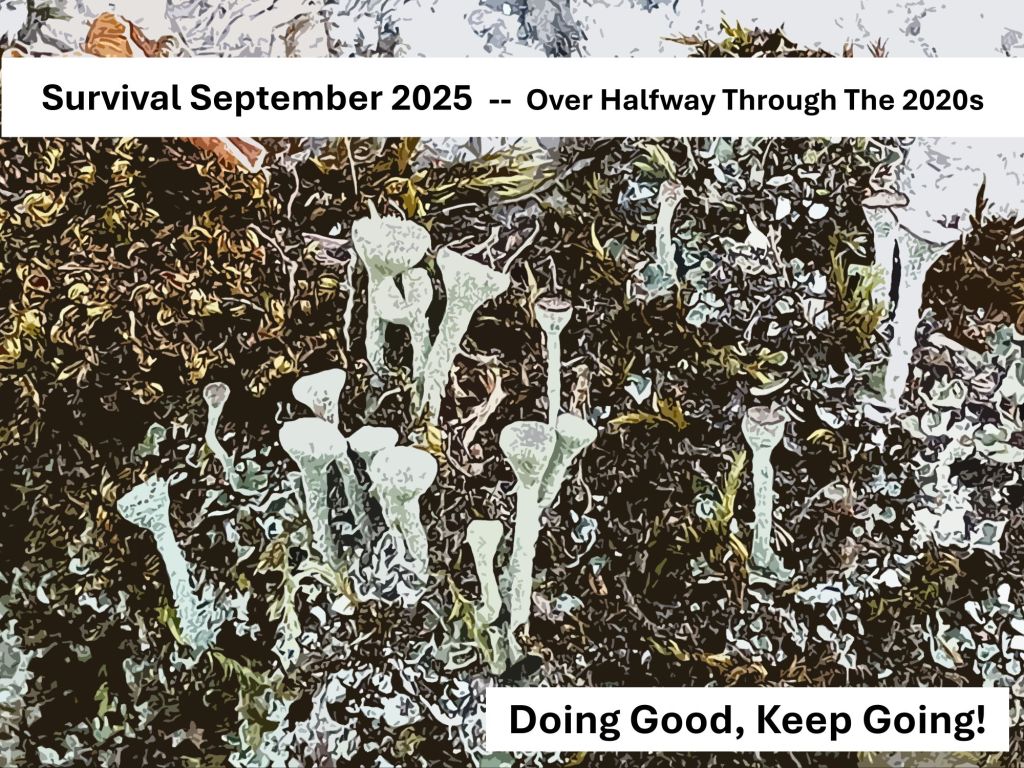
I am selling print on demand duffel bags within USA, on sale for September 2025. This above version with Cladonia cup lichen pattern and “Survival September 2025”-motto is available in PlanktonPunkt Designs Printify and Etsy shop spaces (clicking the mock up image takes to Printify store.) I also have notebooks and accessory pouches available for US customers. Apologies to the rest of the world, but being a solo operator still learning the basics, the international regulations are overwhelming, so unfortunately, USA only for now.
A short, promotional YouTube video that doubles as a commercial.
If you are bored with the selection available in local shops but do not want to pay for specialty sodas, you can always mix juice concentrate into carbonated water. Additionally, this does not require any complicated equipment so it will work in economic crises (such as we are currently living) and more advanced SHTF circumstances.
This is an ad video to my Etsy listing for Spring Blooms, Autumn Colors Ceramic Mug, also available in my Printify store. (In both shops for US only, sorry. The regulatory complexity for international trade is too much for me to handle.)
The online gurus claim that a product sells more if there is a video attached.
Here I used a POD camping cup I had ordered for myself to show how to pack granola in it for travel and loaded the video into YouTube.
Why granola instead of mug of tea? I am currently trying to sell on theme Survival September 2025, and product lines on travel and meals on-the-go aspect of it (mugs, bento boxes, luggage, mobile phone stands, anything else that could be added to the design lines…) Packing an enamel camping cup with food for travel fits the theme, I hope. Though presented as a travel tip, this would be useful for planning a short term bugout bag, or for (emergency) travel under conditions when restaurants might not be open.
I made a critical mistake by publishing it on YouTube immediately after upload – this will bury the video with few views. Or so I am told. I have not published enough in YouTube to discover if this is true or if I am organically uninteresting.
I also loaded a lower resolution version of it into Etsy with the mug in the video. Maybe it will attract a buyer.
In any case, I am learning video editing, maybe the skill will be useful in the future.
P.S. This design is for sale in Printify, Etsy and eBay.
I have decided to start a Survival September 2025 campaign in my on-line POD stores (though probably not in CreateJigsawPuzzles.)
My first design theme was the hardy little Cladonia cup lichen, because I think they are photogenically cute and because they survive the Finnish winter despite being small and cute.
Shameless commercial exploitation of cup lichen and National Preparedness Day.
When it comes to POD business, I have had to adapt and learn fast during the past few weeks and months, but I now think that the focus of my non-jigsaw puzzle stores will be the urban, educated and international professional who nevertheless is alarmed at the direction the world is going, economic, cultural and ecological axes. Someone like me. How many we are and does anyone find my stores (links in the top of this site), is anyone’s guess.
This person, usually traveling a lot within and between continents for work and fun and therefore keeps only minimal apartment, but nevertheless wants to be prepared on the emergencies specific for their circumstances, probably needs lightweight but stylish travel and tech accessories and home decor that does not take too much space. Colorful and / or complex nature or garden based designs balance the dullness of the concrete jungle on-the-go and brighten the home base during a break from hectic life.
With such lifestyle, preparedness does not mean homesteading in a remote bunker hoarding spam and ammo. It means being flexible and able to travel at a moment’s notice, though the home apartment may have micropreps like cash, backup power pack, good first aid kit, and food and drink for a couple of weeks in case of a natural or governmental disaster.
As for my theme, this year has been tough, but I hope to keep going next month, too. Then I learned that September is the National Preparedness Month in USA. Additionally, this September 2025 we have survived over halfway through the 2020s, despite all the calamities that are still befalling around the world, and that is an accomplishment.
There are many governmental and non-governmental websites promoting this (some examples linked in this paragraph and more can be found by searching the Internet using National Preparedness Month as a search term. Disclaimer: None of the agencies or organizations linked here are sponsoring or endorsing me, nor am I their official partner, representative or otherwise connected with them – I just thought people might be interested in the National Preparedness Month.)
Having checked the National Preparedness Month content online, I felt frivolous about my crass Survival September 2025 commercial promotion, but then I remembered that people are commercializing also Christmas and Halloween which to me are actual holy days, and decided to keep on it. I may get booed or even reviled, but even if people buy nothing but get inspired to increase their preparedness, that is important.(By the way, I think most important part of preparedness is the attitude, closely followed by skills – gear can be helpful but without the first two, it will only be a talisman, an emotional support blanket.) As part of my Survival September 2025, I try to post every now and then about prepping for urban international professional (though I think most of us already know the relevant tricks, or at least most of them.)
Meanwhile, to all the people who have survived so far, you are Doing Good, Keep Going! Hopefully to the end of the 2020s and long after that!.
If you have any ideas or opinions on this, or any other content in my shop(s), please comment – feedback from public is always important help for a hermit like me to understand how people actually think.
Put the macaronis, water and bouillon cubes into water, and bring it to boil.
Keep them boiling for a lower heat while opening the corned beef can and carving its contents with the macaronis.
Keep on slow boil for about 10 minutes.
If you want, you can add cheese slices or beef bacon or other stuff, but the above four ingredients should be sufficient for multiple meals for an adult.
Cheese should be added last to melt on the top of the macaroni-corned beef soup (adds a little to the cooking time), whereas bacon should be boiled with the corned beef and macaroni.
Enjoy.
Nutritional content:
calories: plenty
fats: a lot
proteins: yes
carbohydrates: yes
vitamins: unlikely – I’d recommend also eating fruits, vegetables and fish (unprocessed – french fries and ketchup do not count.)
Now for the paranoid version:
An important part of survivalism is to be able to live off your preparations. The rule of the thumb is to store those foodstuffs you will actually want to eat. There is nothing more embarrassing than suffering from gastric upset and awful tasting food because you prepared unwisely. (For the many people who have stored cans of Spam, this recipe should also work with that, though I think corned beef tastes better.)
Take 12 ounces of cheap elbow macaroni (European, to avoid GMOs and more dangerous pesticides, while hoping the grain was not smuggled from Ukraine near Chernobyl or grown on industrial wasteland). Rinse the macaroni with water in case their manufacturer had insects, rat droppings or other such impurities.
Take 3 x 12 ounces of pure drinking water without chloramines – chloramines kill aquarium fish but officially are harmless to humans at the concentrations used (do you trust the government???). Chloramines are nowadays used because the municipal water companies want more durable disinfection chemical than the traditional chlorine. (Bonus points for rinsing your macaroni with clean water, though I think the modern foodstuff is so full of impurities that I use chloraminated tap water because I am cheap.)
Put the pure water and rinsed macaronis in a pot, turn the stove on while peeling 3 Herb ox bouillon cubes into the slowly warming water. You did remember to buy more Herb ox to replenish your Doomsday Cache, right?
While the water is beginning to boil, open a 10 ounce can of corned beef bought on sale from an Asian supermarket (Brazilian, made in China – wonder about the Amazon rain forest, cattle hormones and Chinese food hygiene standards, then decide to ignore the paranoia because the can was cheap) and carve the contents into the boiling liquid.
Also add the beef bacon you bought yesterday and needs to be eaten before it goes bad.
Turn the heat down to let the macaroni soup boil at low temperature while watching a dozen minute conspiracy video.
Turn the stove off, add some cheese slices into the pot and in your bowl on hot macaroni soup. Let them melt while watching another conspiracy video.
Enjoy, while checking conspiracy news updates.
Nutritional content:
calories: plenty
fats: a lot
proteins: yes
carbohydrates: yes
vitamins: unlikely – I’d recommend also eating fruits, vegetables and fish (assuming those are available after the economic collapse or natural disaster – at the very least, if this is your survival food for the unforeseen future, top it up with a selection of vitamins, omega-3 fatty acids and other supplements from your Doomsday Cache. Surely yours has them?)
Privacy & Cookies: This site uses cookies. By continuing to use this website, you agree to their use. To find out more, including how to control cookies, see here: Cookie Policy.