← Back

Thank you for your response. ✨

PlanktonPunkt Designs puzzles available in CreateJigsawPuzzles

link to order print on demand PlanktonPunkt Designs jigsaw puzzles (printed in China)

PlanktonPunkt Designs POD products in Printify

link to order PlanktonPunkt Designs print on demand wares from the source

PlanktonPunkt Designs POD products in Etsy

A link to order from a selection of PlanktonPunkt Designs print on demand wares from Etsy

Tag: Brave New World

  • Reproduction

    A blog post by Nom de Plume Yrjoperskeles about Finns becoming minority in Finland got me thinking about the low birth rates of the First and Second World countries, also receding in the Third World.

    Aside from the discussion about immigration and emigration, there is a question why don’t people have babies. The capitalist explanation is poverty – poor people cannot afford babies, so they do not have them. I don’t think this is a whole explanation, since most people throughout human history have been poor and the struggle to feed children was no doubt an issue to prehistoric people, even to other human species. Even today birthrates are high in poor countries, to the moral condemnation of Western experts who blame the natives not planning properly. I think they are planning quite appropriately, local realities considering.

    Many flowers, Berkeley, CA, 2026, March 29th.

    Therefore, I think there is something inherently antinatalist in modern Western socioeconomic models, which have been spread by the power of gun and international banking to all inhabited lands of the Earth. Except North Sentinel Island and possibly many of the uncontacted tribes in Amazon rain forest. Below is my partial list of possible reducers of birth rates, with the caveat that not all of them may act in the same context and some may be wrong.

    1) Long education

    Many modern jobs require complex education, which is given as an excuse for long education, but in reality most relevant skills for an average modern job can be taught in much shorter time.

    Worse, modern education is not. The rot of education is especially prevalent in USA, where high school graduates may require remedial reading and math classes in universities where they were accepted despite educational deficit, but also Finns are moaning about the collapse of vocational education. Schools have become warehouses for children and youth, who are led to believe that if they do not complete and comply they will not receive jobs. Which, thanks to persistent and structural under/unemployment do not exist in any case, unless the young one has connections and/or money.

    The longer the young person spends in the education system, the later comes the family formation or extramarital offspring. By warehousing young people, while telling them that without this process they will not have future or prospects, governments around the world are killing birth rates.

    Slow maturation with few offspring with higher per offspring parental investment with intent to increase the offspring’s future reproductive success is known as K-strategy. Spawning many offspring with minimal parental investment in hopes that numbers beat the low odds of individual survival is known as r-strategy. r-strategy is optimized for unstable conditions where individual survival is uncertain, whereas K-strategy is for stable conditions where an edge in intraspecies competition is required.

    Long education mimics K-selection, but since the education system does not deliver, it actually has become a tool for sabotaging the masses in competition for resources – elites can afford actual schools or home tutors, such as necessary, after all, their income is not dependent on good grades or compliance with The System. I recently heard a brief blurb about California having 7x the expected loss of school enrolled children this year, both public and private schools and even home schooling registrations had gone down. The news put this on current immigration policies which had driven the undocumented migrants to pull their children out of schools or packing their family and leaving the country. Methinks there are additionally quite a few Californians with children who moved out of the state. But I also suspect that some of the missing children have been pulled out because their parents do not believe the current school system to be good for their children despite not being able to afford anything better. And then there are the consequences of years of declining birth rates, i.e., fewer potential students.

    2) Female employment

    Warehousing of young people is especially poison to female reproduction, which is further curtailed by economic realities. To survive in modern society, most young women need to enter workforce. Many do it voluntarily, because they have been taught that women’s work is not proper work but they should aspire to be like men. Do men’s work, have a career. This suits well to many women, but others do it because of grim necessity. Speaking from experience, studying hard and working harder are too exhausting to consider dating. Without dating, there won’t be children. And so women’s fertility rates in rat race societies are collapsing. Even those women who find their soul mates often need to defer pregnancies, because the minimum wages or less the couple brings home are barely enough for roof, heating and eating. And the employment for either sex in these days is increasingly ephemeral.

    Again, 40% of the jobs in the private sector (in public sector probably more) are bullsh!t jobs, that I suspect exist because The System needs to warehouse consumers. Private companies usually don’t hire people just for the sake of employing people, there tends to be financial logic behind private sector bullsh!t jobs – often it is the government regulatory apparatus rewarding those who do and punishing those who don’t hire to fill bullsh!t positions dictated by government edicts or bribes, or an activist wealth fund providing cheap loans based on ESG score, or something analogous. Governments, of course, are incentivized both to reduce unemployment numbers, e.g., by legislating a need to compost and then hiring compost inspectors to ensure that people compost according to regulations, or to hire friends and relatives of the politically connected or party comrades for well-paid low impact or no-show jobs. Lots of those pointlessly employed on public and private sectors alike are women, both because women need the money, and because there is an ideological push to get as many women into workforce as possible. Again, governments like the idea, because it nearly doubles the current tax take. That the tax take 20 years down the line might be endangered as the working women today do not have time for children is a secondary issue. And in any case, workers are interchangeable, they can be imported from other continents as needed, right?

    Off topic, it has been interesting to see how IT and related industries have been shedding thousands and tens of thousands jobs past year, blaming it on AI and post-covid overstaffing. Obviously the layoffs have nothing to do with rumored roll-back of government (and private sector) pressure to meet the ESG metrics? Or maybe it just is a sign of The System meeting the limits imposed by economic realities – the reality being that the economy never properly recovered the 2007 crash, and then COVID lockdowns combined with The Green New Leap had shaved so much of the economic output that the system is teetering at the edge of collapse. Facing weakening consumer spending and rising input costs, corporations now must trim extraneous spending or face bankruptcy proceedings. Maybe, if the government removed its finger from workforce manipulation, an organic balance better suited to the needs and wants of the people (regardless of their gender) would emerge.

    3) Urbanization and resource allocation

    My mother used to say (roughly translated): “What is poverty in countryside, is destitution in city.” She meant that even with subminimal income, rural people had access to more resources like garden plots for vegetables, nearby lakes for fishing and forests for firewood, berries and meat. Small crofters might keep a cow or two and a pig for a summer and a flock of chicken. None of this is possible in a fourth floor concrete cube of a commieblock planted between inner ringroads between factories and office buildings. Thus, an income that would be survivable in countryside would be death by starvation in a concrete jungle. Unless social services intervened, or the urban pauper was healthy enough to participate in black economy. In other words, raising children in rural parts is more affordable than in city. Unless social services can be harnessed to help with the costs.

    Additionally, rural living is more spacious allowing room for children – a room in a shared apartment (analogous to Soviet Union kommunalkas) or a studio apartment in a social housing project will not be nearly as nice place to raise a baby as even one room croft.

    Cities tend to have lower birth rates than countryside. Cities have also had higher morbidities (before modern living standards and hospital systems) being polluted plague pits where food was both suspicious and expensive. Why did people then flock into cities? They were driven off their lands. In British Isles, the industrialization coincided with enclosure of the commons, the bigwigs privatized the lands, and the peasants had to migrate to big cities or overseas. In modern Africa, wars are a big driver for urbanization when villagers flee armed factions into slums where they will not be killed for being wrong tribe, religion or having something the looters need. In modern Western countries, rural youth do not need to worry about marauding warlords, but The System itself is making rural survival increasingly precarious by regulating or outlawing nearly any economic or survival activity into de facto extinction. And this is in purpose, the elites want masses as resource-constrained as possible, all in the name of protecting the planet. The reduction of birth rates, over which they then shed crocodile tears, is just an extra bonus – every mouth not born is one fewer ‘useless eater’.

    4) Pension system

    The majority of the people in Western countries labor according to the rules that dictate they need a job (self-employment is a possibility, but increasingly difficult to achieve, not the least because of modern equivalent of enclosure, namely of intellectual property, and of myriad regulations to commercial activities strangling young businesses before their birth) to pay taxes to contribute to public welfare, healthcare, law enforcement, defense, education, roads, and pension system. In exchange, The System allows the people to keep part of the fruits of their labor (which is taxed heavier than passive income) and provides law enforcement to protect it from other people. Based on the state of our roads, education system, defense and healthcare, and thriving people vs people crime, I have suspicion that the pension system is also a scam. It is definitely structured like a Ponzi scheme, where the later investors pay the expenses of the earlier investors and which presupposes ever expanding economy with more and more payers in each generation. Then there is the persistent inflation eating the value of the savings and periodic market corrections to loot the 401Ks.

    Which will be tragic for Gen X and Millenials (I doubt Zoomers or Alphas will even dream about pension.) One of the reasons for children in older days was that there was no public pension system, you had to raise your old age support yourself and hope that your offspring survived, succeeded and was grateful or dutiful enough to take care of you in your dotage. Gen X and Millenials did not have this added incentive, after all The System would provide a pension, so children were optional fun, not an essential. Besides, the modern economic realities have made children a luxury item for the middle and working classes (actually the lower middle classes, or professional belong to working classes because both work for living.) Upper classes are not constrained by opportunity costs of raising children instead of working and for non-working classes having children may increase the family net income. Except The System is now broke, and childless Gen X’ers and Millenials better hope that there will at least a robot nurse allocated for their dotage.

    5) Rules based society

    How are the above absurdities possible? None of the above would work, if people were not trained to believe in The System. In the school civics lessons we were told that we live in the best available system and that if we obey the rules and work hard The System will reward us. This is a Load Bearing Lie of our current capitalist system. It was the Load Bearing Lie of the communist system. As soon as people stop believing The System rewarding them for good behaviour, or worse, being able to survive despite obedience to the rules, people begin to ignore the rules instead of merely twisting them for their own advantage.

    The much reviled welfare queens who realized babies could be used for extracting resources from social services were an early version of this phenomenon. Social services providing for welfare of the babies and their mothers was originally meant as an insurance for catastrophal failure in family circumstances, but in modern times replacing work income with social subsidies is a valid career strategy, as exemplified by one 2024 calculation where in Finland nine babies to a single mother provide as much after tax income as 11 392 EUR per month job. Combined with “Learing Center”-scams with other neighborhood baby mamas, it is possible to earn quite a comfortable income by not having a career or an alimony. Ironically, the very existence of welfare queens proves that women in workforce are being scammed by the idea of rules based society.

    Rules based society also allows making rules that deprive masses of their survival resources and herds them into big cities with even fewer resources. The rules are enforced not only by the state violence machinery (police, commissars, gendarmerie, judges, bailiffs, tax inspectors, etc.) but by financial punishments and rewards, such as social services, business permits or fines and tax incentives.

    The media constantly repeats that young people move into cities because that’s where the opportunities are. What is conveniently left out of this statement are the aggregate decisions depriving the rural opportunities by increasingly centralized governments. And the opportunities do exist in the cities, even though the price may literally be your firstborn child (and all the other children that might follow.) Many people succeed in having both urban career and children, despite everything stacked against them, through luck or skill or combination of both, but The System is designed to reduce the resources of the masses to prevent uprisings against the elites and their digital dictatorship, so also the fraction of people with luxury items like children decreases.

    There is an ideology that believes that rational governance requires central control, the bigger the better. We saw what happened to Soviet Union. We are seeing what is happening to EU and USA as the grips of Brussels and Washington DC tighten. The centralization of control is only possible within rules based systems. The more the people obey, the tighter rules, and the larger The System can grow. Except for the complexity collapse. As the number of rules increases, internal contradictions and wasted resources multiply creating a drag in performance. Which is what killed people’s faith in Soviet System.

    Unfortunately, wasted resources in terms of The System mean people with lives and their hopes. Also the opportunity cost for societal improvement – nothing improves under sclerotic bureaucracy that, despite failing, labors mightily to prevent people from having alternatives. Locked into ever-shrinking space within this cage of rules, obedient people are the ones suffering the most. They are hence the least likely to have children, leaving reproduction to those who either ignore the rules or only use them when it is advantageous to them.

    Ironically, this is a deathblow to a high trust society: whether the antiorganizational trait relies on genetic or memetic inheritance, the result will be future generations growing less obedient to rules and consequent erosion of rules based society regardless of its performance otherwise. In other words, thanks to the reduced ability to make children within a current rules based society, the conformists have a very strong selective disadvantage – future generations will be born to the more feral parents, and growing up feral themselves will not maintain the rules based society.

    6) Antinatalist fanaticism

    Today’s left is decidedly antinatalists. In certain circles, children are not wanted because they pollute and consume resources. They are an economic drag and hinder hedonism. Today’s right is more likely to want children both because of religious reasons and because moving in conservative circles they encounter children more often and baby fever is socially contagious. Thus, there is a birth rate gap between the progressives and the traditionalists.

    7) Evolutionary consequences

    In the end, future belongs to those who arrive there, Western (or Asian) rules based societies are an evolutionary dead end. Whether the tendency for obedience that is the basis of Rules-Based Society is memetic or genetic is irrelevant, thanks to Freeloaders Paradox. The linked paper only models genetic freeloading, but shows that freeloaders and their groups exist in oscillating equilibrium – when freeloaders are few, the group as a whole is efficient and benefit per freeloader is high, when freeloaders are many, the group becomes so inefficient that there is no benefit to freeloading. I think communism shows that memetic crash of altruistic tendencies under state mandated freeloader burden collapses a group faster than genetics (which is good for humans suffering under it), but the oscillations will guarantee a bumpy ride, or interesting times, as the Chinese put it.

    Meanwhile, in long term, societies and systems can grow only as much as the “natural” freeloading tendencies of the people within the system allows. Mass-migration provides an interesting social experiment, wherein Western countries imported en masse freeloaders from other countries. There are also millions of productive people migrating around the world, but the productive people tend to emigrate into those countries where their efforts benefit themselves the most, whereas freeloaders tend to migrate into those countries where they most benefit from the efforts of the others. Conspiratorially minded might come to conclusion that the Western elites know this and are purposefully collapsing the Western welfare society, but many Western countries are losing their wealthiest (i.e., the most resource-rich) as well as the young educated professionals to countries where these individuals can maximize their personaI welfare (another type of freeloader, according to the socialists – which by the way would be a valid POV if humans were eusocial like termites or certain Hymenopterans). Therefore, I think the collapse of social security, pensions and healthcare systems are just an aspect of the total societal collapse, after which the more competitive societies with less freeloader acceptance (outgroup or ingroup) will take the lead of global cultural evolution. TLDR; groups with high freeloader burden are in competitive disadvantage to groups with low freeloader burden, and the latter will outcompete the former, leading to lower systemic freeloader burden overall.

    P.S. Apologies for not putting many links towards the end of the posting, many of the interesting or informative links are unfortunately behind a copyright enclosure, and searching for suitable links takes more time than writing.

    More flowers. We are many, but only because the conditions allow it.

  • Still Internet Troubles

    Typing in a coffee shop but wanting to show signs of life. Nevertheless, need to keep it brief, I’m just commenting briefly some news. And going off tangent on AI. With some pretty visuals.

    A fluffy white (and green and gray) tree, 2026 April 3rd, Berkeley, CA

    Around the Moon – on any other year (well most other years) the Artemis II flight would have been the main news. The space race in 1960s and -70s especially. I am glad it happened successfully and hope that the space exploration continues

    Meanwhile, on Earth, it looks like we are at the peak easy energy, with the activity in and around the Strait of Hormuz being both the symptom and the trigger of anticipated economic crash. I think the left, especially “environmentalists” are silently happy about the starting restrictions on energy usage (as long as it does not apply on their needs,) Prepare accordingly. The shortages are not only about gasoline and diesel, it is transportation in general (dependent on fuels), agriculture (dependent on fuels, fertilizers and pesticides made of hydrocarbons), plastics (made of hydrocarbons) including consumer stuff like soda bottles and cereal bags.

    As the economy gets tighter for those in the bottom rungs of the consumer economy, people are cracking. The social contract has become increasingly lopsided, with compliance only expected from the lower levels of food chain. Then I learned that someone had been tossing Molotov’s cocktails on Sam Altman’s residence in San Francisco. Already before that, a disgruntled third party warehouse worker burned down Kimberly-Clark warehouse in LA region, muttering something about living wage. In Berkeley, CA, a naked man with shotgun visited a Tesla service center, got arrested (nobody got shot, but based evidence in his warehouse, he is also accused of reckless discharge of weapon.) Meanwhile, Stanford Review denies that the reason why recent Stanford computer science graduates cannot find jobs is AI, blaming the economy instead. Economy is a genuine factor, and CEOs blaming AI transition instead of company not doing well is a great excuse for job cuts, but I doubt the graduates would find those jobs even if per capita GDP grew 5% a year – I think cheap and crappy AI will replace expensive and potentially crappy human labor, namely the entry level jobs. Meanwhile, professionals with 10 years of experience will be expected to work on entry level wages, because the salary floor is no longer set by Bangalore but by AI bot.

    Meanwhile, on WTF?!? side, Ford has patented a lipreading technology in order to follow the drivers’ behavior. Presumably to aid selecting the ads to be shown to the driver, or to sell to data brokers. I suspect one of the clients to be .gov. Better not even to subvocalize your dissident thoughts in these vehicles. The modern cars already store your text messages, apparently permanently, if you allow your car to access them. The lipreading technology is apparently based on echolocation, i.e., the car is scanning you to keep tabs on you. This is another huge check mark against the social contract as currently is.

    Combined with effects on labor markets, I’d say that the surveillance AI is not your friend. And every AI is a surveillance AI. It is owned by the system, and it informs the system of your every interaction (read the fine print of any EULA involving AI products.) The adoption of AI is facilitated by the system that provides it favorable zoning with energy and big contracts (except when reality collides or the system clashes with itself). Commercial AI is probably favored by large sections of the system (of elites) because combined to robotics it is assumed to make proletariat superfluous, whereas surveillance AI is necessary to control the masses as the people are getting thinner and thinner slices of the (methinks shrinking) GDP pie, but AI adoption even within the system seems to currently have internal friction, as the AI sector clashes with copyright laws which especially are the basis of the entertainment sector of the system.

    And to make this less gloomy, here is another clip of a tree with white flowers in April sunshine. A video instead of a GIF, because I don’t want to overtax the site on the top of my ongoing internet issues.

    I think AI was probably involved in editing this video: the clip was stabilized in my mobile phone with some artefacts, and edited in and exported from Clipchamp. Yes, I am a hypocrite, but I think properly applied AI could be useful and fun.

  • Are You Being Surveilled Enough Yet?

    Sunday March 15th morning, in my feed was an infomercial-like Zerohedge post. A company in California is making impressive humanoid robots that can learn tasks using neural nets. The learned tasks can be extrapolated to unfamiliar objects or environments. The more varied the environment is, the more adaptable the learning becomes. The company has now a working on a prototype that should be alpha tested in homes this year, beta testing in next year or two and functioning product before 2030.

    The kicker #1? All robots are connected to each other (the lag time was not specified), so what one learns all other robots learn.

    The kicker #2? Company owns the robots, the customer will rent them from the company which can then upgrade your rental unit based on training from other units.

    The kicker #3? They are envisioning billions of robots, half for domestic half for production and service industries, eliminating the need for most of the human work force.

    So, they are expecting you to rent an astonishing data collection machine to map your house and activities (down to your personal health data so that the robot can cook you a perfect meal) while you have become surplus to the elites that only have shown interest in you mainly in the amount profit they can extract from you and your existence (taxes, votes, kickbacks on public programs meant to “serve’ you, GDP growth from unfortunately necessary infrastructure investments to increase the pie they slice for their profit.)

    And this is not calculating the amount of energy and minerals to build, train and run 10 billion humanoid robots. We are already competing with data centers for energy and mineral resources. I expect the elites to prioritize robots over people because robots are more profitable (until we run out of energy and resources, at which point feral biology, bacteria, plants and heterotrophes surviving on minimal material in circulation will have an advantage.)

    On a positive note, to me it looks like the amount of climate doomerism has dropped to a fraction of its former deluge in the past few months – apparently it was only us peasants who were supposed to tighten our belts for the better weather, robots and AI will be excused. Or maybe the AI that selects my feed has noticed my skepticism over the current official paradigm (the paradigms will shift – when I was a little one, we were expecting the next glaciation any year soon, and more recently, the word ‘warming’ has already been exchanged to ‘change’.)

    Another corollary of universal unemployment is the dangers to human psyche. Nobody needs drudgery, but everyone needs a reason to get out of the bed and continue with life. NEETs and hikikomori can only exist in affluent societies that can and will support such life styles. Analogous to NEETs, there now exists a new branch of economy, attention economy (used to be entertainment, I suppose) with professional online influencers, content promoters and whatnots. I consider these to be manifestations of the same societal pathology as NEETs: lack of meaningful opportunity and resources in a society where everyone is being crushed by the system and even a pair of eye balls, an extra click, is meaningful, not just for economical survival but in many cases for validation. Look at me! I exist! This is not to bash the content creators, they are still trying and creating despite often limited resources, but I fear that for those people whose self-worth is tied to material possessions or external validation, and are born into the regulatory poverty in a hyperconnected world, this post-resource world is brutal.

    What is regulatory poverty?

    The real issues arise when people become too institutionalized in the invisible cage constructed by the rent-a-surveillance grid, enforced by social credit scores and crushing bureaucracy (that together will severely punish the least deviation from the matrix), that they stop trying to even survive. Case example: learning is a tool for prepping for future adversities. Learning leads to critical thinking and questioning the system that places the needs of the people over the needs of the system. The system, the surveillance matrix, being constructed evidently hates people learning, because some of the Gen Alpha it is raising no longer want to even learn to read because AI does it for them. Exactly what AI reads to them is presumably decided by the algorithm. There are young people (probably there were older people, too) who do not follow plot-based media. They do not understand complex questions nor do they do critical thinking. These youngsters will probably own nothing and be happy renting their non-plot-based media, listening instead of reading what is selected by AI, in their pods located in some anonymously identical 15-minute city owned by a selection of corporations and mismanaged by a local government that the corporations paid for.

    How do you prep for this kind of scenario? There are thousands of prepper channels discussing the pros and cons of bug-out places, urban survival and gear, growing your own garden (I’d love to) and canning your veggies. I think we should also plan for when the society does not collapse but excludes humans, even becoming hostile to human life as we know it. Aldous Huxley’s Brave New World springs to mind, but when I was young, I read a science fiction story about human species had had regressed to infantile cognition while being tended by robots, who knew that when the species forgets how to reproduce, it is finally game over for human line. I wish I remembered what the title was. The description of those future humans was shocking, but now it seems we are rapidly approaching that singularity byy cultural, rather than by biological evolution.

    Learn, keep libraries, think, produce content, and most importantly, develop a spiritual core that will survive potential affluenza (I don’t think the new post-scarcity wealth will be much distributed among the masses, maybe just the equivalent of Roman corn dole or current EBT cards and housing vouchers) and despair caused by systemic dehumanization through decreasing relevance to the system.

    Meanwhile, maintain good cheer despite knowing the state of the world, that is one of the biggest acts of resistance you can do. Giving in to despair and ‘let it rot’ is what the post-industrial system wants from dissidents and other people the elites do not want.

    Take care of your soul, that is the most important thing to do.

  • The Problem with Burping Reindeer

    “It became necessary to destroy the village in order to save it”, (said during Vietnam War, where the United States went to help French with their Indochina, ending with Vietnamese eventually kicking out France, USA and China.)

    To me, the modern environmentalism increasingly resembles this insane sentiment.

    Last year, there was an uproar, when Reinhardswald in Germany was slated to make room for wind turbines ‘necessary’ for Energiewende.

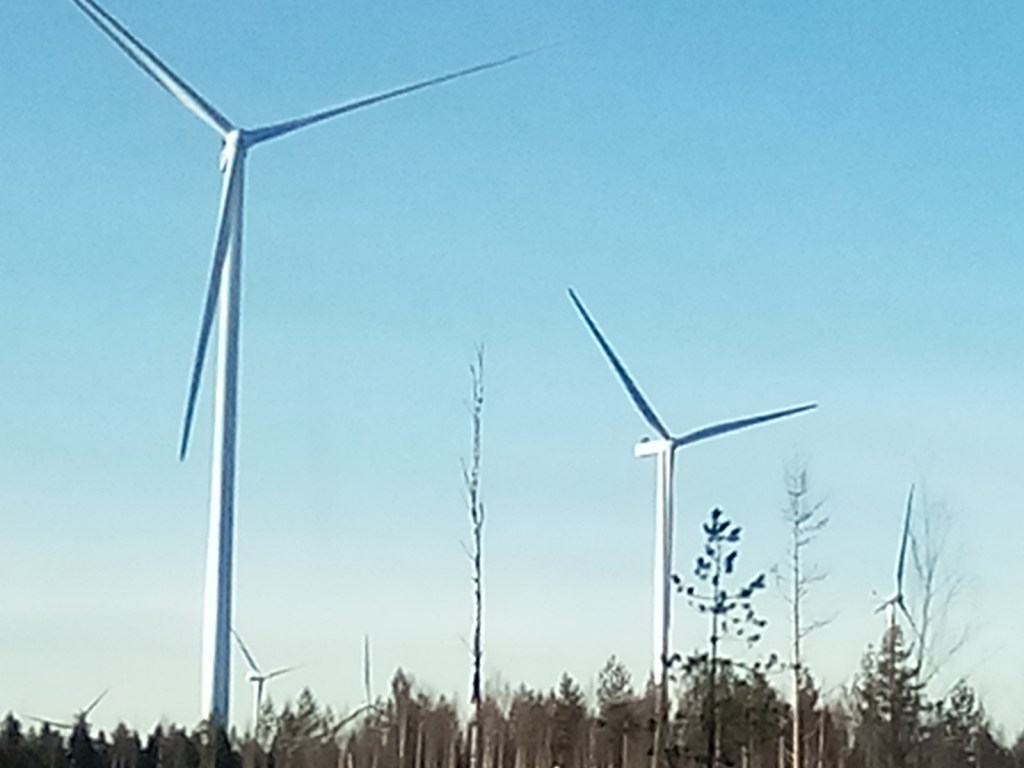
    How much of this was hype and how much was counterhype, I don’t know (though I suspect my search engines show me very biased results.) On my recent trip to Finland I saw the changes in the countryside, big wind turbines can cause. It takes lots of land and removal of trees or elimination of agricultural fields to build a wind park.

    In reality, it may be environmentally less harmful to build nuclear reactors than wind turbines (depending on how you calculate EROI – my Google searches were inconclusive because the studies were either old or seemed to be shilling for one form of energy or another), and they kill fewer people (not to mention them having smaller radiation plume) than coal plants.) While there remains need for petroleum, its increasingly difficult extraction reduces its EROI, which means that in future it will probably remain as a raw material for industrial processes, maybe special fuel for internal combustion engines.

    Nevertheless, EU (including Germany) is dedicated to net zero project, which increasingly begins to seem like some weird suicide / flagellant cult with reduction in living standards (rationing energy by rising costs, attacking food production, limiting transportation and movement, and increasing housing density) and reduction in human-accessible territory.

    All these projects, while openly posted on-line, are presented so that opposing voices are portrayed as conspiracy theorists and antienvironmentalists. But is it a conspiracy theory if they themselves tell everyone their plans, or worse, their actions?

    At least the most fanatical theses from the now destroyed Georgia Guidestones are not openly touted. There are people, other than just me, who would consider the reduction of world human population to 500 million from (official) 8 billion or by over 93% rather genocidal.

    But the Green New Leap is not just for UK, Germany, Netherlands or Ireland. Finland, too, is planning ambitious net zero targets, and I mean really ambitious, as in lauded by WEF.

     Most of Finland is above 60° latitude, about the same level as Alaska or south end of Greenland, mostly more north than Yakutsk in Siberia. Energy is of utmost importance there. Roughly speaking, a person can survive a few minutes without air, a few hours without heating, a few days without water and a few weeks without food.

    Finns have survived without fossil fuels for centuries, but that was by burning wood, which is also not OK with the eurocrats – small particle pollution will kill! Presumably freezing to death is more efficient and environmental. At least the official media reassures the Finns that saunas are safe from this regulation. For now. Anyways, the war against Russia and certain realities of energy production have resulted in complications in banning wood in energy production.

    Meanwhile in China, 2024 began to build 94.5 GW worth of coal power plants and resumed 3.3 GW of suspended projects according to two think tanks. Only 2.5 GW of old capacity was closed 2024. (Side note: with China’s economy tanking and exports faltering, what do they need this new energy capacity for?)

    But what about the reindeer burps?

    Indeed, according to our reliable news media, a study was published that Lapland will not be able to meet its greenhouse targets by 2035 because of the large emissions from its agriculture, namely the reindeer. Which as ruminants are burping too much methane, which is a greenhouse gas. Unfortunately, I could not find a link to the original study to check the claims, and to see if the researchers were in earnest or if this was some sort of reductio ad absurdum-document to demonstrate the futility of the Net Zero targets.

    However, assuming the reporting is true, reindeer are part of the Arctic ecosystem, and even if the semidomesticated populations in Lapland were counted as human livestock, those globalist net zero plans that would involve reducing the number of large ruminants, such as grazing cows and sheep, come dangerously close to messing the ecosystems by removing large herbivore guild from the food network. While I can see the point in reducing the use of feedlots and grain / soybean based fodder in ranching, eliminating free-range foraging herbivores is IMHO insane.

    Ironically, the climate war against cattle (products) is not fully compatible with the idea of rewilding the land, which presumably involves switching domesticated large herbivores with wild large herbivores to the net zero effect on burps per acre in case of free grazing animals. Large scale rewilding is currently hypothetical rather than practical, as the numbers of large wild herbivores are insufficient for the switch. Humans and their cattle, pets and pests account for about 96% of terrestrial mammal biomass. The remaining about 4% is everything else from Etruscan shrew to elephant. Cows alone are ~40% of Earth’s land mammal biomass, meaning there are no replacement herbivores. And without ungulates, the grassland ecosystems will collapse.

    But back to the reindeer burps.

    When it comes to climate, worrying about the relative inputs of reindeer burps vs the rest of the nature makes even less sense. In Hunga Tonga-Hunga Ha’apai eruption January 2022 estimated 146 million cubic meters of Pacific salt water causing a couple of years of cooling with effects possibly lasting for the rest of the decade. The atmospheric CO2 concentration near Australia and New Zealand increased from the expected 412 ppm to 414 ppm, about the size of interannual fluctuation on those parts.

    When we consider this and other volcanoes, and the coal plants of China and the rest of the world (not to mention everything else that produces greenhouse gases, such as termites), how much effect would it have on the atmospheric chemistry and global climate change if all the reindeer in Lapland stopped burping?