Go back

Your message has been sent

Warning

PlanktonPunkt Designs puzzles available in CreateJigsawPuzzles

link to order print on demand PlanktonPunkt Designs jigsaw puzzles (printed in China)

PlanktonPunkt Designs POD products in Printify

link to order PlanktonPunkt Designs print on demand wares from the source

PlanktonPunkt Designs POD products in Etsy

A link to order from a selection of PlanktonPunkt Designs print on demand wares from Etsy

Tag: Corruption

  • Death Spiral

    How do you kill a city?

    So many people complain about the homeless problem (which is very visible in many California cities), but these people and their plight are a symptom of a deeper malaise.

    It is claimed that people are homeless because they cannot afford an apartment. Actually, many of the homeless are homeless, because they get kicked out of any normal apartment due to mental illness, drug habit or just for being nasty neighbors and tenants. Poverty is a common companion of mental illnesses, drug habit and antisocial behavior. Supportive housing rarely works, the restrictions to their lifestyle are considered intolerable and most of the hardcore homeless prefer their freedoms. Which in California are accommodated. Not saying that freedoms are intrinsically wrong, I just would weigh them against infringement of other people’s rights for safe enjoyment of parks and other public places.

    In any case, California has some freedoms not available in other states, such as freedom to use cannabis products and the de facto freedom to shoplift wherever and, in many cities, to camp on sidewalks. This has led to an exploitable situation as the fuming taxpayers are told that the reason the sidewalks are choked by drugged out homeless that support their habit by shoplifting because there is not enough affordable housing. Let’s collect a new tax or municipal bond (funded by taxes) to build affordable housing to homeless.

    Homeless advocacy organizations mobilize for this initiative, after all someone must administer the funds to the indigents. Signature collectors are hired to ask good citizens (“are you a registered voter here?” to sign a petition for the tax / bond initiative. Politicians speak warmly for (or rarely against) the initiative. There may be an advertisement campaign, at which point a thinking voter should get alarmed – why would anyone pay for an advertisement campaign when hundreds of millions or even billions of dollars are proposed to be raised for ‘common good’?

    Nevertheless, many voters will back an initiative that sounds good without thinking about the long term effects. Once the initiative passes, property or sales taxes are raised, and now the small property owners and small retail businesses are in trouble. The property owners increase the rents making both apartments and small businesses renting their spaces less affordable, Poorer tenants fall behind and get evicted or move somewhere cheaper. The business owners may hang on a bit longer, raising their prices until the customers disappear, and they, too disappear. With loss of tenants, the properties will undergo distressed sales. Which was the purpose of the original initiative.

    A property developer (with sufficient contacts to the municipal bureaucracy and politics to smooth the permitting) will buy the distressed property cheaply and develop it into ‘affordable’ housing. Which somehow does not reduce the swarms of homeless camping on the sidewalks, possibly because they are still free to camp there and the homeless advocacy organizations are flush with funds to use on homeless services.

    Meanwhile, the older residents are losing their homes and the main streets are becoming ghost towns of shuttered and graffitied empty shopfronts. The city is hemorrhaging jobs and residents, with homeless numbers increasing, despite well-funded homelessness services and more affordable housing being built.

    The solution is obvious – let’s raise the taxes to deal with the homelessness and lack of affordable housing! Or maybe, stop using the homeless to exploit the tax payers to enrich the local moneyed interests.

  • Magic Money Computers

    Apparently, our government had at least 14 of them, 11 in Department of Treasury, Department of Health and Social Services, Department of State and Department of Defense had their own magic money computers too. A Magic Money Computer, according to Elon Musk is a machine that creates money out of nothing by just issuing payments.

    The original Magic Money Computer, Sampo, being stolen from Pohjola by Kalevala raiding party. Sampo of the legend was a magic mill that produced flour, salt and money. (art by Akseli Gallen-Kallela, image sourced from Artvee)

    There has been speculation that such Magic Money Computers would allow fraudulent or erroneous invoices (such as double billing) to be paid regardless of available government funds. However, the truth of the bottomless money pit is probably more about standard prosaic grift – based on the parade of DOGE news, the US Government seems to be full of weird offices where the Directors pay to themselves and their “workers” outrageous salaries and lavish other perks (luxury apartments, luxury offices) and then top it up by (relatively) small embezzlements like expensing their everyday (luxurious) life.

    These money sinks are supplemented by a class of government parasites, ‘NGOs’ (Non-Governmental Organizations, which actually are mostly or fully dependent on government money). ‘NGOs’ (not to be confused with true charities) siphon money from government coffers and can act as money laundromats by donating heftily to nice politicians and PACs and by hiring politicians or their family members with attractive perks and reimbursement packages.

    After hearing more and more about all the ‘NGO’ grift, I felt slightly like a chump for not having founded a ‘charity’ dedicated to “Physical and emotional well-being of an individual” (namely myself),  with the governing board and financial regulators consisting of Me, Myself and I and set up a reasonable monthly stipend of, say $7497.68 including taxes and fees, though for that, I would have needed much better political connections within the bureaucracy (not to mention far more flexible morals).

    Joking aside, Magic Money Computers are a problem because they are not synchronized, i.e., there was some variation between their bookkeeping, estimated to be about 5 – 10%, which can lead to unregulated increase in nation’s money supply. Which is presumably on top of the official increase by the approved deficit spending.

    Officially, the US government does not print money. What happens is that the government issues treasuries which the big banks (primary buyers) buy to sell forward, or to Fed, which buys treasuries from the public by injecting money into the accounts of the selling banks, i.e., creating more money. Banks, of course, use their new capital as a security for issuing new loans via fractional reserve banking, multiplying the money printing effect.

    With Magic Money Computers potentially adding to the money supply, we are essentially talking about unsupervised inflation. In theory, as long as the increase in production (of goods) increases with the money supply, the prices remain steady. If the production of goods increases relative to demand at a greater rate than money supply, resulting oversupply causes price deflation, but if the money supply increases faster than production while demand remains steady or increases, this results either in price inflation or, in case of price controls, product shortages.

    I suspect that the US economy has been running an experiment where it has artificially inflated money supply (by deficit spending) while increasing demand (by paying people to consume and by importing more people) in hopes that the production would increase due to increasing demand (look at all these new workers.) What was conveniently forgotten was the regulatory jungle stifling any private enterprise while the masses of new capital were scooped by the well-connected who used it to monopolize resources needed for private enterprises, either by buying the resources themselves, the legislation regulating how the resources can be used, or the bureaucrats who determine who can use the resources (and how), namely those who are insiders.

    I would further speculate that as an increasing fraction of government money goes to the politicians, bureaucrats and their family and proteges (and paying patrons like megacorporations and transnational NGOs), an increasing fraction of resources, public and private tends to get concentrated to the hands of politically connected oligarchy. Not only does the increased regulation and fewer resources mean fewer small businesses and anemic economy, with political class acting as oligarchy the national ‘free’ enterprise begins to converge towards a top-down command economy. Command economies are very fragile and prone to collapse for multiple reasons that would be a whole another post.

    Let me finish by saying that The United States has been for many years unofficially converging towards the Soviet Model, namely the centralized command economy, and while I have been observing faint signals since the previous decade, now the results are visible in our shops to everyone.

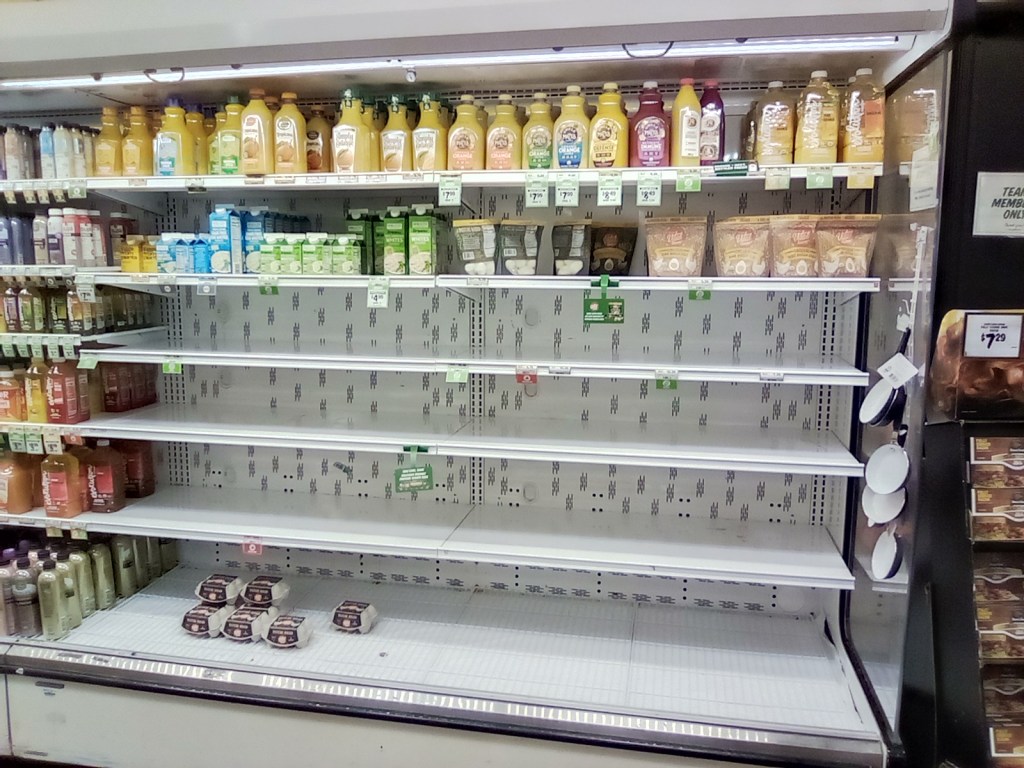
    Take for example, eggs. The number of laying hens has gone down due to cullings, whereas the number of mouths has increased due to immigration. Unlike the mythical Sampo that produced also edible goods, the US government has only increased the amount of money in circulation, leading to price inflation and egg shortages. Magic Money Computers are not helping.

    An old photo from January 2025. Tonight, I saw lots of eggs in a supermarket.