I just saw a video on YouTube by a gentleman who seems to be into Bitcoin. Aside from the Bitcoin part, there were interesting little news.
Bank of England has published a bail-in guide. The term of note is ‘resolution weekend’. That’s when the peoples’ bank accounts will be converted into bank stocks at some fraction of value.
I had already become aware that millionaires and billionaires are fleeing the UK by their thousands, an exodus greater than that afflicting PCR, despite PRC having vastly larger population. I was surprised at the claim that the departing assets are equal to 4% of UK GDP. Dividing the 91.8B$ cumulative wealth of the departees by 3640B$ estimated GB GDP gives only about 2.5% in mu calculator. It will be interesting to see if the UK government will go full DDR and slam the exit doors shut at this hemorrhage. They already have the hate crime reporting lines and speech crimes police (in case someone could post something UK government does not approve) so why not go for the full experience, complete with empty shops?
Meanwhile, EU has made a deal of the decade (this century is too young to claim that something even weirder would not be coming through the pipes) agreeing to: 15% export and 0% import tariffs with US, 750 billion euros worth of US fossil fuels while banning all the Russian fossil fuel imports (which had continued despite the war, including quite a lot of natural gas transiting in pipelines through Ukraine), and 600 billion euros of private direct investment to US.
Exactly what this private investment is and how EU Commission can agree to seems unclear. According to the document description page on EU side, the agreement is not legally binding. I suspect that the tariff and energy deals were a bribe to US to let EU still continue their war – I further suspect large amounts of US military gear to be included in that 0% import tariff. Also, I suspect that EU will rather soon have a resolution weekend for bank accounts as they are already talking about mobilizing funds laying in peoples’ bank accounts to fund plans that are excessive for the public purse. Pension funds are joining the arms bonanza. Bonus points if these ‘privately funded’ imports/investments will count towards the 5% of GDP funding target for non-US NATO members.
Joker in the game: EU CBDCs, denied by European Central Bank to be programmable with expiration dates (not to mention blocking or sin fees for non-approved uses, which would similarly depend on programmability.) (There are also privacy questions.) I wonder what the actual utility of EU CBDCs for the small people would be, and how CBDCs (programmable or non) would affect application of a Resolution Weekend?
While there has been sporadic rice shortages around the world recent years, Japan is a first world country and a traditional rice producer. The problem is word traditional. According to First Post, the average age of Japanese rice farmer is 71 years, and government agricultural policies in general and rice policies in particular have hit the farmers whose numbers, citing Bloomberg, have shrunk by 25% between 2015 and 2020s.
The some explanations to Japanese rice shortages is that Japanese 2023 rice harvest was bad (already reporting rice rationing in some shops on 2024), there was an earthquake and people are panic buying (also as a hedge for rice inflation, which probably increases the rice shortfall causing more rice inflation), people are eating more rice because the war in Ukraine has increased wheat prices, and that there are hordes of tourists eating rice. And the Japanese government started selling the stored rice from reserves last year. A bit like US sells oil every now and then from strategic reserves to smooth consumer sentiment. Except that Rice News Today blames the shortage on government policy to reduce rice production, which has thinned the buffer between production and consumption to such extent that even slightest consumption increase would cause shortages.
The Japanese are having an election soon, July 20th. The price of rice and the rice shortages (estimated 1.8 months of annual supermarket sales worth of staple rice – either the consumers will consume something else or Japan will soon import lots of rice) may annoy the electorate enough to lead to political upset. According to Zerohedge, SocGen (a French bank) has predicted that there is about 50% chance of election results leading to governmental crisis in Japan, which may lead to problems in yen bond market. More importantly, the price of rice is part of Japan’s inflation metrics, and if rice prices explode, the rising inflation may trigger BOJ rate hikes.
The global bond markets are highly interconnected and the financial omnibubble is floating around in search of a pin prick. Thus, the rising rice crisis just could be the trigger of global financial collapse. Though I personally doubt it. The markets are so rigged that full collapse by contagion is unlikely. But what I have seen over the years, is that small retail investors rarely fare well in turbulence.
Apparently, our government had at least 14 of them, 11 in Department of Treasury, Department of Health and Social Services, Department of State and Department of Defense had their own magic money computers too. A Magic Money Computer, according to Elon Musk is a machine that creates money out of nothing by just issuing payments.
The original Magic Money Computer, Sampo, being stolen from Pohjola by Kalevala raiding party. Sampo of the legend was a magic mill that produced flour, salt and money. (art by Akseli Gallen-Kallela, image sourced from Artvee)
There has been speculation that such Magic Money Computers would allow fraudulent or erroneous invoices (such as double billing) to be paid regardless of available government funds. However, the truth of the bottomless money pit is probably more about standard prosaic grift – based on the parade of DOGE news, the US Government seems to be full of weird offices where the Directors pay to themselves and their “workers” outrageous salaries and lavish other perks (luxury apartments, luxury offices) and then top it up by (relatively) small embezzlements like expensing their everyday (luxurious) life.
These money sinks are supplemented by a class of government parasites, ‘NGOs’ (Non-Governmental Organizations, which actually are mostly or fully dependent on government money). ‘NGOs’ (not to be confused with true charities) siphon money from government coffers and can act as money laundromats by donating heftily to nice politicians and PACs and by hiring politicians or their family members with attractive perks and reimbursement packages.
After hearing more and more about all the ‘NGO’ grift, I felt slightly like a chump for not having founded a ‘charity’ dedicated to “Physical and emotional well-being of an individual” (namely myself), with the governing board and financial regulators consisting of Me, Myself and I and set up a reasonable monthly stipend of, say $7497.68 including taxes and fees, though for that, I would have needed much better political connections within the bureaucracy (not to mention far more flexible morals).
Joking aside, Magic Money Computers are a problem because they are not synchronized, i.e., there was some variation between their bookkeeping, estimated to be about 5 – 10%, which can lead to unregulated increase in nation’s money supply. Which is presumably on top of the official increase by the approved deficit spending.
Officially, the US government does not print money. What happens is that the government issues treasuries which the big banks (primary buyers) buy to sell forward, or to Fed, which buys treasuries from the public by injecting money into the accounts of the selling banks, i.e., creating more money. Banks, of course, use their new capital as a security for issuing new loans via fractional reserve banking, multiplying the money printing effect.
With Magic Money Computers potentially adding to the money supply, we are essentially talking about unsupervised inflation. In theory, as long as the increase in production (of goods) increases with the money supply, the prices remain steady. If the production of goods increases relative to demand at a greater rate than money supply, resulting oversupply causes price deflation, but if the money supply increases faster than production while demand remains steady or increases, this results either in price inflation or, in case of price controls, product shortages.
I suspect that the US economy has been running an experiment where it has artificially inflated money supply (by deficit spending) while increasing demand (by paying people to consume and by importing more people) in hopes that the production would increase due to increasing demand (look at all these new workers.) What was conveniently forgotten was the regulatory jungle stifling any private enterprise while the masses of new capital were scooped by the well-connected who used it to monopolize resources needed for private enterprises, either by buying the resources themselves, the legislation regulating how the resources can be used, or the bureaucrats who determine who can use the resources (and how), namely those who are insiders.
I would further speculate that as an increasing fraction of government money goes to the politicians, bureaucrats and their family and proteges (and paying patrons like megacorporations and transnational NGOs), an increasing fraction of resources, public and private tends to get concentrated to the hands of politically connected oligarchy. Not only does the increased regulation and fewer resources mean fewer small businesses and anemic economy, with political class acting as oligarchy the national ‘free’ enterprise begins to converge towards a top-down command economy. Command economies are very fragile and prone to collapse for multiple reasons that would be a whole another post.
Let me finish by saying that The United States has been for many years unofficially converging towards the Soviet Model, namely the centralized command economy, and while I have been observing faint signals since the previous decade, now the results are visible in our shops to everyone.
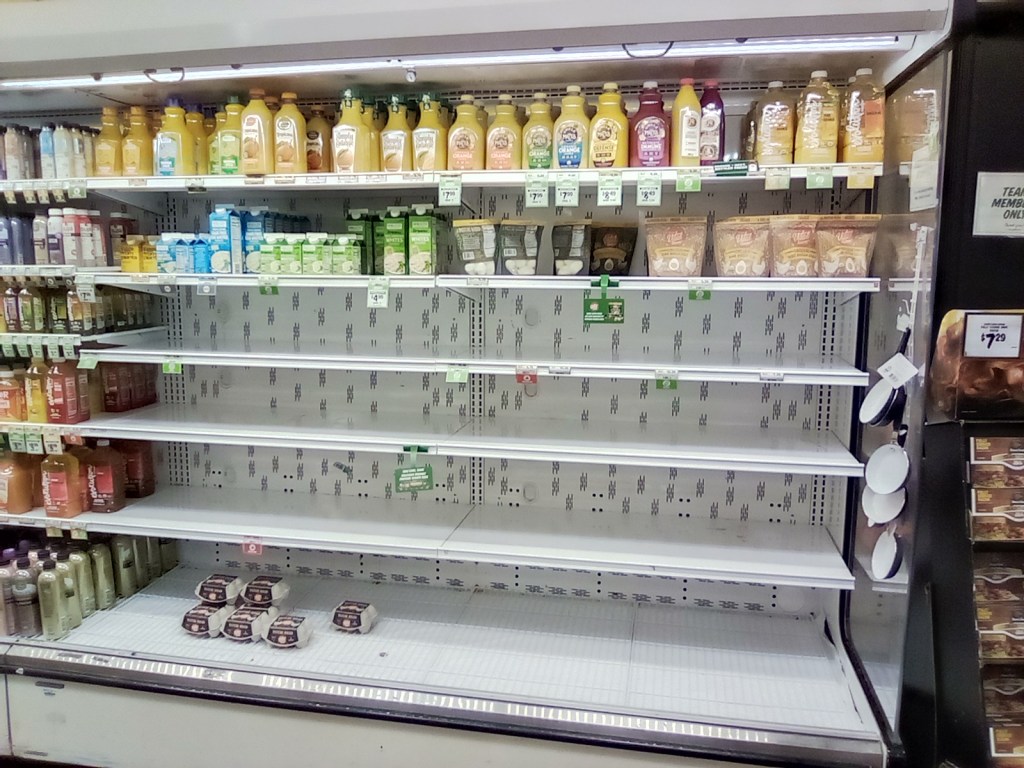
Take for example, eggs. The number of laying hens has gone down due to cullings, whereas the number of mouths has increased due to immigration. Unlike the mythical Sampo that produced also edible goods, the US government has only increased the amount of money in circulation, leading to price inflation and egg shortages. Magic Money Computers are not helping.
An old photo from January 2025. Tonight, I saw lots of eggs in a supermarket.




 PlanktonPunkt