Been busy, but managed to get some photography and short video clips, joined three together into a short silent video (standard stabilization artefacts apply), two clips of giant white poppies, probably Romneya or Matilija poppies which are native to California, and one clip of bees foraging in lavender.
I like the floppy petals of the poppies. The lavender and bees seem to be an all year feature – when one lavender bed withers, another seems to begin to bloom somewhere else, if not immediately, then soon.
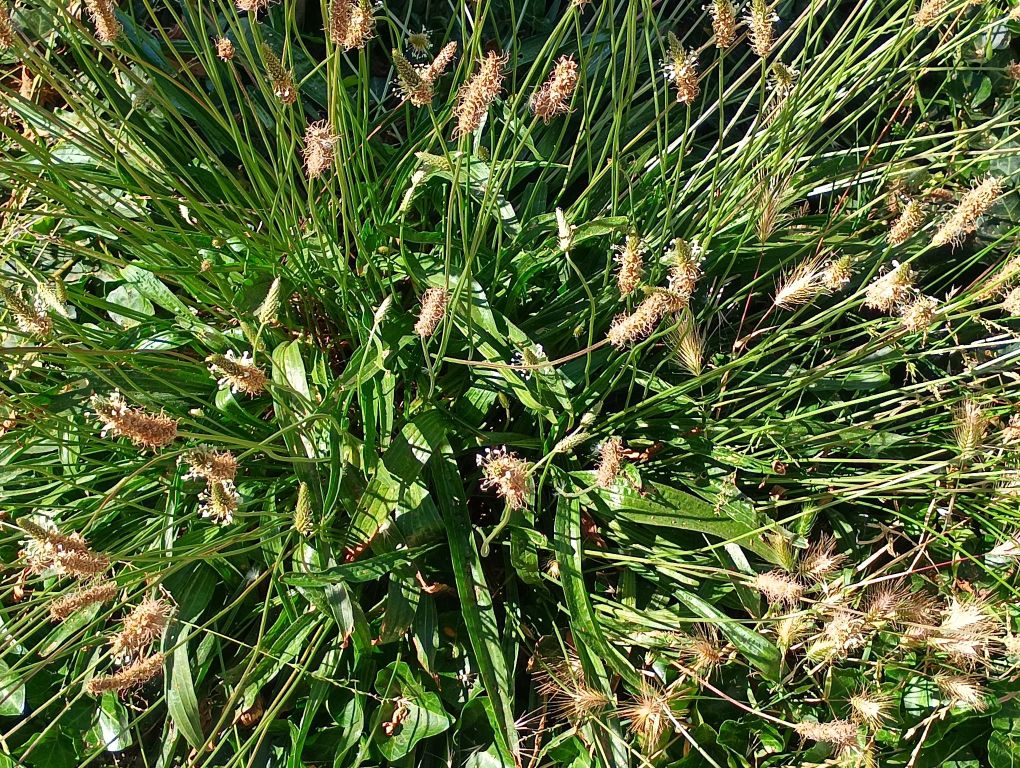
Not all flowers are showy – here is Plantago (I don’t know the species, but it’s not Plantago major based on the narrow .leaves). I would love to process some day a photo of a Plantago flower from close up, they are quite funky to look at but difficult to photograph so as to show it.
I have been busy designing but still keeping an eye (or ear, in case of YouTube videos, which I treat as partial podcasts) on commentary online. Here are some niggling vignettes:
Meanwhile, fuel crisis in Russia (not due to the Iran war, the other war, remember?) has caused the central government to prioritize deliveries in western parts (most of the Russians live west of Urals), which means agriculture in Irkutsk region did not get fuel. I don’t know how much Irkutsk region contributes to global food supplies, but I doubt we can afford to lose any more capacity, anywhere and Russia is one of the main exporters.
And now a big warehouse for frozen goods, Big Bear 7, meant for consolidating all Los Angeles frozen food storage under one roof, has caught fire. Bad news for Angelenos, but since all centralized systems are vulnerable to catastrophal collapse when a critical node fails, one must wonder about the wisdom of concentrating all food in one spot… In general, the Western food systems are overly consolidated with four seed companies having a stranglehold over 80% of corn seeds and nearly 80% of soy bean seeds, and USA occasionally having a chicken shortage due to failing fertilization rates in one of the few chicken breeding corporations.
Molten Salt Cooling
Normally, when I think of this term, it invokes nuclear power generation. However, there is a domestic molten salt cooling method, which may be of interest in saving electricity costs on air conditioner. Note: I have not tested this myself, but it looks relatively cheap to experiment with, so it might be of interest.
Apparently, Glauber salt melts at 32.38 degrees Celsius, storing heat in the process, and by mixing the salt with polymers and nucleating agents (chemical, not nuclear physical) to prevent sedimentation, one can build a flat container (to maximize the surface to volume) heat sink to suck the afternoon heat from a living space. Whether it is as cheap and easy as these, clearly AI assisted/generated videos promise is a different issue. One genuine caveat is that what goes in must come out, i.e., for the cooler to work the next day, the previous day’s heat must dissipate over colder night, so this method will not work in steady heat but will require hot days – cold nights environment. YMMV.
Weather
Has been warmer this year. The spring in California has advanced earlier than I recall from previous year. Flowers are blooming (and withering) earlier and I have snapped a fraction of my photos as a memento to haphazardly ‘document’ their blooming times. Scientists were earlier this year worried that week’s earlier season of Joshua tree bloom would be out of sync with yucca moth breeding, but I haven’t heard any news after the initial worry. I suppose the moths figured it out, probably by using the same environmental cues as the Joshua trees.
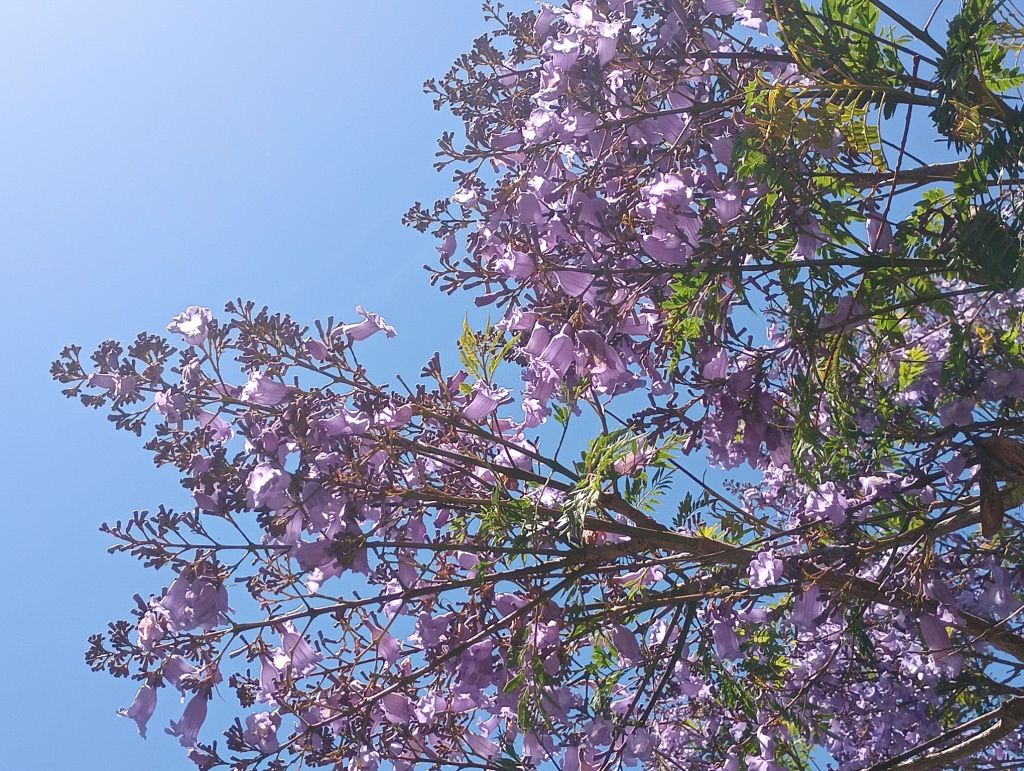
Despite lots of No Kings-signs, monarch butterflies continue to flit around Berkeley, CA. This one was filmed perching on a flowering tree on April 15th, 2026.
Another, smaller insect makes an appearance at about 9 seconds into the video.
The wisteria season is going out. This post was meant to be out earlier, but my internet started acting up so finishing it got delayed. In any case, redbuds are done, but new flowers are showing up. There were within nearby blocks weird, fluffy white flowered, presumably fruit trees that I have loved to observe for a couple of years already but this year I have been busy and missed the start of their blooming.
The spring was very warm and quick, and it feels like a summer here, though some plants did not get the memo and are still without leaves or flowers. Also, I partially missed spring posting because of internet issues – for some unknown reason my home internet again allowed me to blog dashboard again yesterday. The Liquidambar are full of new leaves and many have new small ‘spiky balls’ growing, light green like the new leaves. The balls began to grow despite many trees had many of their last year’s dark and hardened ‘spiky balls’ hanging, too. Some Liquidambar even had last year’s leaves left among the new growth. Confused about seasons or insufficient winter storms?
Insects had been active, and birds were still singing when I began to draft this post (now the chorus has quieted, presumably they are busy with chicks.) Multiple species of butterflies, not just the wintering monarchs, were flitting around and in flowers. As a testimony of warm weather, I even saw a skipper butterfly, though I do not have photographic evidence – the little beast was too fast.
That was on my walk to a shop and back to get 10lb elbow macaroni. I bought cans of corned beef last weekend and failed to buy canned sprats. By my estimates (based on empirical experience on how many times I can eat the same meal before I lose appetite), I can eat max 1-2lb macaroni boiled with a couple of cans of meat a week (preferably less often than more) thus cutting my grocery bills, should the food situation worsen, either through supply shock (geopolitics), through reduced income (read unemployment) or through inflation (economic collapse.) Adding fresh greens and fruits to stored food to balance the diet should stretch the supplies meant to be a buffer for temporary shocks. There should be at least lemons in Berkeley, CA, barring the most exceptional circumstances. I got 10 more macaroni on my next shopping trip, also keeping my eyes peeled for cheap sprats (protein + fatty acids) and more corned beef or other non-perishable meat products (protein). If the situation lasts over three months, I’ll be in trouble. But then, so will be everyone else.
For the people who are surprised at 3 month preps, rather than a homestead with doomsday bunker, most of the SHTF events are either short term (storms, blips in supply system, specialized economical events) or personal (accidents, injuries, corporate lay-offs) so it makes sense to invest some resources on stuff that might realistically happen to anyone that to invest a lot in case an extremely long tail event like a total thermonuclear war happens.
Remembering the collapse of the Soviet Union, a definite SHTF event for the Soviets, the society remained largely intact, bureaucracies existed, and economy muddled on, as did the regular people. I am expecting similar circumstances in United States, the Obama years reminded me of Brezhnev Era, Biden years of the Andropov/Chernenko years at the twilight of the Soviet Union. I expected Trump to be the Gorbachev of the United States, overseeing the economic collapse and centrifugal tendencies of increasingly assertive states overriding the Federal legislation and enforcement, but apparently our trajectory of failure will resemble more the end of the British Empire, that died by Suez Canal. Meanwhile, canned fish is getting expensive.
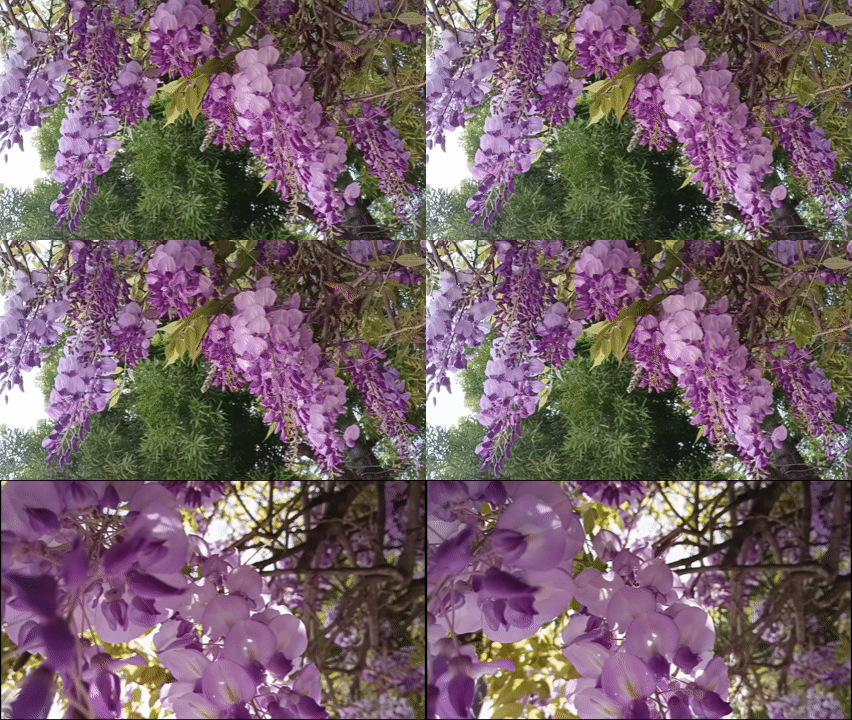
But the wisterias were pretty this spring, and I’m happy that I got some pictures.
Wisterias from 2026, March 21. Better late than never.
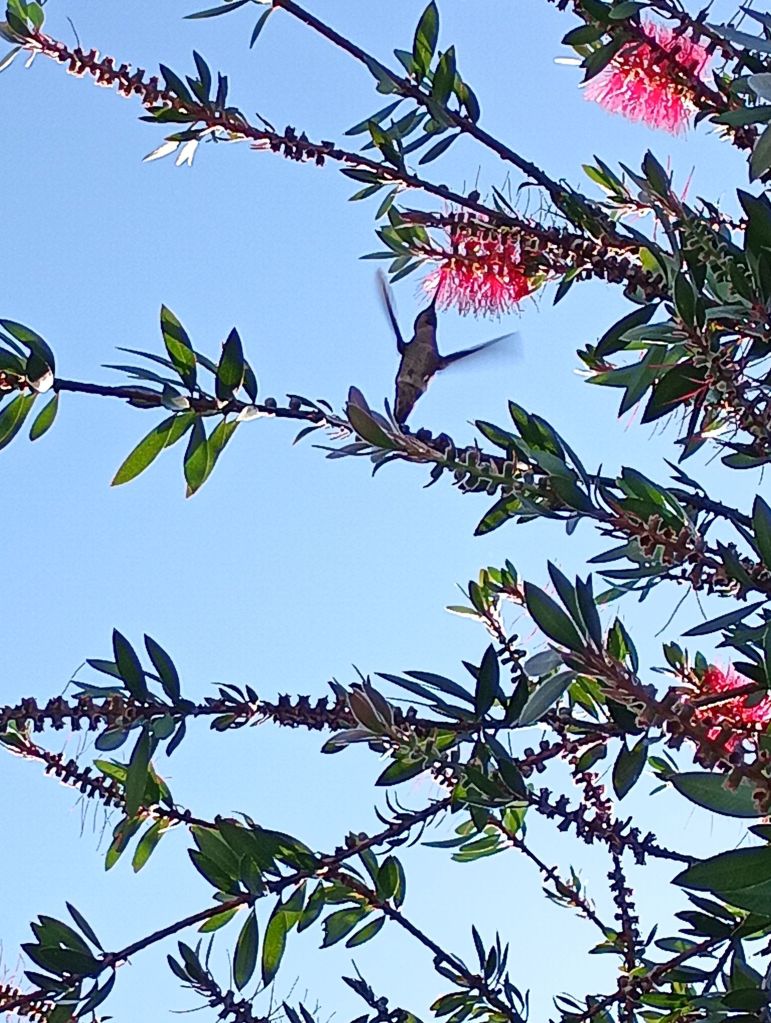
Today, while walking with my mobile ready to snap a picture or even a video, I noticed a number of hummingbirds, not as a flock but a hummingbird or two every now and then. More than I could photograph. Aside from being fast, the little birds are well camouflaged when sitting among the green leaves of a tree. Also, they are small, which means my camera’s resolution will not be sufficient for a good picture or a video. Hummingbirds are migratory, moving south for winter and flowers. I don’t know if they stay here in Berkeley for winter, maybe they are just passing through, but some were singing.
A photo of a hummingbird and a bottle brush plant, October 19th, 2025, Berkeley, CA
Monday’s rain had apparently inspired little green shoots to peek from the ground. Hopefully this was not a false start. The best part of the winter is the greenery as the rainy season ushers new growth.
Skipper butterflies were still around, though this time I did not see a swarm. There were also occasional Monarchs and smaller white butterflies.
I was lucky enough to be aiming for a red bottle brush flower, when a hummingbird flew to feed. Quick switch to video mode captured a few seconds of hummingbird and red flower.
A short video of a hummingbird and a bottle brush plant, October 19th, 2025, Berkeley, CA
Sometimes you need to take a break and appreciate the small things
So, I got a temp job as a scientist starting late September and have been busy. But I am planning on keeping posting, even if the intervals between content get lengthy.
About a week ago I was walking around taking snapshot and videos, and was impressed at the amount of butterflies fluttering around, multiple species of them, multiple places. I am still trying to process my videoclips (I have quite a few of them taken this year) into YouTube videos, but here is a little sample at lower resolution.
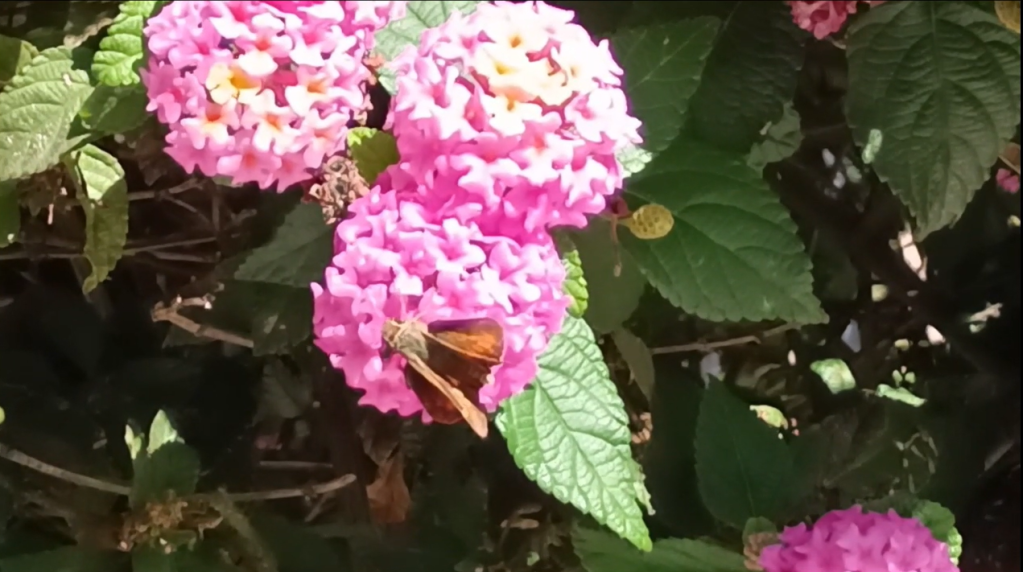
There was a bush (or a cluster of them) with yellow and pink flowers, which seemed to be very popular with small brown and quick butterflies. I had seen them occasionally around, but their numbers had been increasing towards autumn. They look like online photos of skippers, which are common in California and North America, and though I would not presume to identify the exact species with 100% certainty, an Umber Skipper or a Fiery Skipper seems a possibility.
I think this swarm was from the latest brood that had eclosed and was preparing for winter and / or having a mating season. I have some earlier clips of similar-looking butterflies, but those were difficult to obtain because the insects were skittish and quick to fly. The butterflies in this swarm seemed to be more interested in feeding, occasionally chasing each other, but I could get close to this specimen without it flying away. Maybe they were preparing for winter or for laying eggs.
Pure speculation, since Winter in California is the rainy season, with new green shoots, so it may be a good time for new caterpillars to hatch. On the other hand, maybe the adults were preparing to hibernate through the wet and cold.
A skipper butterfly in pink inflorescence, October 04, 2025
The ants are haplodiploid relatives of wasps, females are diploid, males are haploid. In Messor ibericus species the queens can produce two types of male offspring, one of their own species, other from a related species Messor structor, with which they have been estimated to have a common ancestor about 5 million years ago. The queens mate with both types of males, because ibericus males are needed to make new queens, whereas structor males are needed to make hybrid workers. The structor male genome survives because the queen can somehow clone haploid offspring from sperm (though the mitochondria of the ova come from ibericus.) It should be noted that the ibericus-born genetically structor males are morphologically different from wild structor males, which the authors of the study hypothesized to result from differences in mitonuclear environment, from differences in brood rearing conditions, or from genetic differentiation of the ‘cloned’ lineage of structor males. This case is interesting, because it stretches the concept of biological species to have genomes of two species, separate but intertwined by sexual reproduction to maintain the colonies of the species lineages.
Little black ants in Finland, crawling in and around their hole in the ground. Not connected to the ants discussed above.
As for life on Mars, NASA scientists published a paper on speckles on Mars rock, which on Earth would have formed by metabolism of accumulated microbes. I do not know enough of mineralogy to follow the paper, but the NASA press release was much more accessible. The speckled rock was found in area that had contained long ago liquid water. While alternative processes have not been totally excluded, the most likely ones were. This biosignature is the strongest evidence that Mars has some time in the past hosted life. This implies either life evolving easily in multiple locations or if life evolves rarely, panspermia, i.e., life spreading in space, and it has been speculated that life on Earth and Mars being related. Also, considering the prevalence of lithospheric life on Earth, I would not consider it impossible that there still exists (microbial) life deep underground in Mars.
I have been working through my insect clips and this is a bit too short for YouTube as a stand alone but too big for Pinterest, so I posted a mobile phone formatted version here, since the bumblebee and rhododendron video was so pretty.
A bumblebee is an important part of Finnish ecosystem. A garden Rhododendron is an imported species.
I hope this little clip will provide a relaxing break, enjoy!
I have now made a short video (6 min 45 s) on the subject, its consequences, its causes (especially discussing metapopulation dynamics) and about one idea how to combat this trend (microrewilding.)
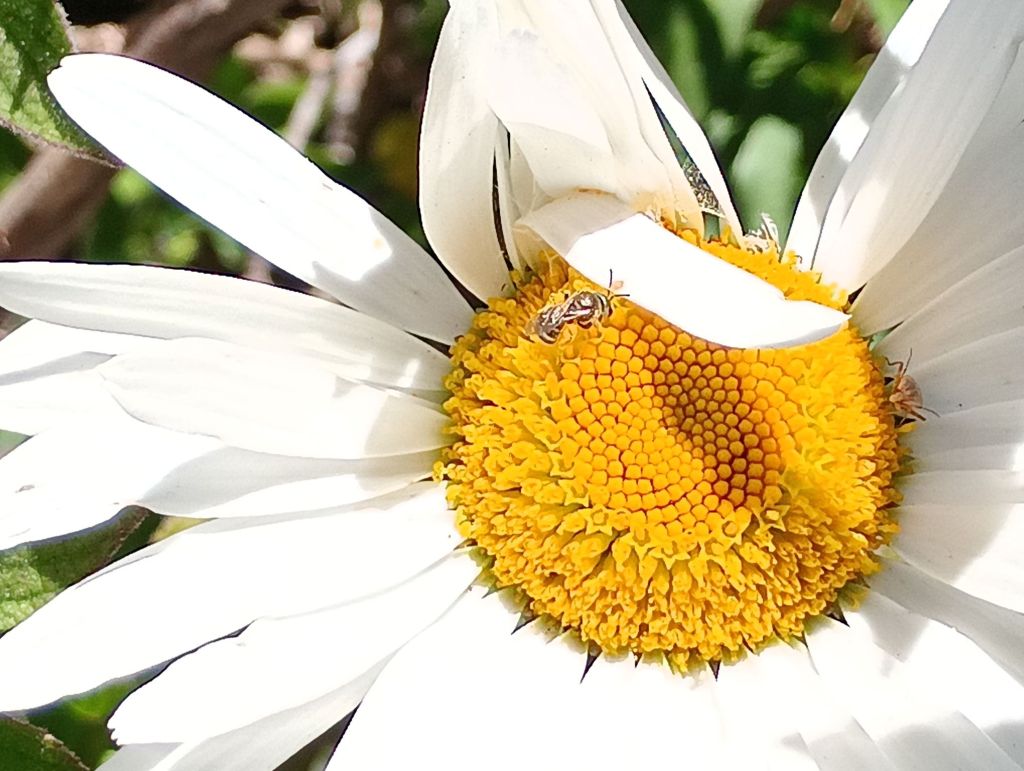
A small Hymenopteran and a probable bug in the same flower in Berkeley, June 2025
Recently, a samizdata channel I watch has had multiple reports that insects are missing this summer, in locations scattered around United States.
This was not unexpected. The reduction in insect numbers started decades ago, if German amateur entomologists’ data is to be believed, but it has since been recorded around the world, including places like Colorado and Costa Rica.
The scientists have sounded an alarm – insect are possibly the most important group of land animals in terms of species numbers and biomass. They are important pollinators, decomposers, soil and biome modifiers, and they disperse nutrients even when not serving as important food source to other species in food web.
The loss of insects has been attributed on a variety of reasons, among other things pesticide use (and other environmental poisons, including chemtrails and 5G radiation), monoculture, spreading diseases (especially Varroa mite born in bees), and changing climate. While a large number of species are affected, reading the reports has given me an impression that the selection of missing species seems to vary from place to place, suggesting multifactorial causes. The modern world apparently does not have space for bees or butterflies.
I would probably blame monoculture, i.e., humans have appropriated too fat a slice of ecological resource flows for themselves. Traditional agricultural landscape in Europe had many verges, ditches and hedges, where wild plants and insects that relied on them could flourish. Now such places are rare.
For example, I have observed in horror, how most species of the meadow flowers, once common on road sides near Turku, Finland, seem to have had a population collapse in the past decade. I blame this on the municipal maintenance crews mowing the verges before the seeds have ripened. Annual plants fare the worst, but I suspect perennials will eventually follow. Any insects relying on those flowers also likely fared poorly.
As the small wild spots grow fewer and further between, I suspect we have crossed a critical threshold on insect metapopulation dynamics. Ilkka Hanski, studying Glanville fritillary butterflies living on dry meadows on rocky islands, showed that as long as there were enough patches with butterflies near each other (in this case, the minimum was estimated to be 32 patches covering total 10ha over 5km2 area), individual patches of plants or insects living on them could be ephemeral, i.e., the butterflies on a given patch could disappear or appear from year to year, but the butterfly populations of individual patches form a metapopulation that keeps the species going if the amount and density of patches are sufficient.
Extrapolated onto insects in general, I think the on-going collapse may indicate that despite good people setting their individual gardens for butterflies, bees and other insects, if a garden population is lost, for example to local bad weather or disease outbreak, there are no longer enough insect patches left nearby to repopulate the patch. Sooner or later, isolated gardens will lose their insects. And then the metapopulation is gone.
What can be done to reverse this trend? I suggest starting by restoring some verges. Also not mowing your yard while the flowers are seeding, as ugly as the drying seedheads may look. Insects are not very big, so they do not require nearly as large sanctuaries like roaming megafauna, but there should be plenty enough patches to maintain a viable metapopulation, so that if some species is lost from one spot, it can be colonized by insects from the neighboring spots. I believe this type of microrewilding to be compatible with current human population, possibly even essential if we want to retain their ecosystem services necessary for food production. Assuming there are no confounding factors like (possibly) 5G radiation to prevent its success.


 PlanktonPunkt