

“It became necessary to destroy the village in order to save it”, (said during Vietnam War, where the United States went to help French with their Indochina, ending with Vietnamese eventually kicking out France, USA and China.)
To me, the modern environmentalism increasingly resembles this insane sentiment.
Last year, there was an uproar, when Reinhardswald in Germany was slated to make room for wind turbines ‘necessary’ for Energiewende.
How much of this was hype and how much was counterhype, I don’t know (though I suspect my search engines show me very biased results.) On my recent trip to Finland I saw the changes in the countryside, big wind turbines can cause. It takes lots of land and removal of trees or elimination of agricultural fields to build a wind park.
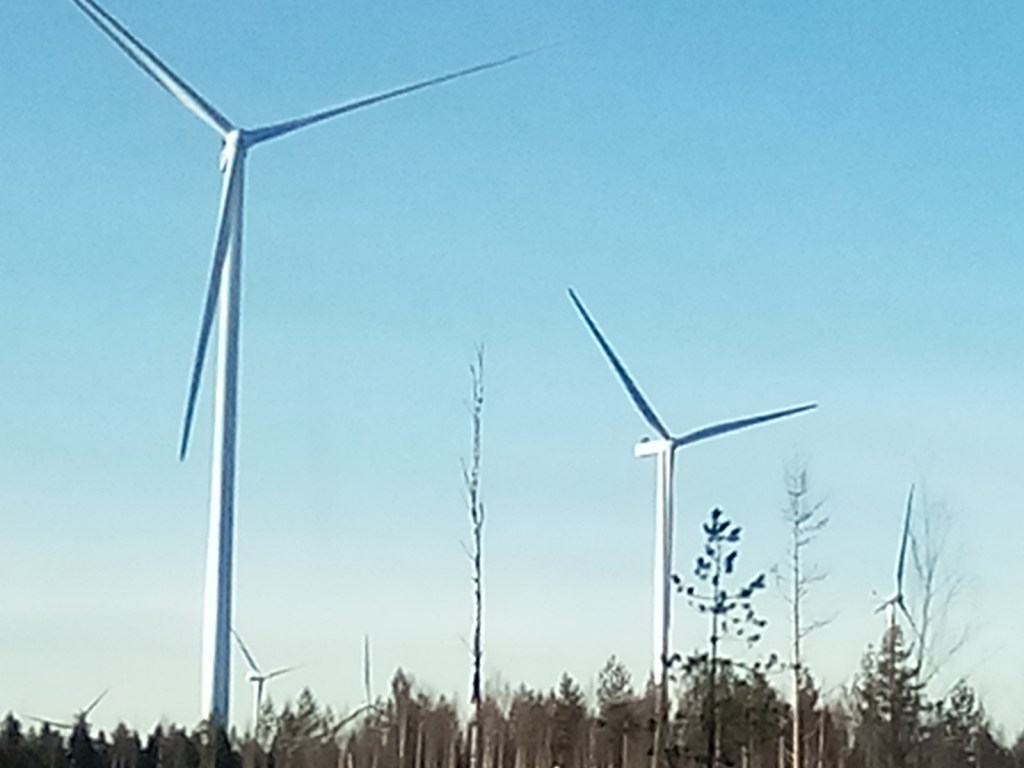
In reality, it may be environmentally less harmful to build nuclear reactors than wind turbines (depending on how you calculate EROI – my Google searches were inconclusive because the studies were either old or seemed to be shilling for one form of energy or another), and they kill fewer people (not to mention them having smaller radiation plume) than coal plants.) While there remains need for petroleum, its increasingly difficult extraction reduces its EROI, which means that in future it will probably remain as a raw material for industrial processes, maybe special fuel for internal combustion engines.
Nevertheless, EU (including Germany) is dedicated to net zero project, which increasingly begins to seem like some weird suicide / flagellant cult with reduction in living standards (rationing energy by rising costs, attacking food production, limiting transportation and movement, and increasing housing density) and reduction in human-accessible territory.
All these projects, while openly posted on-line, are presented so that opposing voices are portrayed as conspiracy theorists and antienvironmentalists. But is it a conspiracy theory if they themselves tell everyone their plans, or worse, their actions?
At least the most fanatical theses from the now destroyed Georgia Guidestones are not openly touted. There are people, other than just me, who would consider the reduction of world human population to 500 million from (official) 8 billion or by over 93% rather genocidal.
But the Green New Leap is not just for UK, Germany, Netherlands or Ireland. Finland, too, is planning ambitious net zero targets, and I mean really ambitious, as in lauded by WEF.
Most of Finland is above 60° latitude, about the same level as Alaska or south end of Greenland, mostly more north than Yakutsk in Siberia. Energy is of utmost importance there. Roughly speaking, a person can survive a few minutes without air, a few hours without heating, a few days without water and a few weeks without food.
Finns have survived without fossil fuels for centuries, but that was by burning wood, which is also not OK with the eurocrats – small particle pollution will kill! Presumably freezing to death is more efficient and environmental. At least the official media reassures the Finns that saunas are safe from this regulation. For now. Anyways, the war against Russia and certain realities of energy production have resulted in complications in banning wood in energy production.
Meanwhile in China, 2024 began to build 94.5 GW worth of coal power plants and resumed 3.3 GW of suspended projects according to two think tanks. Only 2.5 GW of old capacity was closed 2024. (Side note: with China’s economy tanking and exports faltering, what do they need this new energy capacity for?)
But what about the reindeer burps?
Indeed, according to our reliable news media, a study was published that Lapland will not be able to meet its greenhouse targets by 2035 because of the large emissions from its agriculture, namely the reindeer. Which as ruminants are burping too much methane, which is a greenhouse gas. Unfortunately, I could not find a link to the original study to check the claims, and to see if the researchers were in earnest or if this was some sort of reductio ad absurdum-document to demonstrate the futility of the Net Zero targets.
However, assuming the reporting is true, reindeer are part of the Arctic ecosystem, and even if the semidomesticated populations in Lapland were counted as human livestock, those globalist net zero plans that would involve reducing the number of large ruminants, such as grazing cows and sheep, come dangerously close to messing the ecosystems by removing large herbivore guild from the food network. While I can see the point in reducing the use of feedlots and grain / soybean based fodder in ranching, eliminating free-range foraging herbivores is IMHO insane.
Ironically, the climate war against cattle (products) is not fully compatible with the idea of rewilding the land, which presumably involves switching domesticated large herbivores with wild large herbivores to the net zero effect on burps per acre in case of free grazing animals. Large scale rewilding is currently hypothetical rather than practical, as the numbers of large wild herbivores are insufficient for the switch. Humans and their cattle, pets and pests account for about 96% of terrestrial mammal biomass. The remaining about 4% is everything else from Etruscan shrew to elephant. Cows alone are ~40% of Earth’s land mammal biomass, meaning there are no replacement herbivores. And without ungulates, the grassland ecosystems will collapse.
But back to the reindeer burps.
When it comes to climate, worrying about the relative inputs of reindeer burps vs the rest of the nature makes even less sense. In Hunga Tonga-Hunga Ha’apai eruption January 2022 estimated 146 million cubic meters of Pacific salt water causing a couple of years of cooling with effects possibly lasting for the rest of the decade. The atmospheric CO2 concentration near Australia and New Zealand increased from the expected 412 ppm to 414 ppm, about the size of interannual fluctuation on those parts.
When we consider this and other volcanoes, and the coal plants of China and the rest of the world (not to mention everything else that produces greenhouse gases, such as termites), how much effect would it have on the atmospheric chemistry and global climate change if all the reindeer in Lapland stopped burping?


 PlanktonPunkt