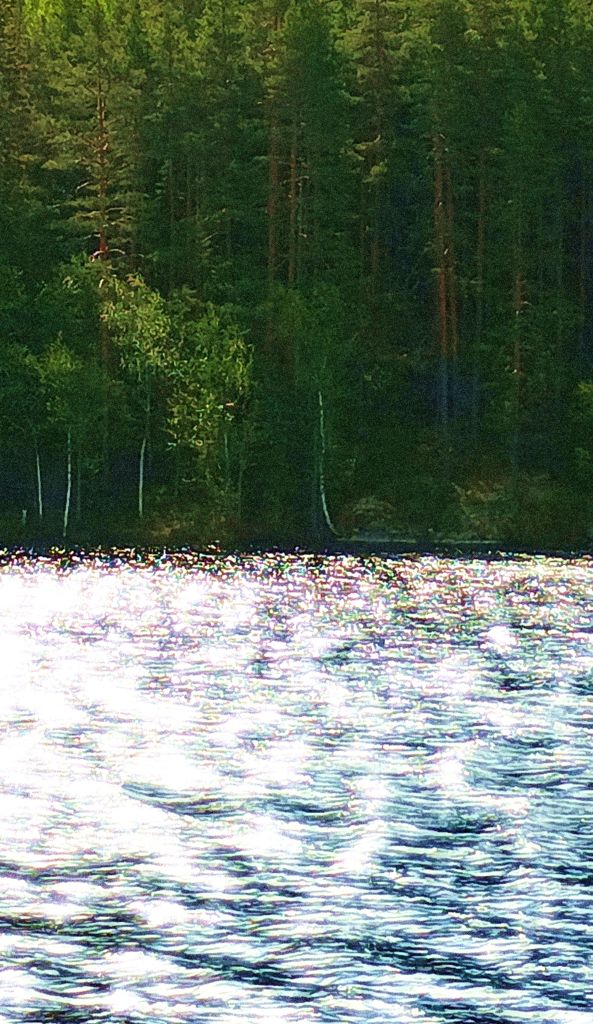
Just another free jigsaw puzzle via Jigsaw Explorer. A depiction of light on Finnish forest lake water.
For people who have only a short break, 24 pieces. Access the puzzle by clicking the image. For those who want more challenge, the number of pieces can be adjusted at the beginning of the game.
I have now began Survival September 2025 sale in my print on demand shops.
My Etsy store is running for US customers a 20% off sale for all items I have uploaded so far until the end of this National Preparedness month in the USA.
I am currently updating the prices of my eBay items (those need to be updated manually each and some include shipping while others do not.)
After that I try to do something to my items in Amazon, and then to those in Printify pop-up store.
All the shops except my Amazon sales channel (which is still just in its beginnings) are listed in the banner, or you can click the highlighted links in the text.
I will be adding more items to my shops as the month progresses.
And while I am setting up the Survival September 2025 sales in this side of the Pacific, I am also uploading more jigsaw puzzle designs, especially for tube puzzles, onto my shop space in CreateJigsawPuzzles market place.
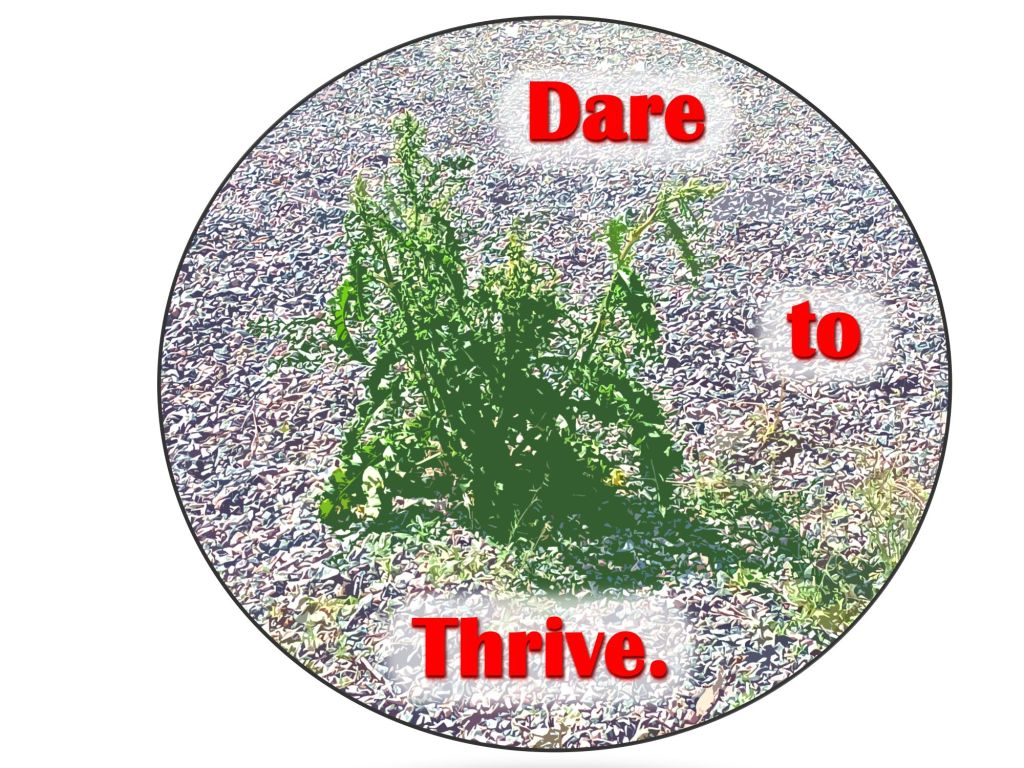
Be like a weed, dare to thrive. Also, be prepared.
This May in Finland I was lucky enough to spot this beetle on a tree stump. The stump was also hosting a fungus, recycling nutrients. Life goes on.
Now I am in California. The job situation is bad. The official US unemployment percentage for July 2025 was 4.2%. Functionally unemployed in July 2025 were estimated by Ludwig Institute for Shared Economic Prosperity to be 24.7% of US labor force. With AI, especially white collar unemployment is estimated to soar further. I think AI is an excuse for job cuts resulting from austerity enforced elimination of Bullshit Jobs.
David Graeber estimated in his 2014 book Bullshit Jobs – A Theory that about 40% of the jobs are unnecessary and people are being paid, often well, to do nothing useful.
Meanwhile, we have printed money, that is accumulated debt, faster than productivity has grown since the previous century, but now the buy-now-pay-later Ponzi scheme is unraveling. Most of the printed money seems to have been soaked into stock market and complex derivatives, benefiting governments and their servants and ‘NGOs’ and the 0.1%, which have sucked the money (plus interest) away from real world investment. While also saddling the people with unpayable public debt loads, the consequences of which manifest as increased taxation, reduced services, and proliferating licensing requirements and fines, which both are additional taxes in disguise to government coffers.
Now the production is no more, despite the inshoring attempts of the current administration of US and the 99.9% are doing price discovery. The economy is shedding jobs. Optimally the lost positions should have been the 40% Bullshit Jobs, but it seems that many useful positions are eliminated, too, further damaging the economy.
Part of this is the loss of consuming power driven by the mass functional unemployment. While the people with Bullshit Jobs may not have produced anything, they used their salaries to keep up the consumption demand, being vital for the survival of many small real businesses like pizzerias, lawn care companies, cosmetologists and car dealerships.
Another part of it is the pathologies of the system itself. After years of promoting incompetents into leadership positions, be it by nepotism, political clientilism (including DEI) or slack allowed by easy (freshly printed) money, the managerial class no longer recognizes which workers are necessary for operating a business. A case example: Boeing.
The regular people (including many of the 40%ers) are now suffering from another effect of money printing, inflation, including food inflation. Although food (and other) inflation is not driven by money printing alone but by money supply growing faster than food (or other) supply. The demand is semielastic, if that is a word. The former middle class downgrades consumption and the poor skip meals, but the number of mouths to feed depends on immigration plus births minus emigration plus mortality.
Unfortunately, thanks to the globalization, also problems are global. I think food inflation in the West is not only due to reduction of food production per capita or collapsing Western economies but also due to increasing wealth in poor and middle income countries, that now can better compete for the global resources.
I also believe that the global food production has not kept apace with the global money printing, and though the poorest in the West have traditionally outspent the poor and even the middle classes in poorer countries, now even in West we now have food inflation because other countries can pay for the food on global export markets. For example, China has during recent years bought massive amounts of grain, pulses, oils, meats, fruits increasing price pressures.
Meanwhile, people with money to travel are leaving global south for global north increasing pressure in the Western countries. Traditionally, if food supplies or economy grow tighter people emigrate. However, it is not the poorest of the poor who can apply for visas or pay for human smugglers if they are not eligible for a visa. Nowadays the situation in the departure country does not does not need to be catastrophal to induce emigration. Just the perceived better economic opportunities in other (including Western) countries – thanks to mass media and ubiquitous internet -, and the comparative ease of traveling are now major drivers of mass migration from poorer countries to wealthier, and if the situation in the country receiving the immigrants changes, the flow of people will head some other place.
Thus, I think that fewer people are starving to death but the price of the global affluence paradoxically is that more people in West go hungry.
Some time ago I was in a grocery market here in California, not a hugely expensive one. They advertised for two avocados for seven dollars. The economy may be toast but it won’t be an avocado toast.
Crude claims that USA just wants Venezuelan oil again, just like in the past 20+ years of regime change attempts, seem somewhat plausible.
It might be the Venezuelan threats against Guyanan oil fields in Essequibo that are currently exploited ExxonMobil that triggered the latest action.
An infographic shown by X user placed Canada among the high oil resource countries – most of which were either destabilized, contested, under hybrid warfare / influence campaigns, or Western sock puppets. Kazakhstan may have been the only exception in the list, but that may be just US being more remote than Russia and China. Bouts of sanity, like recognizing the limits of former ‘hyperpower’ are extremely rare, rarer than pacifism, in Washington DC.
But a grim fact is that the Western technocivilization is running out of energy, among other resources. Whether for AI powered surveillance dystopia or utopistic popst-scarcity dream, reality is reasserting itself crushing them all with resource scarcity.
Looks like the oil wars (including hybrid warfare), this time north and south, are back on menu. With War on Drugs joining hands with War on Terror as casus belli.
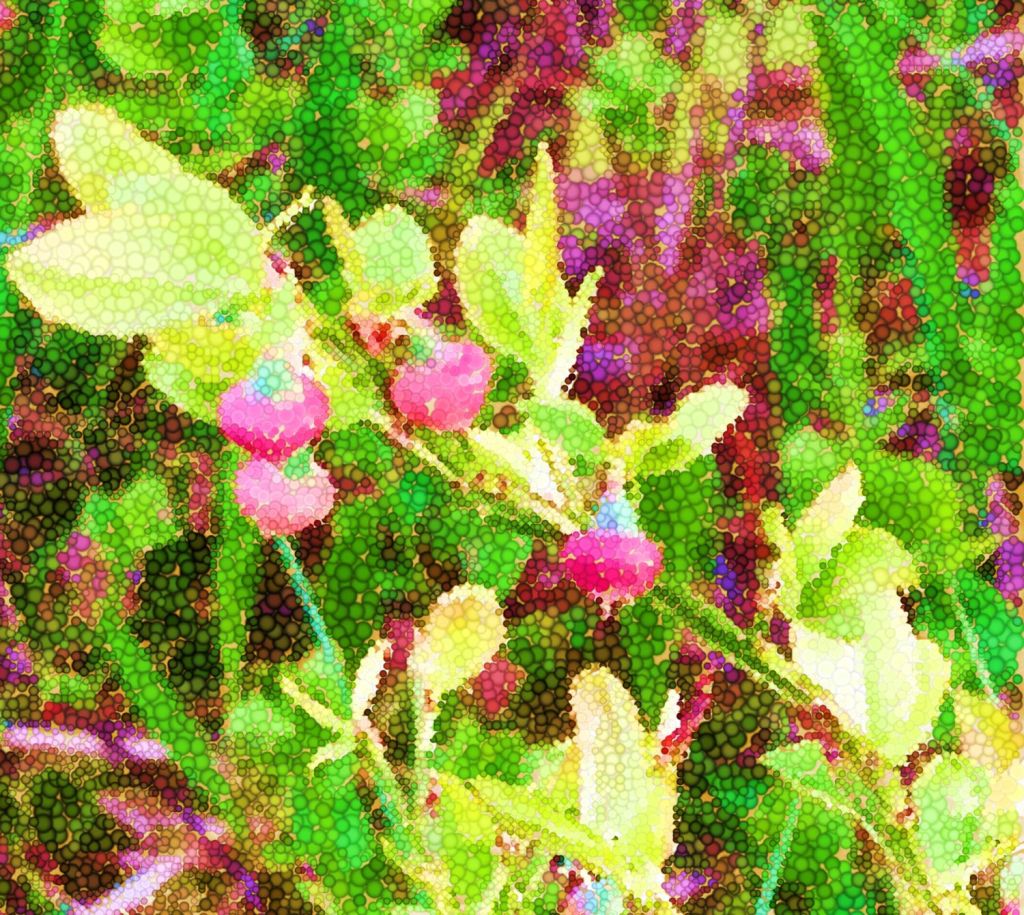
I wanted to make something for Pinterest, but of course, it should be here, too.
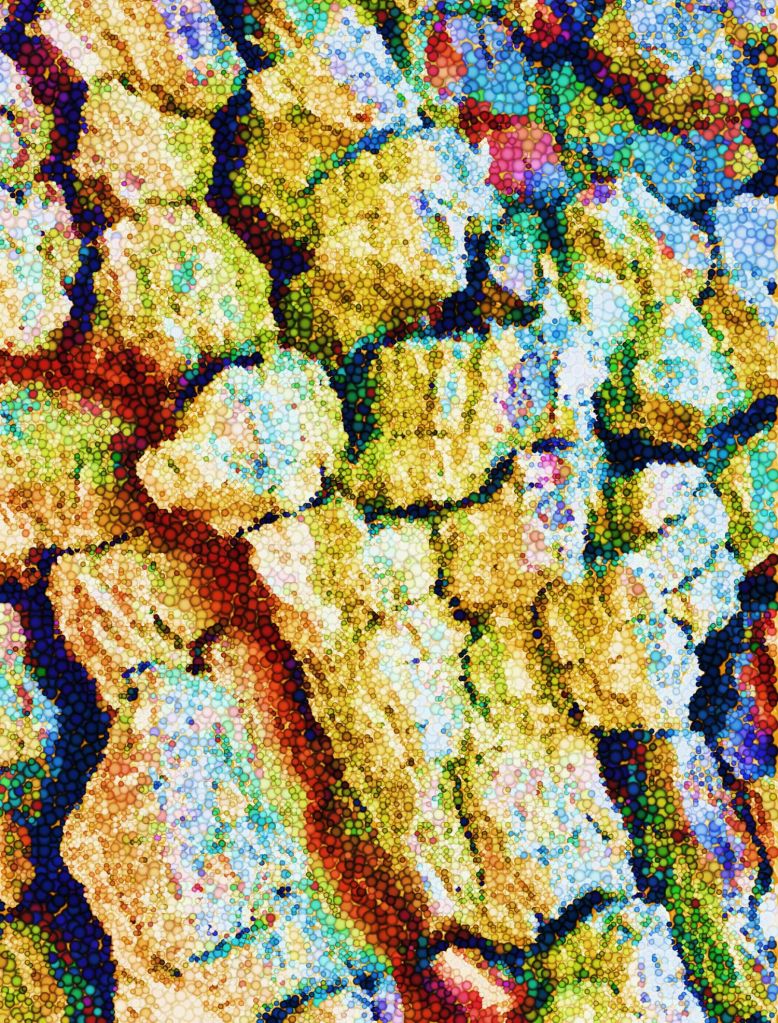
This is a color saturated bubbles rendering of a close up view of tree bark I photographed this month (August 3rd) in Berkeley. Unfortunately, I have forgotten which tree.
After processing the photo for different versions (maybe one or more of them will make it to POD designs), I uploaded this image here and copied the planktonpunkt.com image link to Jigsaw Explorer to make a puzzle.
I saw an interesting video from YanasaTV. He was discussing about blue pigs and their causes in California. I think this is a symptom of even bigger problem than he described, so I thought to expand a bit.
The starting point was boar meat that had turned blue in some parts of California, because of liberal use of rat poison, which dyes the meat.
According to the video, farmers have been fighting against a figurative tidal wave of rodents, whose populations had exploded in four counties due to farm and orchard closures leaving them tens of thousands of acres of prime breeding areas in almond country.
The official explanation of the laws was the environment and need to save water. However, an important underlying cause influencing the passing of water laws was consolidation of water rights under the big players. (get reference)
Any case, according to Yanasa TV, last year California lost 8000 farms, to multifactorial causes, but lack of water is a big one. Oddly enough, Texas lost even more farms, 18000, also often due to lack of water. In Texas, the irrigation competes against AI server farms. And is losing.
That caught my attention. The news have been buzzing for a couple of years about how the Silicon Valley firms have been moving to Texas because of their nicer regulatory environment. The discussion online had given me the impression that this was due to the taxes and insane regulatory policies of California. I had not thought about the water regulation, but in hindsight, it should be obvious. The firms are moving to what is greener pastures (more resources) for them, never mind the parched pastures of the ranchers. Which are blamed on climate change.
The final point I got from this YanasaTV video was the question, how do we feed the billions of people if we reallocate agricultural resources to feed AI? The regulations hindering the agriculture are passed under the pretense of ‘conserving the resources’, but to me it seems that most if not all conservation regulations are nowadays just to preserve the ‘protected’ resources for the powerful, whereas the little people like me get to enjoy the Green New Leap as increased energy and food prices. And as shortages of critical resources.
The California water rationing for urban dwellers and destruction of small farms is not about conserving resources, since water is very much available for the Big Almond, golf courses, and such. It is about extirpating the competition for scarce resources the big players want for themselves. If the side effect is the ballooning fruit, vegetable and meat prices for the small people, someone is making money of that, too. At some point the breakeven point when increasing prices will not bring more profits because the consumers cannot afford to buy will be reached but the availability of food (and energy or other resources) relative to the need will determine whether that happens before or after a mass uprising.
Speaking of AI and energy, I wrote the other day about rolling blackout warnings in Maryland and New Jersey. I think the AI industry will have to begin to address its effects on the energy grid soon, maybe already next winter. Once people will begin to experience survival threatening acute shortages, backlash is guaranteed. The incoming collapse of the power grid, by the way, is the main reason why I chose coastal California as my bugin place. If the grid fails, I will not freeze to death.
But my realization about all of the above: there is no such thing as a conservation law. There are only resource reallocation from the poor to the wealthy laws.
Note added in proof:
Nova Scotia in Canada banned people from going into woods, either Crown lands or privately owned lands belonging to someone else. Traditionally people had enjoyed access to Crown lands, but now they had been told that this privilege had been taken away to prevent forest fires. 25000$ fine for people trespassing their country’s forests. Would you feel like hemmed in?
Then I read that the Nova Scotia woods (over 3500 acres of them) are getting sprayed with defoliant that is being used to kill unwanted (less economically useful) tree species. Imagine large swathes of dying and drying trees in the middle of a drought. Controlled burns to free land for more profitable tree species were speculated. The cost to the ecosystem is hideous, so is the loss of immaterial (and material) value to the people.
Not that immaterial value even matters to the powerful. My uncle back in Finland told that they are planning a data center next to a big hydropower plant in the town he lives in, and the land being developed has stone age sites on it. I don’t know how valuable these sites are archeologically, but I suspect they have not been properly studied, either.
The online gurus claim that a product sells more if there is a video attached.
Here I used a POD camping cup I had ordered for myself to show how to pack granola in it for travel and loaded the video into YouTube.
Why granola instead of mug of tea? I am currently trying to sell on theme Survival September 2025, and product lines on travel and meals on-the-go aspect of it (mugs, bento boxes, luggage, mobile phone stands, anything else that could be added to the design lines…) Packing an enamel camping cup with food for travel fits the theme, I hope. Though presented as a travel tip, this would be useful for planning a short term bugout bag, or for (emergency) travel under conditions when restaurants might not be open.
I made a critical mistake by publishing it on YouTube immediately after upload – this will bury the video with few views. Or so I am told. I have not published enough in YouTube to discover if this is true or if I am organically uninteresting.
I also loaded a lower resolution version of it into Etsy with the mug in the video. Maybe it will attract a buyer.
In any case, I am learning video editing, maybe the skill will be useful in the future.
P.S. This design is for sale in Printify, Etsy and eBay.
If you are bored with the Big Corporate flavors but do not want to pay $$$ for specialty sodas, do as I do.
Buy cheap, no brand or shop brand bubble water (mineral or seltzer) and add juice concentrate to your taste. Bonus points if home made from self-grown and picked berries, but commercial juice concentrates should work just as well. The amount of extra chemicals in the ‘soda’ depend mostly on the concentrate used. As a city slicker, I buy concentrates with minimal numbers of additives, especially avoiding artificial sweeteners and azo dyes, which may make the ersatz sodas healthier than many big brand sodas.
This may or may not count as Survival September 2025 post, but IMHO survival comes in many forms, and if this helps others with their finances and health, that is preparedness, too, and more resources for other prepping.
Midwest Chick posted recently that Lava Ridge Wind Project in Idaho was cancelled.
This project was opposed by the residents but the previous administration gave it go ahead in December 2024 anyways. Now the approval was canceled by the Department of Interior due to legal deficiencies, including proximity to a Minidoka National Historic Site (WWII Internment of Japanese-Americans) and local opposition including lawmakers and local 0fficials
Meanwhile, Maryland is threatened by rolling blackouts. Rolling blackouts may have lots of proximal reasons, but my gut feeling is that the main causes in some order are: fragility of green power sources, deferred maintenance of the grid, and increasing power demands of everything is computerized AI society. In the end of the article was a warning for people with refrigerated medication or medical devises needing electricity to have an action plan in case of outage. The power prices in Maryland and New Jersey are moving up and the consumers are livid.
As a Californian, I am not in a position to point fingers on energy grids, but ours should have been a warning example, not something to emulate.
I have decided to start a Survival September 2025 campaign in my on-line POD stores (though probably not in CreateJigsawPuzzles.)
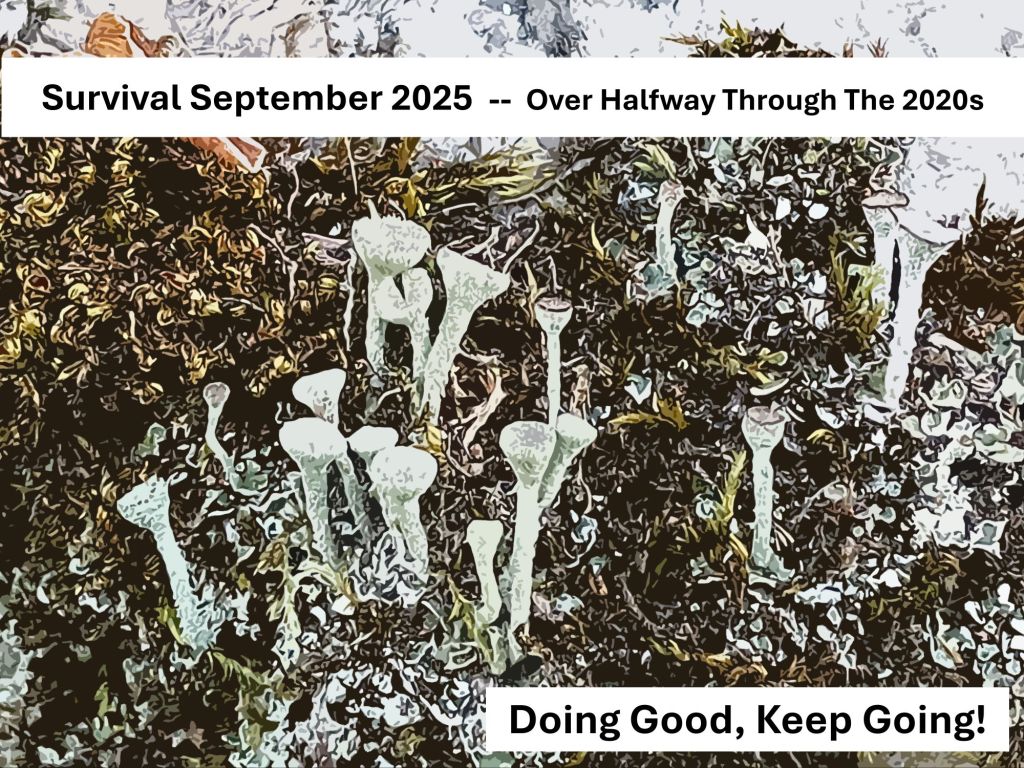
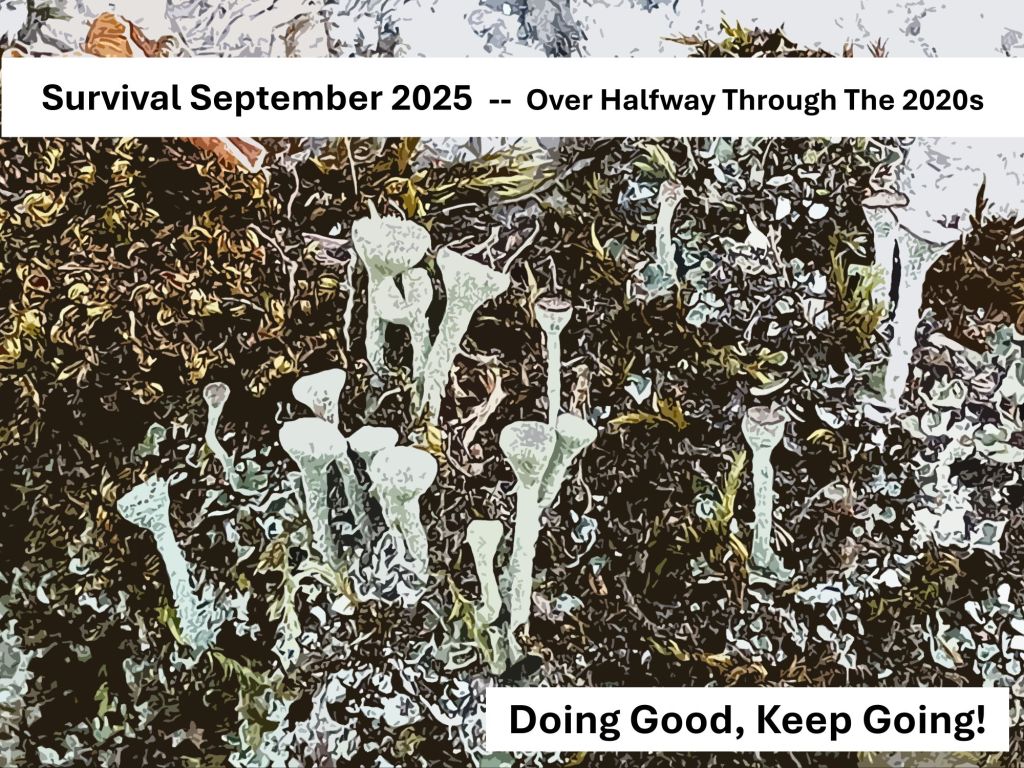
My first design theme was the hardy little Cladonia cup lichen, because I think they are photogenically cute and because they survive the Finnish winter despite being small and cute.
Shameless commercial exploitation of cup lichen and National Preparedness Day.
When it comes to POD business, I have had to adapt and learn fast during the past few weeks and months, but I now think that the focus of my non-jigsaw puzzle stores will be the urban, educated and international professional who nevertheless is alarmed at the direction the world is going, economic, cultural and ecological axes. Someone like me. How many we are and does anyone find my stores (links in the top of this site), is anyone’s guess.
This person, usually traveling a lot within and between continents for work and fun and therefore keeps only minimal apartment, but nevertheless wants to be prepared on the emergencies specific for their circumstances, probably needs lightweight but stylish travel and tech accessories and home decor that does not take too much space. Colorful and / or complex nature or garden based designs balance the dullness of the concrete jungle on-the-go and brighten the home base during a break from hectic life.
With such lifestyle, preparedness does not mean homesteading in a remote bunker hoarding spam and ammo. It means being flexible and able to travel at a moment’s notice, though the home apartment may have micropreps like cash, backup power pack, good first aid kit, and food and drink for a couple of weeks in case of a natural or governmental disaster.
As for my theme, this year has been tough, but I hope to keep going next month, too. Then I learned that September is the National Preparedness Month in USA. Additionally, this September 2025 we have survived over halfway through the 2020s, despite all the calamities that are still befalling around the world, and that is an accomplishment.
There are many governmental and non-governmental websites promoting this (some examples linked in this paragraph and more can be found by searching the Internet using National Preparedness Month as a search term. Disclaimer: None of the agencies or organizations linked here are sponsoring or endorsing me, nor am I their official partner, representative or otherwise connected with them – I just thought people might be interested in the National Preparedness Month.)
Having checked the National Preparedness Month content online, I felt frivolous about my crass Survival September 2025 commercial promotion, but then I remembered that people are commercializing also Christmas and Halloween which to me are actual holy days, and decided to keep on it. I may get booed or even reviled, but even if people buy nothing but get inspired to increase their preparedness, that is important.(By the way, I think most important part of preparedness is the attitude, closely followed by skills – gear can be helpful but without the first two, it will only be a talisman, an emotional support blanket.) As part of my Survival September 2025, I try to post every now and then about prepping for urban international professional (though I think most of us already know the relevant tricks, or at least most of them.)
Meanwhile, to all the people who have survived so far, you are Doing Good, Keep Going! Hopefully to the end of the 2020s and long after that!.
If you have any ideas or opinions on this, or any other content in my shop(s), please comment – feedback from public is always important help for a hermit like me to understand how people actually think.
Privacy & Cookies: This site uses cookies. By continuing to use this website, you agree to their use. To find out more, including how to control cookies, see here: Cookie Policy.